Chloe Chapin is a costume designer, fashion historian and the author of “Suitable: The Sartorial Revolution and the Fashioning of Modern Men.”
Like migratory birds, they arrive every spring. The legs of the males are pale tan, while the torso is a dark blue. They congregate all summer, and while some remain year-round, many will retreat when the leaves turn colors.
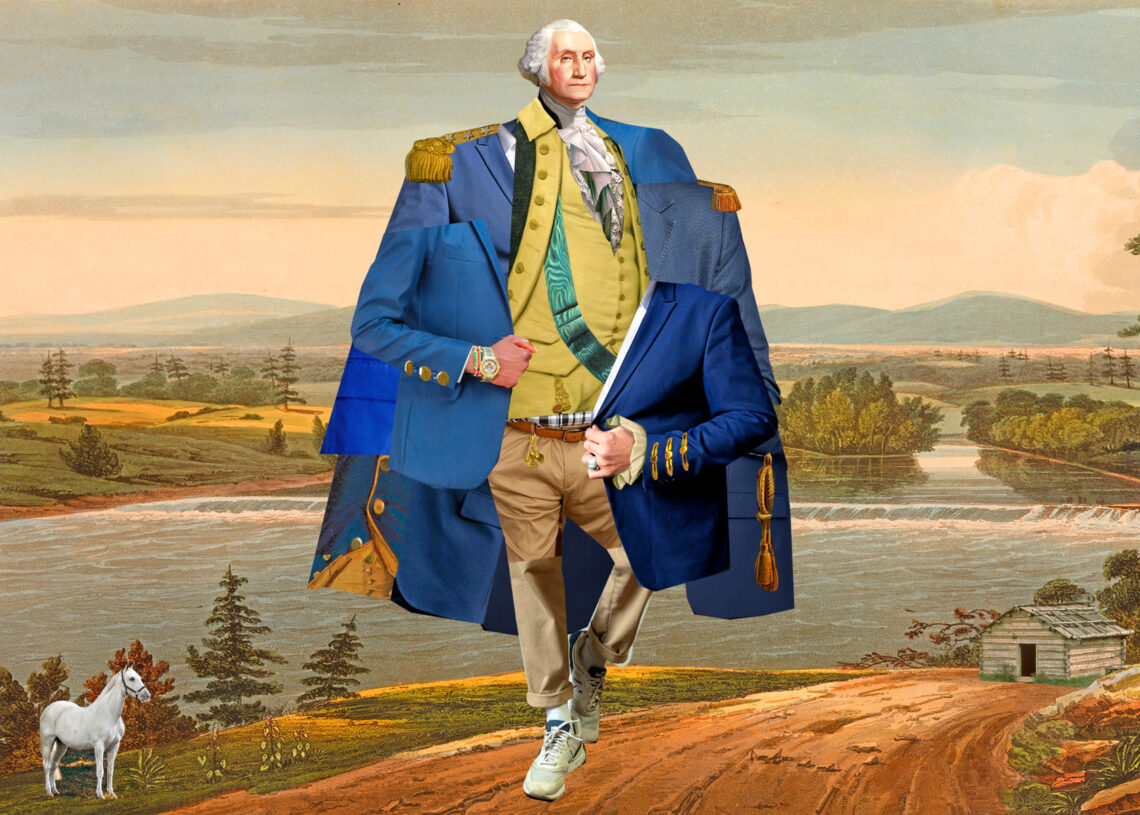
I’m talking, of course, about American men dressed in khakis and navy blazers. They’re staples at weddings and church services, and they stalk offices that are still formal enough for a “casual Friday” dress code. As a historian, I see them when they flood the summer academic conferences in a sea of attire I call the “semiformal humanities.”
In the summer, this look might be worn with a white polo shirt and casual loafers. In the fall, button-down shirts and neckties return, joined by oxfords and sweaters as the weather turns cold. Eventually, the tan cotton khakis are replaced with charcoal wool slacks for the winter, only to remerge in the spring.
But why, out of all possible color combinations, does the American man gravitate to blue blazers and khaki pants? It turns out, this style has its roots in the American Revolution — a fashion that united the nation.
Of all the achievements history has attributed to George Washington, it’s remarkable that he hasn’t yet been credited for his fashion sense, since the two most long-lasting styles in modern menswear can be attributed to him.
As a young provincial officer in the British Army during the French and Indian War, Washington wore a blue coat with red facings, which he donned for a later portrait by Charles Willson Peale. This blue coat was a reminder of his resentment over being denied a full commission from the crown. When he couldn’t wear the proper red coat of a British officer, he also didn’t receive their status, recognition or paycheck.
Repeatedly passed over for promotions and snubbed by British-born officers for being unsophisticated, Washington fumed over being treated like a second-class citizen. In 1757, he complained in a letter to his commander, Robert Dinwiddie, “We cant conceive, that being Americans shoud deprive us of the benefits of British Subjects.” Frustrated, the following year, he resigned his commission.
In July 1774, Washington and fellow Virginia planter George Mason drafted the Fairfax County Resolves, a radical statement of constitutional rights and rejection of Parliament’s authority over the colonies. Later that September, they founded the Fairfax Independent Company, a volunteer militia to enforce the principles of the resolves.
Washington still considered himself a loyal subject of the British crown, though staunchly opposed to the treatment the colonies were receiving under the Tory regime and its prime minister, Frederick, Lord North. When it came time to choose uniform colors for the new company, Washington picked buff and blue because they were the colors of the Whigs, the British political party that opposed the Tories.
Washington and Mason decreed the company would “meet at such Times & Places in this County … dress’d in a regular Uniform of Blue, turn’d up with Buff; with plain yellow metal buttons, Buff Waist Coat & Breeches, & white Stockings.”
In April 1775, less than a year after Washington announced the Fairfax resolves, skirmishes between colonial militia and the British army at Lexington and Concord in Massachusetts ignited the American Revolutionary War. In May, when Washington set off for Philadelphia to attend the Second Continental Congress, he wore his buff and blue uniform.
When the delegates chose Washington as commander in chief for the new Continental Army, he kept his own uniform design, which he wore for the remainder of the war.
Washington’s military portraits showcase this uniform, including “General George Washington Resigning His Commission,” the painting by John Trumbull that has hung in the U.S. Capitol Rotunda since 1824. Washington stands center; the two men behind him, Cols. Benjamin Walker and David Humphries, are dressed in the same style of uniform, adopted by his aides-de-camp to visually align themselves with the general.
In this painting, Trumbull also depicted men wearing buff and blue in civilian dress, referencing Washington’s uniform. The man sitting directly to Washington’s left is future president James Monroe. The man to the far left is Thomas Mifflin, who had served as aide-de-camp to Washington. Though dressed differently in this painting, another early adopter of the buff and blue was Thomas Jefferson: Portraits of him painted while he served as the minister to France and then as the secretary of state depict him in a blue coat and a gold waistcoat.
Americans weren’t the only adopters of buff and blue. In 1782, while the conflict in America waged on, the British member of Parliament Charles James Fox wore a blue coat and buff waistcoat to a meeting of Parliament. He chose these colors to annoy the Tories, whom the Whigs blamed for the disastrous war. In his memoirs, Sir Nathaniel William Wraxall noted that Fox’s dress “constituted the distinguishing badge or uniform of Washington and the American insurgents,” showing that its new political symbolism was well-understood by contemporaries.
The French also associated buff and blue with Americans and democracy. On July 12, 1789, two days before the storming of the Bastille, French journalist Camille Desmoulins leaped onto a table in the garden of the Palais Royal, urged the crowd to take up arms and coaxed them to adopt cockades as a symbol of their own revolution. He asked the crowd if they would prefer “green, the color of hope,” or the “blue of Cincinnatus,” referring to Washington; the color by then was understood to be a symbol of American liberty and democracy. Washington had turned a color of politics and diplomacy into a campaign for freedom.
Though the English and French initially connected buff and blue to Washington and Jefferson, the style eventually lost its overtly political register and became just another style, followed because fashionable people followed it.
Between the popularity of plain material and the connection to Washington and democracy, buff and blue solved an ongoing problem for men in the early American republic. Previously, they had struggled to balance an independence from sartorial distinction with the provincial desire to be recognized as equals. Buff and blue helped American men construct a new form of masculinity that was both revolutionary and that of a fashionably republican gentleman.
When revolution became fashionable, so too did revolutionary fashions.
Perhaps one reason that khaki pants and navy blazers are still so popular among Americans is that it subtly conjures a simpler time, before politics were splintered into parties, when we were united behind the cause of the buff and blue.
This summer, when the nation hosts barbecues in honor of the country’s 250th anniversary, Americans can raise their light beers, hot dogs and strawberry shortcakes to George Washington. He leaves behind a complicated legacy, but he got many things right. He prioritized America’s welfare over his personal interests. He warned against the dangers of political factions, and he cautioned the country to maintain a limit on executive power. Between his character and his costume, Washington was more than a Founding Father — he was America’s first fashion icon.
The post Incredibly, men are still wearing ‘the George Washington’ appeared first on Washington Post.