In October 2006, while seeking re-election as California’s Republican governor, Arnold Schwarzenegger appeared on “The Tonight Show With Jay Leno” on NBC. It seemed innocent enough: Mr. Schwarzenegger had been a guest on Mr. Leno’s show many times, and the two Hollywood stars enjoyed a warm relationship.
But Mr. Schwarzenegger’s Democratic opponent protested the appearance to the Federal Communications Commission and demanded that NBC give him 15 minutes of airtime in return, citing a rule in a decades-old communications law. The “equal time” rule requires certain broadcast shows to provide equal airtime to candidates competing for the same office.
Within days, the F.C.C., then under President George W. Bush, disagreed, issuing a ruling that effectively added late-night talk show interviews to an exemption that had been awarded to news programs.
That exemption stuck for two decades, even as late-night television became far more political.
Now, the Trump administration has effectively removed the exemption, with the newly aggressive F.C.C. making it clear last month that it would use the rule against late-night talk show hosts, who have been among the most relentless critics of President Trump.
The shift could reshape the political landscape of late-night television, where most shows overwhelmingly book Democrats over Republicans. It has also raised questions about whether a rule created in 1927 to ensure that then-powerful radio networks would not have undue influence in American elections should be applied now, when there are so many avenues for political candidates to promote themselves in a vastly expanded media landscape.
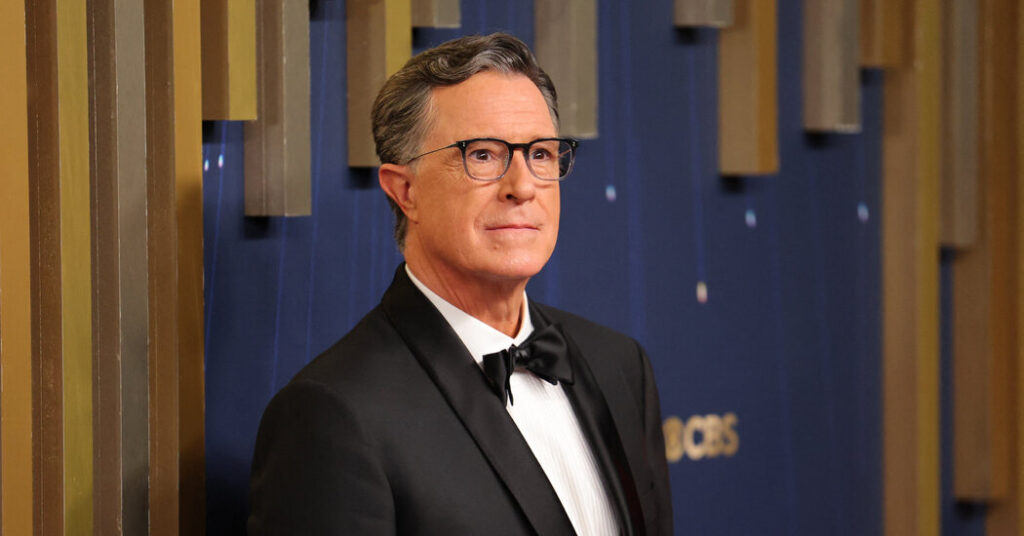
The issue burst into public view this week when Stephen Colbert criticized both his network, CBS, and the F.C.C. on his show, saying CBS had barred him from interviewing James Talarico, a state lawmaker running in the Democratic Senate primary in Texas, on the air, citing the agency’s shift.
Mr. Colbert said, with clear exasperation, that he had never encountered such pushback in his 21-year career as a late-night talk show host, and that he expected his network to do more to defend him.
“I’m just so surprised that this giant global corporation would not stand up to these bullies,” he said.
CBS disputed Mr. Colbert’s version of the events, saying it had offered him “guidance” on how he could comply with the new interpretation of the rule, including offering similar airtime to two of Mr. Talarico’s Democratic opponents.
The new interpretation is being driven by Brendan Carr, the chairman of the F.C.C., who has carried out Mr. Trump’s mission in targeting television shows that are critical of the president through the use of regulatory power. Mr. Carr’s scrutiny was also behind ABC’s decision to take “Jimmy Kimmel Live!” off the air for nearly a week last September. And this month, his agency opened an investigation of “The View” over the equal time rule.
Mr. Carr’s aggressive posture toward the media has set off alarm bells about the change.
Some believe his latest move could have a chilling effect on invitations for candidates to appear on late-night shows, even as this year’s midterm elections get closer.
“The goal here is to intimidate broadcasters,” said Andrew Jay Schwartzman, a longtime public interest lawyer. “The message to broadcasters is: Tone it down, stay out of controversy, avoid discussing political campaigns.”
Mr. Schwartzman, a veteran of major media regulatory battles, added that the networks had traditionally protested this sort of action from the F.C.C., and he said he was struck at how silent they were being now.
Anna M. Gomez, the F.C.C.’s lone Democratic commissioner, said at a news conference on Wednesday that she was concerned the shift would cause networks to “self-censor.”
“It’s all a part of the ultimate goal of bringing these broadcasters to heel,” she said.
Mr. Carr suggested this week that he hoped the change would accomplish the opposite goal. The “whole idea here is more speech, not less — you can have more candidates on,” he said.
“Congress passed the equal time provision for a very specific reason,” Mr. Carr said. “They didn’t want the media elites in Hollywood and New York to put their thumb on the scale and pick the winners and losers in primaries and general elections. That’s the whole point.”
At the F.C.C., Mr. Carr has dominion over the licenses that television and radio stations need to broadcast, and that are vital to distributing the major networks’ shows nationally. He has frequently warned station owners that violations of F.C.C. policies could lead the agency to refuse to renew their licenses — a posture that has struck fear into the industry.
Several major broadcasters have business before the Trump administration. CBS’s parent company, Paramount, is seeking to acquire Warner Bros. Discovery, a deal that would require government approval.
Broadcast licenses come with requirements that they serve the “public interest,” including several rules about how stations handle content. Cable, streaming and social media do not fall under the F.C.C. requirements, and as they rose, the rules had gone largely unenforced.
But Mr. Carr has worked to revive some of them, including the equal time rule. His moves come as late night has already been facing increasing pressure from a number of directions. Ratings have fallen, advertising revenue has plummeted and viewers seem more inclined to watch video podcasts than traditional shows with a studio audience, a band and celebrity guests.
Mr. Colbert, a veteran of Comedy Central’s liberal late-night programming, took over “The Late Show” in 2015, as late-night hosts on every network were pushing increasingly political messages on their shows. He, too, made his program newsier, to great success: “The Late Show” eclipsed “The Tonight Show” in total viewers in 2017, and it has remained the most-watched late-night show since.
Still, CBS announced last year that “The Late Show” franchise would end in May, arguing that mounting financial losses, not politics, were the only reason. After Mr. Colbert’s show goes off the air, CBS will be out of the late-night business.
Mr. Kimmel, the only late-night host for ABC, has openly mused about retiring for some time. Some TV executives believe that within a few years, NBC’s “The Tonight Show” could be the only late-night show left on the broadcast networks.
John Koblin covers the television industry for The Times.
The post How Trump Is Upending Who Can Be a Guest on Late-Night TV appeared first on New York Times.