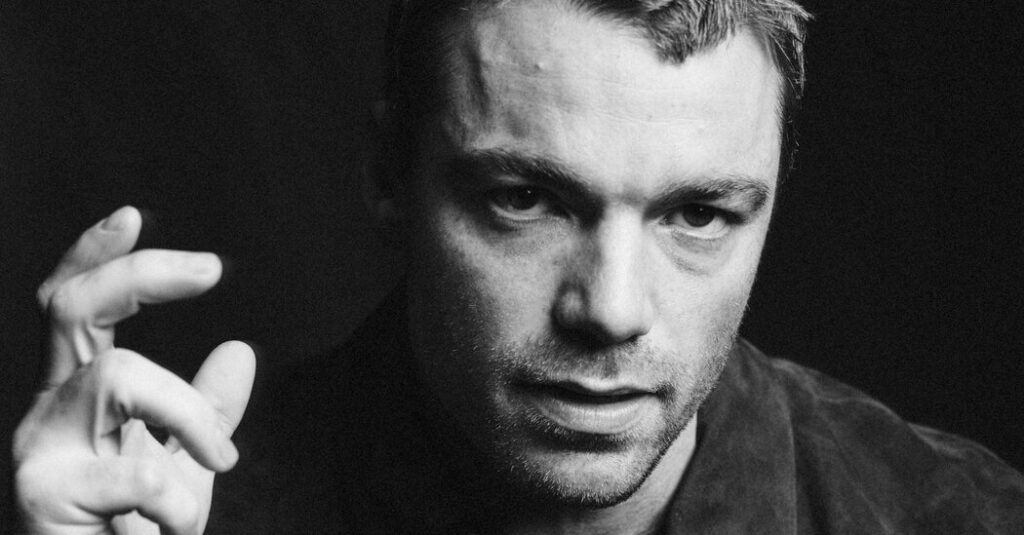
The actor Gabriel Basso had been at the American Museum of Natural History for an hour or so when he turned the conversation to ancient geopolymers. He then skipped to sonar-jamming moths, Phoenician trading ships, the etymology of amethyst, impossible architecture and the prospect of dinosaurs learning to parrot human language.
“That would be actually terrifying,” he said.
Basso, 31, is the star of “The Night Agent.” One of Netflix’s most watched shows, it returns on Thursday for its third season. Basso plays Peter Sutherland, a maverick F.B.I. agent keen to unravel a government conspiracy. Onscreen, his typical affect is either angry — eyes narrowed, square jaw clenched — or like a guy shaking off a sucker punch.
But on this February afternoon he was a picture of enthusiasm. Confronted with a model of the Titanosaur, the museum’s largest dinosaur, he grinned. “Sick,” he said. Then he mused about its skeletal structure.
Boyish and macho, voluble and guarded, Basso wandered the museum mostly incognito and obviously enchanted. About his acting career, he is more ambivalent.
“It feels like one of those things that shouldn’t be a life obsession,” he said as he observed the painted dioramas. “Like, your life should never revolve around it completely. Because it’s not real.”
Growing up in Missouri, Basso was, he said, most comfortable in nature, wandering the woods near his house, collecting snakes for a terrarium. When his sisters moved to Los Angeles with their mother to pursue acting careers, Basso initially stayed home with his father. But during a visit to Los Angeles he found an agent, and he soon began working, appearing as a teen in shows like “The Big C” and films like “Super 8.” Always on set, he missed prom, he missed homecoming, he nearly missed his graduation.
“It was sort of a tough environment to figure out who you are as a person,” he said, settling on a bench near the prehistoric mammals.
In 2016, as he was aging out of teen roles, he moved back to Missouri and began playing in a punk band. He hoped the experience would ground him. It didn’t. “I wasn’t living great,” he said.
So when a friend suggested that he meet with an agent, he took the meeting, which led to a starring role as JD Vance in “Hillbilly Elegy,” the 2020 film adaptation of Vance’s book, and then a few years later to “The Night Agent.”
Shawn Ryan, who created the show, wasn’t initially persuaded. In Basso’s audition tape, he wore a full beard, which didn’t jibe with Ryan’s clean-cut vision of Peter, an F.B.I. newbie relegated to receptionist duties. But a casting director convinced Ryan to call Basso back and Ryan’s opinion changed.
“I was looking for somebody who felt inherently good, somebody who felt a little like an underdog,” Ryan said. Basso had that.
Though Basso was drawn to the action sequences and the espionage trappings, Peter’s moral certainty was the real attraction.
“Anyone who’s worth emulating, anyone who’s done anything historically has that level of conviction and values,” Basso said. “Even if they go down in history as a villain, they had something they were pursuing.”
Basso doesn’t necessarily endorse Peter’s choices. “Peter is not me,” he said. “He’s not a hero; he’s dancing on the line of will to power.” But he enjoys playing someone staunch in his belief in his own rightness.
“Peter’s willing to die for it,” he said. “It’s cool reading those lines where I’m like, Yeah, he is.”
Peter’s politics are opaque, and Basso is circumspect about his own. “I don’t get to pick who my fans are, so the last thing I’m going to do is moralize or politicize,” he said. While he shares the show’s conspiratorial mind-set, his preferred conspiracies are historical. (He mentioned theories about the Lusitania and the Titanic.) And he thinks there would be less conspiracy if there were more accountability.
“I know people lie; I know people with power lie; and there’s a system that you can’t hold accountable,” he said. “So within that trifecta of evil, you’re going to have people that do stuff and get away with it.”
To play Peter, Basso set out to acquire an F.B.I. agent’s expertise and then some, learning evasive driving and weapons handling. He also continued his mixed martial arts training: boxing, kickboxing, jujitsu, wrestling.
“In my head, it’s how much of myself can I bring where I’m not acting and I can make this real?” he said.
In Season 3, which concerns dark money and campaign finance, Basso was allowed to do more of his own driving. Fight scenes are plentiful. These scenes entail risks, and Basso believes in taking them.
“You can’t be paid a lot of money and eat really good food and stay in really nice places and have people take care of you and be sheltered,” he said. He believes that if a movie or a show is going to ask for hours of a viewer’s time, it is incumbent on actors to give it their all.
Was his personal safety a concern? No, he said. “Because I don’t think that’s legitimate.” Admittedly, much of acting feels illegitimate to Basso.
“I don’t think that people should make their life revolve around emotion, hysteria, subjectivity,” he said.
What should a life revolve around? Basso listed a few core values: humility, objectivity, accountability, law, being of service. To him, stories have a value, but only if they feel real and have real-world implications.
“Some of the greatest warriors in history had a narrative that motivated them, like, what would Achilles do?” he said. Stunts and fight scenes, however faked, are a way to justify a vocation he can’t entirely defend, bringing fiction closer to physical fact. Twice that afternoon, Basso referred to the entertainment industry’s idealized, masculine past — “the guys who built this business had all been to the war,” he said — a past that he seemed to long for.
Ryan said, “I don’t think he’s interested in cashing in on this. He’s somebody who has real values that he wants to adhere to, and he doesn’t want Hollywood to change him.”
Basso recently wrote and directed his first film, “Iconoclast,” about a man (Basso) who develops a dangerous obsession with an influencer. He enjoyed the process, but he isn’t sure how long he will stay in the business, in any role. He believes that a real-life maverick like Peter would have been killed off by the bureau, or politicians beyond it, long ago. If it happens in “The Night Agent,” Basso won’t regret it.
“I have a feeling I’m going to take a break soon,” he said.
He has interests beyond Hollywood — in art, masonry, music, martial arts, nature. And he wouldn’t mind some time to pursue them, especially now that he has left behind what he described as “the corruptive forces” of youth. Sitting on the museum’s fourth floor, with much of prehistory arrayed before him, he seemed certain of his own history and of his future.
“I now know a lot of things about myself,” he said. “I feel confident in my ability to go somewhere and not lose course.”
Alexis Soloski has written for The Times since 2006. As a culture reporter, she covers television, theater, movies, podcasts and new media.
The post Gabriel Basso, of ‘The Night Agent,’ Gets Back to Nature appeared first on New York Times.