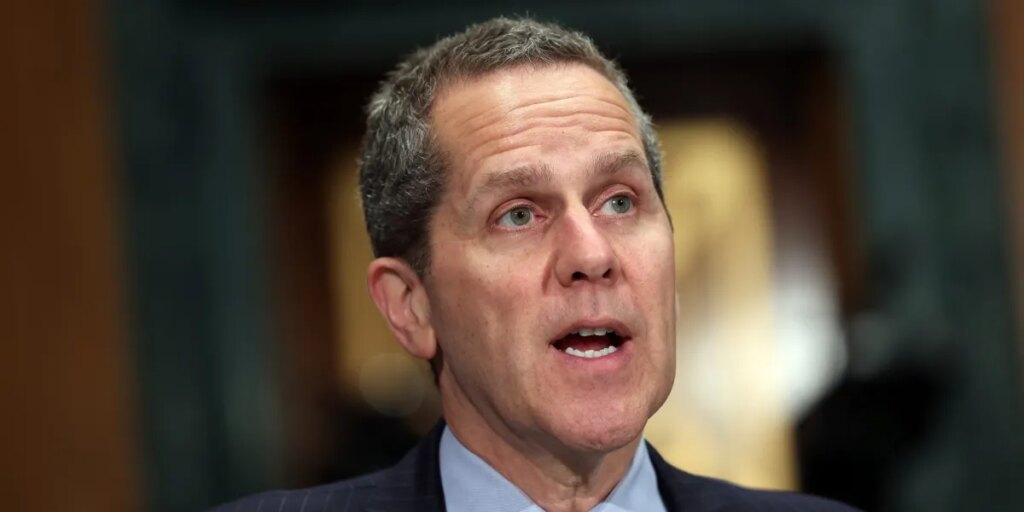
The end may not be near after all. While fears of total automation often dominate public discourse, Federal Reserve Gov. Michael S. Barr suggests that the rise of artificial intelligence could actually help jobseekers and boost the economy.
In a speech to the New York Association for Business Economics on Feb. 17, Barr gave three different scenarios for how AI might reshape the labor market. Describing generative AI as an all-purpose technology, Barr claimed we can see three stylized economic futures. One features a “jobless boom” for the economy that would be disastrous with workers, and the other two featuring varying levels of usefulness.
What would a boom look like?
Barr put forward a bit of a doomsday scenario where the aggressive exponential growth of AI leads to a labor market full of people that are, he said, “essentially unemployable.” “Agentic AI” systems, which are capable of achieving general goals with minimal human supervision, would replace a large swatch of professional and service roles.
Autonomous vehicles will replace transportation jobs, just as unsupervised robotics would deplete the manufacturing industry’s need for human workers. This will lead to widespread unemployment in the short-term and large declines in the labor market over time — unless there are “profound changes in education, training and workforce development,” Barr said.
There will be much less demand for labor despite the “vastly productive economy,” Barr argued, sparking a “jobless boom” that would force jobseekers to reevaluate their approach to the new Ai-dominated economy.
“Society would have to rethink the social safety net to ensure that the gains from unprecedented economic growth are shared rather than concentrated among a small group of capital holders and AI superstars,” Barr warned.
“We should be clear-eyed about how painful these changes could be for affected workers and how challenging it would be for the government and the private sector to successfully manage the fallout.”
The only resolve for jobseekers would be to specialize themselves in industries that AI cannot easily replicate, like in manual or highly-skilled trades, or within industries where consumers may put a premium on human interaction.
What would a bust look like?
Barr also offered a scenario where the AI revolution hits a ceiling, resulting in an economic bust. This would be due in part due to the depletion of all viable user input and training data and a shortage of funds or electricity to power the massive data centers needed to see the larger AI-boom he outlined previously.
AI investment will require an estimated $1 trillion in new debt over the next five years, Barr said, while noting that businesses that don’t see immediate productivity gains may lose interest.
This stagnation could be driven by the exhaustion of training data, a shortage of electricity to power massive data centers, or a shortage of capital. With AI investment requiring an estimated $1 trillion in new debt over the next five years, businesses that do not see immediate productivity gains may lose interest.
In the “bust” scenario, Barr likened AI to social media, email, or smartphones. “AI still ends up widely adopted,” Barr said in his speech, where the tools “are ubiquitous, even indispensable, but not necessarily revolutionary by themselves.”
However, one industry wouldn’t go unscathed: the financial sector. “In a scenario where AI disappoints, the balance of risks shifts from the labor market to the financial sector. When anticipated demand falls short, the risk of financial stress increases,” Barr said, referencing the overbuilding of fiber optic cables in the 2000s as a possible result of a “bust” scenario.
A balanced path is still possible
Barr’s last scenario is one of a gradual adoption, where AI follows the trajectory of previous technological revolutions, diffusing into the economy at a manageable pace. The governor references the dot-com boom of the late 1990s as how a balanced-AI economy can play out. Although some initial unemployment will be inevitable due to skill mismatch, Barr argued, jobseekers will adapt and their training and education will adjust over time.
“Many workers [will] successfully retrain and retain their jobs or find new ones,” Barr said. “With strong productivity growth, the economy can sustain faster output growth and real wages rise.” The balanced scenario is already backed by research, Barr said, with data suggesting AI adoption is leading to a reallocation within firms instead of complete unemployment.
Regardless of which scenario unfolds, Barr emphasized that the long-term effects of AI are likely to be profoundly positive for living standards. However, he warned that we are already seeing adverse effects on young, early-career workers in high-exposure fields like software development. To navigate this, Barr insisted society must be “nimble and bold,” investing now in worker training and new job creation to ensure the benefits of AI are broadly shared
The post Fed governor lays out 3 AI scenarios, including one with a giant population of ‘unemployable’ workers appeared first on Fortune.