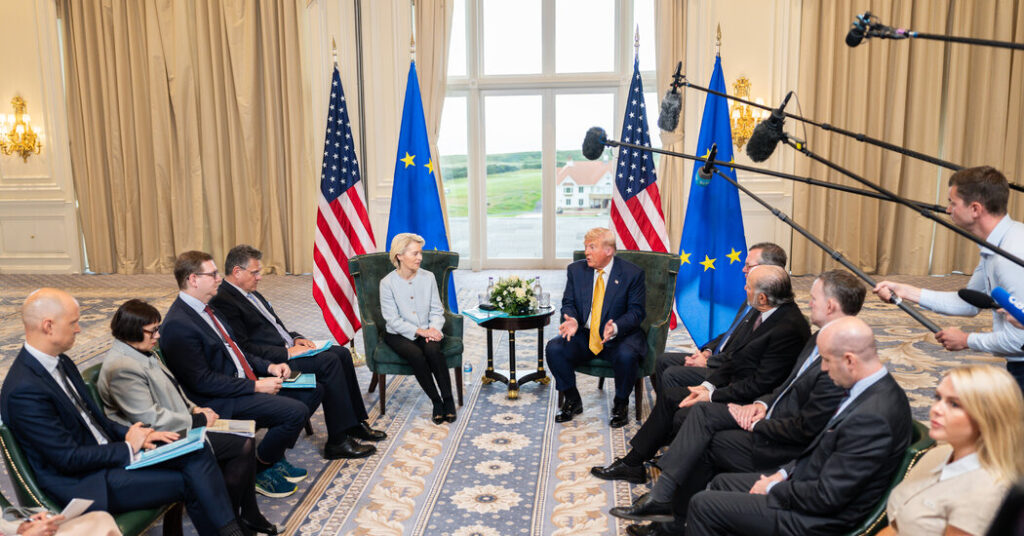
After a year filled with trade-related drama between the United States and the European Union, one outstanding gripe still has potential to fuel the fire: how the bloc regulates technology.
At the heart of that dispute is the bloc’s Digital Services Act, which requires big technology companies to take steps to prevent illegal or dangerous content on their platforms. The Trump administration, arguing that the regulations impede free speech and put up unfair barriers to American firms, has warned repeatedly that it could retaliate.
Now, European officials are beginning to fret, privately and in public, that this is merely the calm before the next Trump-created storm.
“The U.S. will in the coming months — that’s certain — attack us over digital regulation,” President Emmanuel Macron of France told several European news outlets in an interview this month, suggesting that the United States could hit the European Union with tariffs related to the Digital Services Act.
The Trump administration has recently echoed that prediction.
Europe’s online services regulation “has become almost like a digital speed trap to try and fine American companies,” David Sacks, a White House official, said on his All-In podcast last month.
“You could argue that it’s effectively like a tariff on American tech companies operating in Europe,” he added. “If that’s the case, well, I mean, I guess Europe is allowed to have tariffs — but then that’s going to change the tariffs that we set.”
Sarah B. Rogers, the under secretary of state for public diplomacy at the State Department and a guest on that podcast episode, agreed that “a lot of Americans see this as a tax.”
Bill White, the U.S. ambassador to Belgium, said in an interview that Michael J. Rigas, a top State Department official, would come to Brussels in early March in part to discuss free speech and digital regulation with European Union officials. The State Department press office confirmed that he would make the trip and would discuss E.U. digital regulations.
It is not clear what the United States might do if it decided to attack Europe over its digital regulations, or which companies it might target. Some trade experts have suggested that one option would be a “301 investigation,” a mechanism under U.S. trade law to fight against unfair foreign trade practices. The tool allows the United States to impose tariffs, fees or other punishments on countries that are found to have cheated on trade.
Mr. Trump has used such an investigation against China, but so far he has wielded other tools against Europe. His use of one trade weapon in particular — a wide-reaching mandate that allows for across-the-board tariffs in the case of a national emergency — is now up for review before the Supreme Court, which could rule on the case as soon as Friday.
Nor is it clear what precisely would prompt the United States to act, if it did at all.
For months, the Trump administration has vaguely threatened to place tariffs or other penalties on European companies if the bloc continues to enforce its digital rules. The U.S. Office of the Trade Representative suggested in a memorandum last year that it was contemplating how it could punish nations that it thought discriminated against American firms with digital services regulations..
In December, the office posted on X that “if the E.U. and E.U. Member States insist on continuing to restrict, limit, and deter the competitiveness of U.S. service providers through discriminatory means, the United States will have no choice but to begin using every tool at its disposal to counter these unreasonable measures.”
The office noted that American law permits “the assessment of fees or restrictions on foreign services” in response, among other options. It has previously pointed out that European companies like Accenture, Spotify and Capgemini operate in the United States, suggesting they could be in the cross-hairs.
The United States has already imposed travel bans on several people involved in digital regulation, including a former E.U. official.
Asked for comment on this article, the U.S. trade office replied that while a U.S.-E.U. trade deal struck last year addressed many issues, the Trump administration still wants to “achieve fairness” in digital trade and has “additional options” if negotiation doesn’t work.
But some experts say that the United States is unlikely to follow through on its threats to attack Europe over its technology regulations, in part because tensions between the two trading partners have finally cooled. The European Parliament could next week take another step toward approving the trade deal that was struck last year and that would apply 15 percent tariffs to many European goods.
“I think the threshold for something major is very high,” said Jacob Funk Kirkegaard, a senior fellow at Bruegel, a Brussels-based think tank.
Still, Payne Griffin, a senior director at FTI Consulting, a business advisory firm, said he had received queries from corporate clients about what it would look like if the United States hit back at Europe over its digital rulebook.
“Based on public comments from U.S. officials, taking action against E.U. digital services is one of the things they’ve thought about,” he said.
E.U. officials are left weighing whether enforcing the bloc’s technology rules is worth further irritating the United States, especially as issues like American involvement in the war in Ukraine hang in the balance.
So far, the European Commission, the bloc’s executive arm, has said repeatedly that it would not move away from its digital regulations. It has continued to actively enforce them in recent months, despite the Trump administration’s threats.
In December, the commission announced that it would issue a fine of 120 million euros, or about $141 million, against X, over transparency issues. Regulators in Brussels have also been investigating Google and Meta for possible violations of online competition and safety laws.
“I want to be very clear: our digital sovereignty is our digital sovereignty,” Ursula von der Leyen, the president of the commission, said at the Munich Security Conference last week. “We have a long tradition in freedom of speech. Actually the Enlightenment started on our continent.”
Europe, she said, will “not flinch” in enforcing its digital rules.
Adam Satariano contributed reporting from London, Catherine Porter from Paris, and Ana Swanson from Washington.
Jeanna Smialek is the Brussels bureau chief for The Times.
The post Europe Worries About Another Trump Blowup, This One on Tech appeared first on New York Times.