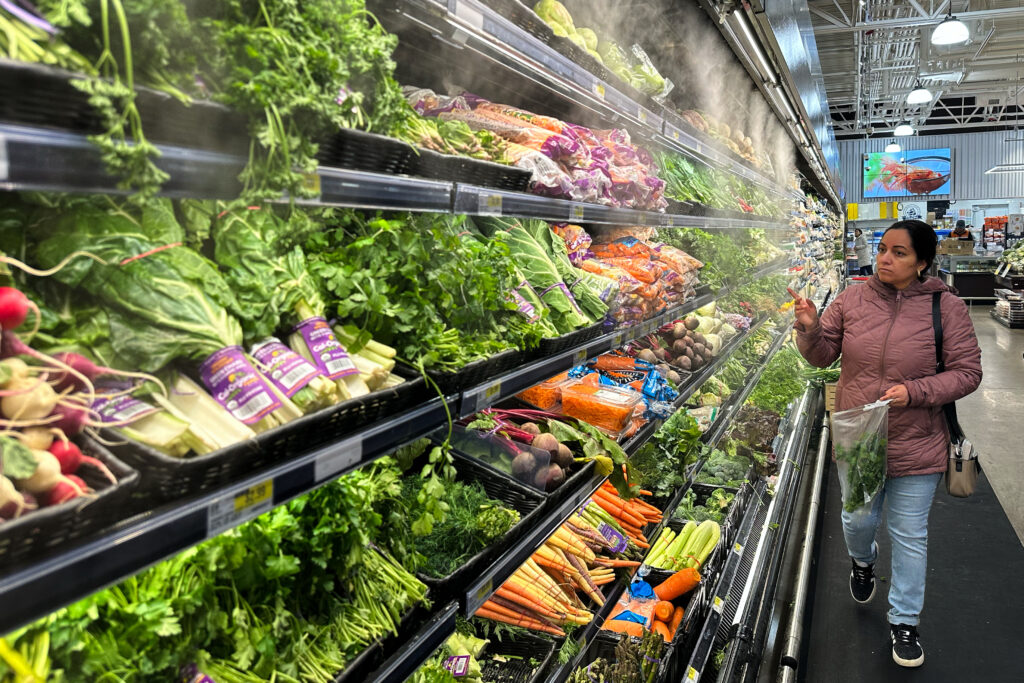
As voters keep indicating that grocery prices are a top concern, Democrats are exploring a new idea for what the government could do to bring down the cost of food.
But the proposal itself shows how hard it is to reduce food prices in a politically palatable — or financially feasible — way.
On Thursday, the Center for American Progress, a prominent left-leaning think tank that often cultivates policy ideas later adopted by the Democratic Party, proposed a two-year freeze on the prices of 22 food items, such as strawberries and steak.
Grocers would voluntarily agree to capping the cost of food in exchange for paying lower fees on credit card transactions, according to the proposal, which was written by a group led by Jared Bernstein, who chaired the White House Council of Economic Advisers during Joe Biden’s presidency.
That, in effect, would force credit card companies to absorb the cost of subsidizing food purchases, a highly unusual arrangement. A draft of the proposal said the Federal Reserve could force credit card companies to do so via its regulatory oversight, though that provision was removed after questions from The Washington Post.
It is not clear how else the government might persuade credit card companies to foot the bill, nor how many grocers would agree.
“We’re focused on an affordability policy where people’s paychecks have a chance to catch up to grocery prices that spiked in 2021 and 2022,” Bernstein said. “Even if grocery inflation has come down, which it has, the level of grocery prices is still causing sticker shock.”
Food prices have been a major complaint for consumers since the 2022 inflation spike. Since 2020, the cost of bread is up 32 percent, lettuce 39 percent, mayonnaise 50 percent, and coffee 80 percent, for example, compared with a 29 percent rise in wages.
Republicans and Democrats have pledged to address grocery bills. President Donald Trump ran in 2024 promising to bring down grocery prices “on day one,” and recently revoked some of the tariffs he had imposed on specific foods including bananas and coffee. In a 2024 YouGov poll, Americans showed openness to government intervention on food prices: 45 percent said they would support direct government involvement in negotiations between farmers and grocers, and 62 percent would support a law requiring food companies to drop their prices when the cost of their materials falls.
“I think the interesting story here is how far we have come,” said University of Massachusetts economist Isabella Weber, who sparked fierce criticism from fellow economists when she endorsed price controls on food during the Biden administration. “We are now at a point where the affordability agenda is really breaking through into the mainstream of economic policy discussions.”
Bernstein says many grocers would sign up, since it would attract shoppers into their stores: “The ones who join immediately have a competitive advantage relative to those who don’t. We’re confident that there are enough advantages to pull groceries into the plan.”
FMI, a group representing the food industry, declined to comment on the proposal, and the National Grocers Association did not respond to questions.
The government’s options for changing what grocers charge are limited. And economists tend to vehemently oppose price controls, which they say lead to shortages.
“Price caps interfere with the very basics of a capitalist economy,” said Steven Kaimin, an economist at the American Enterprise Institute who read the Center for American Progress paper before its publication. “Maybe it’s impossible to produce eggs at $3. Maybe the cost of producing them is $3.50. In which case the eggs come off the market entirely, or … only the cheapest producers can sell at $3, and then the supermarket puts them out at $3, and they sell an hour later, and everybody else goes and sees empty shelves.”
When Kamala Harris proposed a law against grocery “price gouging” on the campaign trail two years ago, economists on the right rushed to deride the proposal for distorting the market price of food, and supporters on the left hastened to say that Harris wasn’t actually advocating for price controls.
Thursday’s paper comes somewhat closer to proposing exactly that. Bernstein said in an interview that his proposal differs from the standard idea of price controls because it includes incentives for the grocers to join a voluntary agreement, not a fiat, and that the incentives to boost grocers’ bottom lines would prevent shortages.
The bargain would apply only to certain foods. The think tank’s suggested list is eggs, steak, chicken, pork chops, canned tuna, milk, cheese, butter, rice, flour, bread, pasta, cereal, potatoes, lettuce, tomatoes, apples, oranges, strawberries, canned corn, dried beans and coffee. The paper projects that by 2028, a family of four will be spending $229 more per year on those items, which they would save if the grocers froze prices at 2026 levels.
Those 22 items, the authors say, represent about half the cost of an average four-person household’s weekly grocery trip.
The plan reaches for a way to pay for the grocers’ lost income from the price freezes, landing on an expansion of certain SNAP benefits, exemptions from tariffs for the participating stores and a cap on the credit card fees that they pay.
The authors estimated that consumers nationwide could save a maximum of about $13 billion.
The plan would leave credit card companies as the losers. Richard Hunt, who chairs the credit card industry group Electronic Payments Coalition, decried the plan in response to questions from The Post: “Price controls do not work in any industry. Historical evidence proves they harm consumers in the long run and repeatedly fail to solve the problems they aim to address.”
The roundabout idea is a sign of how Democrats around the country are looking for ideas to address grocery prices. Cities including Atlanta and Madison, Wisconsin, are opening government-owned grocery stores, a project that New York City’s new socialist mayor Zohran Mamdani has expressed interest in.
The Center for American Progress shared the price-freezing paper with some congressional Democrats in advance of its publication and plans to lobby Democrats to turn the idea into legislation. Senate Minority Leader Charles E. Schumer (D-New York) did not endorse or reject the proposal in an email to The Post about the paper, saying: “Senate Democrats are advancing a clear affordability agenda: crack down on corporate abuse that drives up food costs and deliver real relief for families, farmers, and small businesses.”
Neera Tanden, who is CEO of the think tank after leading Biden’s Domestic Policy Council, said that the idea is based on a 2022 Mexico policy to freeze the price of certain key groceries. The plan also calls for the federal government to force cities to undo restrictive land-use rules that block new grocery stores from opening, pass legislation creating transparency in pricing in the meatpacking industry, expand crop insurance for new farmers and offer them favorable loans, and several other policies to increase competition and strengthen the food production industry during the two-year price freeze.
“I think that this is a moment for some policy creativity,” Tanden said. Trump, she said, has used the federal government’s power to intervene in markets in many ways, like a deal giving the government a 10 percent stake in the company Intel, and a slew of tariffs. “When a Republican president directly intervenes in the market to take shares of companies, we believe a Democratic president can and should use the federal government’s powers to drive lower costs for working class Americans.”
Ryan Bourne, who holds the right-leaning Cato Institute’s chair for the public understanding of economics, read the paper in advance of publication and criticized the idea. “Price controls on food have a long, storied history of failure. … Holding prices of ‘essentials’ below market rates will produce some combination of shortages on shelves, deteriorations in product quality, and black market re-selling,” he wrote. “In the 1970s, Nixon’s price ceilings led poultry farmers to destroy millions of chicks and dairy farmers to cull herds rather than sell at a loss. … CAP’s ‘negotiated’ compact, if binding across the economy, would have similar effects.”
But Weber, the Massachusetts economist who favors price controls, pointed to a reason some Democrats might embrace price freezes regardless of economic theory: It may be politically popular. “Biden should have done some sort of shelf in supermarkets clearly branded: ‘This price-stabilized shelf is from Biden stepping in on behalf of the American people.’ I still think doing that kind of thing could have saved us Trump,” Weber said
The post Democrats revive a once-taboo idea: Capping grocery prices appeared first on Washington Post.