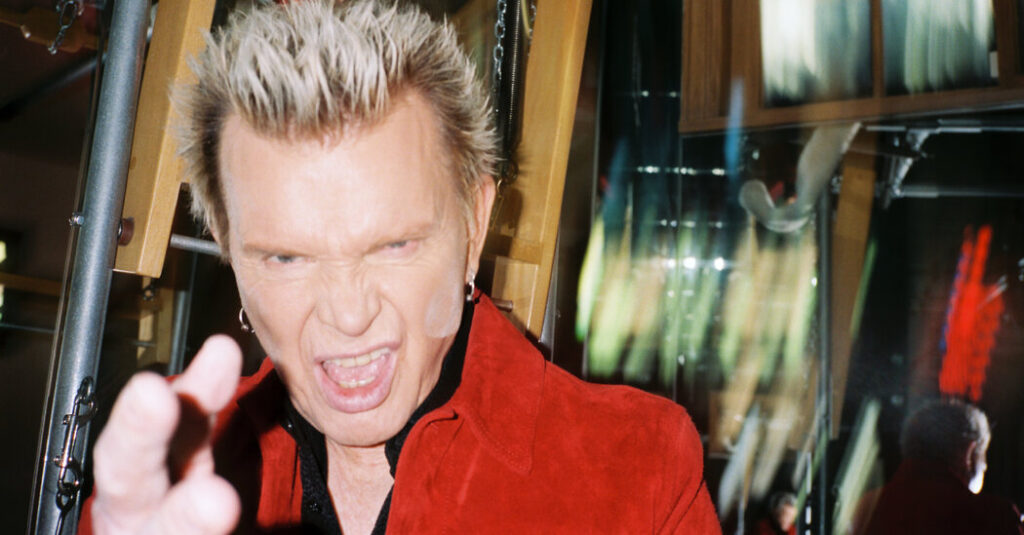
Billy Idol has lived in the same gated compound in the Hollywood Hills since 1987, late in his heyday as a chart-topping star of MTV’s debut generation. It is a lair, complete with stone-facade buildings, expansive valley views and a waterfall.
The previous owner “was a soft-porn guy,” Idol said. “Mainly, they were using this house to film things.” He discovered this because he later inadvertently screened them. “I would suddenly see people [expletive] in the garden,” he recalled. “I’d be watching something, going: Wait a minute, that’s my house!”
He didn’t mind the X-rated shenanigans — quite the contrary. “Into the spirit, we carried it on,” he said, with a raspy chuckle.
This was minute three of my introduction to Idol, the razor-blond British singer with the everlasting sneer, whose anthemic, power chord hits — “Rebel Yell,” “White Wedding,” “Dancing With Myself” — and swaggering attitude made him the bad boy of ’80s rock. Idol, now 70, has revealed just how bad in a best-selling memoir and an upcoming documentary, “Billy Idol Should Be Dead.”
The film, directed by Jonas Åkerlund, opens on him composing an introspective song on guitar. “In ’84, I OD’d on my kitchen floor / woke up and had some more.” Sex, debauchery, addiction, aggression: Softcore, it wasn’t.
But as he nears a half-century in the music business, Idol, who got his start in the roiling London punk scene in the ’70s, is cleareyed about his cultural place. He is one of the last remaining strands connecting that raw, D.I.Y. energy to the glam era and the mainstream. And the rockers who followed in his leather-clad wake are eagerly paying their due. At a talk in Los Angeles late last year, Dave Grohl genuflected directly to him about “the ultimate badassery of you and your amazing band.”
“One thing that I love so much is seeing generations of people singing every word to every one of your songs,” Grohl said, adding that at one festival gig, “You absolutely just wiped the stage.” Idol raised his arms in victory.
“The whole stadium was moshing,” he responded proudly. “Just this writhing mass of people, going crazy to ‘Mony, Mony,’” his No. 1 cover hit from 1987. Nearly 40 years after his debut at Madison Square Garden, Idol returned last summer, promoting his reflective 2025 album “Dream Into It,” with his biggest tour ever — one of the longest stretches between headlining performances in the arena’s history.
None of this was preordained, of course, and a lasting career seemed mighty unlikely in the decades when Idol was snorting heroin and riding motorcycles too fast. “I’m super lucky,” he said. Somehow his appetite for risk fused with his tenacity in just the right measure. “I really wanted this artistic life, where I was in love with what I did.”
Idol’s bristling charisma and shirtless, fist-pumping antics may have been what the casual fan responded to; his studly frontman aura was undeniable from his earliest days (especially once a hairstyling snafu resulted in his signature bleached look). But as his 2014 autobiography, “Dancing With Myself,” and the documentary, opening in wide release Feb. 26, highlight, his songwriting was as deeply considered as his style — and it was honed among the giants of punk, rock, new wave and pop.
He cribbed the title “Rebel Yell” from the bourbon that he once saw the Rolling Stones swigging at Ronnie Wood’s New York apartment. He knew everyone, and built on influences that included the aggressive, minimalist duo Suicide, Russian constructivist art and Elvis Presley’s lip curl.
From their first meeting in 1981, said Steve Stevens, his longtime guitarist, “he had a definite vision of what he was looking to do.” He didn’t ascend into a rock star posture. “He was already there.”
And his deceptively simple hits, many written with Stevens, a virtuosic shredder, have withstood decades, still beloved — “Eyes Without a Face,” his 1984 jagged ballad, has lately surged on streaming and social media — and still adaptable. Maren Morris, the country star, gave “Dancing With Myself” a dreamy twist in a 2024 cover, which Idol approved. “The original structure is so memorable,” she said. “He’s a legend.”
One sunny winter afternoon, Idol, in a Sun Records T-shirt and his customary poundage of heavy silver jewelry, was sunk into a red club chair in his living room. As a counterpoint to L.A.’s sleek taupeness, he had decorated the space, years ago, in overstuffed British pub style: moody reds and blacks, lion-crested wallpaper, fleur-de-lis brocades. It was very lived-in, with mementos and photos of his three children and grandkids. Legal pads lay stacked by the couch — his book notes — and Civil War-era weaponry hung near the ceiling. Idol is a lifelong history buff, especially the battlefield stuff.
He “has probably watched more American westerns than anybody I know,” Stevens said, noting that Ozzy Osbourne, whom he and Idol helped induct into the Rock & Roll Hall of Fame, shared those History Channel and Americana interests.
School was otherwise not Idol’s strong suit — “I have an A.D.D. problem, which people didn’t know about in the ‘60s,” he said — but music captivated him fully.
In our conversation, he lit up talking about his inspirations, and the way he folded all those sounds — the crooners of the ’50s and ’60s, the reggae he heard in London record shops, the electronica of Kraftwerk, the dance beats of Giorgio Moroder via Donna Summer — into his punk roots. “‘Dancing With Myself’ is the same speed as ‘Blitzkrieg Bop.’ You never think that, but it is!” he said delightedly, singing the guitar line of that Ramones classic. (His first proper band, Generation X, opened for them in 1977.)
The solidly middle class son of a British businessman and an Irish nurse, he was born William Broad in England, but always felt a bit American; his earliest memories are from when his father’s job took them to Long Island, and he listened to his mother’s big band and jazz records, along with musicals.
“I learned a lot from Richard Burton doing ‘Camelot,’ because he spoke-sang,” Idol said, rearranging his elastic features for a (surprisingly good) Burton-as-King Arthur impression. That lip curl? He comes by it naturally, but he added the dose of Sid Vicious snarl.
Back in the London suburbs, he picked up drums and guitar, seduced by the disaffection of the nascent punk scene. As a teen, he traveled in a pack with pals like Siouxsie Sioux, of the Banshees, in sliced up T-shirts, leather pants and military waistcoats, hanging out at a lesbian club — the only place their style wasn’t an invitation for a fight.
At 20, in 1976, he first saw the Sex Pistols, and Generation X opened for the Clash on New Year’s Eve. His stage name came from subverting a report card admonishment: “William is idle.”
As a musician, though, he was anything but, helping open a Covent Garden club, the Roxy, with some compatriots, as their fan base grew. “We were one of the few punk bands to have females in our audience,” he noted in the book; sex appeal was always a spark. (When he played Wembley Arena in 1990, he had balloons with condoms affixed to them drop from the ceiling.)
Arriving in the studio hung over one morning after a night with a girl (or “a bird,” in his parlance), he and his Generation X songwriter and bassist Tony James produced “Dancing With Myself,” inspired by a clubgoer they once spotted in Tokyo, grooving with his reflection in a mirror.
By the time Idol returned to the U.S. to try to make it as a solo artist, in 1981, “you couldn’t go to a club and not hear it,” Stevens said. One night when Idol was jonesing for a screwdriver at a crowded West Side spot, the bar suddenly cleared: The D.J. had played the song, and everyone dashed for the dance floor.
“I know who Billy Idol is, in that moment,” he recalled thinking. “This is what I wanted to do.”
From then on, he tested all his freshly written tracks in clubs. “White Wedding,” with a thrumming guitar sound Stevens said was inspired by Martin Rev’s electric organ in Suicide, had its debut at what is now the Viper Room on the Sunset Strip.
By that point, Idol had formed lasting artistic connections on both coasts. “We met in ’78,” said Joan Jett, who opened for Idol at the Garden last year. “I lived across the street from the Whiskey a Go Go,” in L.A. “He came over and hung out.”
His fledgling band played Max’s Kansas City, the legendary New York art-punk hangout, for its closing-night showcase in 1981, in D.I.Y. style. “We got up unannounced,” Stevens said, “so that afternoon in our crummy little rehearsal place, Billy brought in white T-shirts and fluorescent paint, so we’d look like we belonged together.”
Idol made every inch of the ‘80s scene, joining Blondie at the Mudd Club, catching Grandmaster Flash in the East Village, giving an already-confident Madonna a ride, absorbing all the references. He writes in the book about a memorable Prince gig: “He was wearing a raincoat with thigh-high socks and a jock strap that squirted water during his guitar solos.”
Soon enough, the advent of MTV, which launched the same month Idol started recording his solo album, made him globally famous, and his long months on the road were as wild and womanizing as you’d expect. (A few years ago, through a series of 23andMe tests, he discovered he’d had a son, Brant Broad, in this period.)
But the drug habit Idol had developed eventually began to disintegrate his success. He was a heroin (and more) user throughout the ‘80s, holing up alone in his dark apartment for days, hallucinating. A split with Perri Lister, a British dancer and choreographer who was his longtime girlfriend and muse, drove him further into despair. (They later reconciled and had a son, Willem Wolfe Broad.) Working through withdrawal symptoms made him so erratic and aggressive, his collaborators nicknamed him Zool. For his first interview with Rolling Stone, he drank several bottles of red wine and went on a tear to the reporter, E. Jean Carroll, about how much he hated Rolling Stone (which was not true).
As he put it: “I had it all, and I lit it with butane.”
He also kept the scale of his addiction hidden, and in those pre-internet days, dangerous escapades, like the time he was ushered out of Bangkok on a gurney by the Thai military, never made the press. “I learned a lot” watching the documentary, Stevens said.
A serious motorcycle accident that almost cost Idol his leg in 1990 changed the course of his career; he had to turn down a part in “The Terminator” because it involved too much running.
The move to L.A. and parenthood — he also has a daughter, Bonnie Blue Broad, from another relationship — helped him tame his ways. “There was a voice telling me, you can’t do this forever,” he said.
These days, Idol, who is currently single after a long relationship with the model and TV host China Chow, is a near teetotaler (two years ago, on the advice of his doctor, he even gave up alcohol) and a devoted fitness buff. The documentary and his last album helped him take stock of things. But then, he has always mined his own life.
“White Wedding,” which he drafted alone in 20 minutes, was inspired by his sister’s nuptials. He gave them a more sinister spin — “and of course a million people got married to it,” he said, laughing. The song does contain some of his most vital lyrics, he said, speak-singing himself into it: “Start again. You can restart your life, if you think it’s over. Start again.”
Melena Ryzik is a roving culture reporter at The Times, covering the personalities, projects and ideas that drive the creative world.
The post Billy Idol Had It All, and Then He ‘Lit It With Butane’ appeared first on New York Times.