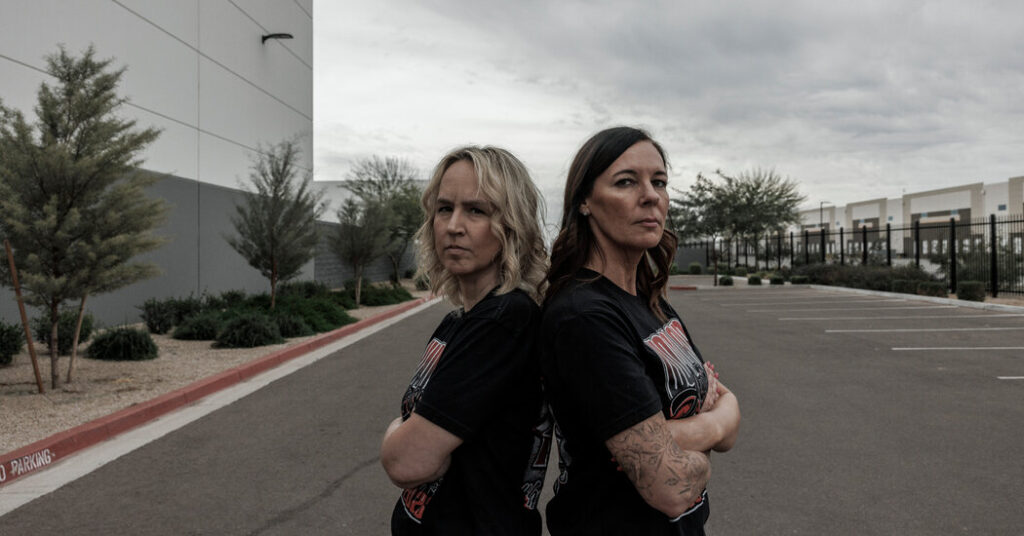
Stacy Bradley voted for President Trump because of his border policies, and she likes that he has restored “law and order.” But she is unsettled by one aspect of his immigration agenda.
Last month, the federal government bought a warehouse next to her cheerleading gym in Surprise, Ariz., which the administration plans to convert into a detention center for up to 1,500 immigrants.
Ms. Bradley, the co-owner of Woodlands Elite Cheer, said she worried that a detainee could escape, or that protests could break out. The children who train at her gym are as young as 3 and could see “people in shackles” next door, she said.
“That’s a scary thing for a little kid to process,” Ms. Bradley said.
Across the country, the Department of Homeland Security’s plans to buy industrial warehouses and turn them into detention centers for immigrants are running into local resistance, including in communities like Surprise that voted for Mr. Trump in the last presidential election.
The pushback is complicating efforts to expand detention capacity to accommodate the tens of thousands of additional immigrants the administration expects to confine, to deliver on its mass deportation drive.
Local officials and residents in at least a dozen areas have voiced opposition to the facilities, packing town hall meetings and expressing fears that the protests that recently shook Minneapolis could be unleashed in their backyards.
Those who object to the facilities say that the sites would diminish property tax revenue, harm local businesses and strain water and sewer infrastructure. They have also expressed humanitarian concerns over converting industrial warehouses into detention centers that could hold people for an average of 60 days.
Nevertheless, the Trump administration is pressing forward in pursuit of its goal to expand its detention footprint to at least 100,000 beds, which will help it arrest, detain and deport more people. A D.H.S. official with knowledge of the plans, speaking anonymously to share internal information, said the expansion would allow the agency to avoid overcrowding.
Immigration and Customs Enforcement has already faced complaints of crowded and unsafe conditions at many current facilities, including in hold rooms and processing centers that were not intended for long-term detention.
Of the roughly 20 warehouses being eyed for purchase, at least eight have already been bought in states including Maryland, Georgia, Texas and Pennsylvania, according to internal Department of Homeland Security documents obtained by The New York Times. Some purchases collapsed in recent weeks in other areas as potential sellers faced mounting public backlash and canceled sales.
The warehouses will be renovated to meet detention standards and provide food, medical and laundry services, according to ICE.
“I can understand local concerns,” said Kenneth T. Cuccinelli II, an acting deputy homeland security secretary during the first Trump administration. “However, ICE is long overdue for setting up processing facilities all over the country.”
He added: “These facilities will make ICE more efficient.”
Around 68,000 people are currently in detention, according to the latest data from ICE. The new detention model is expected to allow ICE to expand its bed capacity to 92,600 by the end of November, according to a document from ICE describing its plans that was released last week by Kelly Ayotte, the Republican governor of New Hampshire, who had requested information from the agency.
It would also greatly expand the number of permanent facilities owned and used exclusively by ICE. The vast majority of ICE detention facilities are currently owned and operated by private prison companies, and many of those facilities also house other federal prisoners.
In a statement, an ICE spokesperson said the agency’s initial purchase of eight facilities would bring economic benefits to local communities, including thousands of jobs. The spokesperson added that the facilities would also be structured well and meet regular detention standards.
The federal government plans to turn eight facilities into “large-scale detention centers” and 16 facilities into processing sites, according to the ICE document. The agency also intends to buy 10 detention facilities where ICE already operates.
The administration’s expansion plan is set to cost about $38 billion, which will be drawn from the billions of dollars Congress approved last summer for Mr. Trump’s mass deportation campaign, the document says.
ICE said that it had completed a “thorough due diligence process” before purchasing the facilities, including reviewing the water supply at each site before determining it to be “sufficient,” according to the document. Some detention facilities will need upgraded wastewater systems, the document says.
Some local governments have tried to halt the federal government’s plans. In Oakwood, Ga., city officials released a statement last week urging residents to contact ICE directly to push for a pause and full review of the proposed location. Kansas City, Mo., passed a five-year moratorium on approvals for detention facilities not owned or managed by the city last month amid reports about ICE’s plan to buy a warehouse there.
But many local officials say there is little they can do legally, because the federal government is generally exempt from local land use and zoning regulations.
Some sales have fallen through after public fury intensified. Jim Pattison Developments, a Canadian company, said late last month that it would no longer sell a warehouse in Virginia to the Department of Homeland Security, after facing criticism and calls for a boycott.
Senator Roger Wicker, Republican of Mississippi, said in a social media post this month that a planned facility in Marshall County would not move forward after he spoke with Kristi Noem, the homeland security secretary.
“I appreciate her for agreeing to look elsewhere,” Mr. Wicker said in the post.
Local officials said that they had explored legal options to try to block the sales. But many conceded that there was little they could do to stop the federal government.
“As far as legal has told us, there’s nothing we can do,” said Chris Judd, a councilman in Surprise.
Mr. Judd said the facility that the federal government recently purchased was close to local businesses, homes and schools. He said it was difficult for city officials to plan for the new facility, given that they had not received more information from the Department of Homeland Security.
“Not having any information coming from the feds as to what we need to do or what’s going to happen is very frustrating,” Mr. Judd said.
Joshua Breese, a business owner in Surprise who voted for Mr. Trump in 2024, said he supported the administration’s crackdown on illegal immigration. But he worried that the new facility would bring protests to the area, similar to the clashes in Minneapolis he had watched on the news.
“I was so sick and tired of turning on the TV and seeing millions of people flood across the border. I’m so happy with what they’re doing,” Mr. Breese said about the Trump administration. “Do I want it to touch my neighborhood? No.”
He said he was unsure if he was completely opposed to the facility, because federal officials had provided few details about it, and because there could be some positive impacts. “I’m sure it’ll bring some jobs,” Mr. Breese said.
In Social Circle, Ga., local officials said they were concerned about the federal government’s plans to operate a detention center that could hold as many as 8,500 immigrants in the city. This month, the federal government finalized the purchase of a warehouse that was recently constructed in the area, according to county records.
Eric Taylor, the city manager of Social Circle, said it was unclear how the federal government would be able to access the water and sewer infrastructure it needed to house detainees. The city is already at capacity with about 5,000 residents, he said.
Mr. Taylor said the city would lose property tax revenue that would be generated by the site if it was purchased by a commercial buyer instead of the federal government, which generally does not pay property taxes to local governments. And he said he was concerned about the potential strain on local emergency services.
“We only have two police officers on duty at any given time, so we’re not sure how to deal with any public safety emergencies that may happen out there,” Mr. Taylor said. “There are only two hospitals in this area. Both of them are 20 minutes away, and they’re just small, rural hospitals.”
Even though more than 70 percent of the city voted for Mr. Trump in the last presidential election, the vast majority of residents are against the facility, Mr. Taylor said.
Some local officials vowed to keep trying to stop the facilities. Nicole Wilson, a commissioner in Orange County, Fla., said county attorneys were looking into legal options to stop ICE from purchasing a warehouse in Orlando, including applying zoning and land use regulations to the planned facility. She said that the county could face legal challenges from the federal government, but that local officials had to “try using the tools we have.”
“It’s horrifying to me that it’s even an option to be able to use a warehouse as a detention facility,” Ms. Wilson said. “I think it’s something worth challenging.”
Madeleine Ngo covers immigration and economic policy for The Times.
The post As ICE Buys Up Warehouses, Even Some Trump Voters Say No appeared first on New York Times.