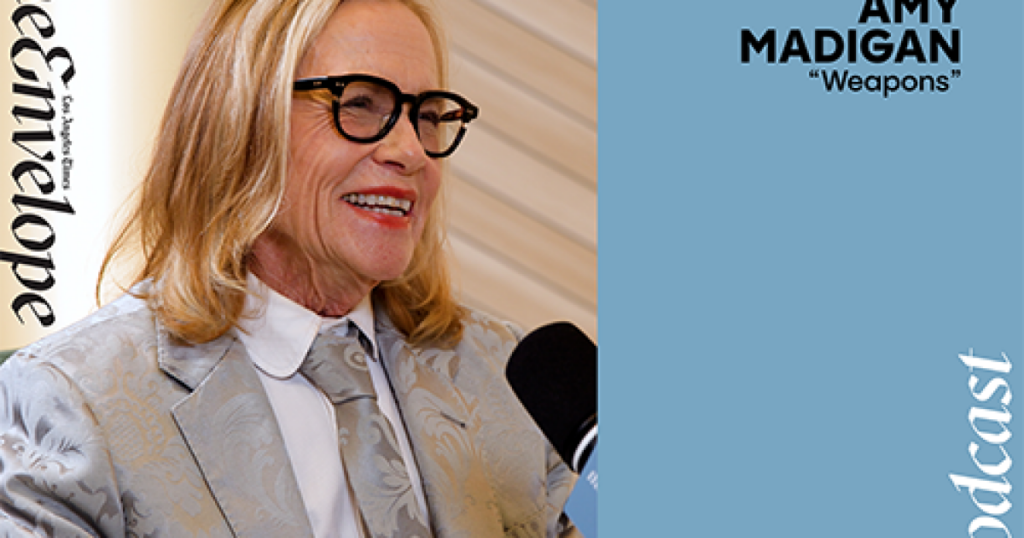
In this week’s episode of The Envelope podcast, the “Weapons” star discusses finding viral fame with her Oscar-nominated role as Aunt Gladys after years of ups and downs.
Kelvin Washington: Welcome to The Envelope. I’m Kelvin Washington, alongside the usuals, Yvonne Villarreal, we got Mark Olsen as well. Everybody doing well?
Yvonne Villarreal: Doing good!
Mark Olsen: Terrific!
Washington: Good, good. Last time we discussed Oscar nominations. Obviously a big deal. Folks were excited. Certain films, certain directors, actors as well. We went over that a little bit. But I also want to talk about something you, my friend, brought up. You mentioned the Oscar nominee luncheon last episode. I want to hear more about this, you know, [as] someone who’s never been. So I have to live vicariously through you two. Tell me more about it.
Olsen: Well, exactly as it sounds, it is a luncheon for all of the Oscar nominees. So from the biggest stars down to, you know, relatively unknown craftspeople, all get invited to this luncheon at the Beverly Hilton hotel. And it’s really one of those kind of, like, secret highlights of award season. It’s not televised, and so everyone’s feeling loose and there are drinks in the afternoon and also, at this point, everyone is a winner. Nobody’s lost anything yet. And so everybody’s kind of on equal footing, even in their categories, and people seem to really enjoy it.
We were not actually in the room for the luncheon. Our esteemed colleague, Josh Rottenberg, was there and wrote about it. We were in a press area in a ballroom, sort of backstage-ish to do the interviews that we did, but even there — I always get such a kick out of the fact that publicists are coming by with all this talent — other outlets will do much shorter interviews than we do — and kind of like, “Hey, do you want to talk to so-and-so?” And it just is so funny to me to see them kind of being showcased in this way. Yvonne, what stood out this year for you?
Villarreal: So it takes place at the Beverly Hilton, and I was there a few weeks back for the Golden Globes. And so in some ways it felt like a more subdued — like it was the luncheon version of that. The star power was as insane, but they’re maybe a little more casual in the vibe. At one point I’m walking down the corridor and you have Emma Stone or people walking by looking at the security guard dogs. It is interesting thing because they’re all sort of coming together and loose and talking with each other, taking the selfies. You’re seeing, like, Elle Fanning reuniting with Timothée Chalamet — they starred in a movie last year together. It was interesting to have everyone come together, but also do these interviews in a much rowdier setting than we were last year, and having to concentrate on our guests while a lot of commotion is happening. But I think we did well.
Washington: Well, I tell you what, I know how that is. It can be trying to do an interview when it’s loud in the background. Our producer, Matt, was saying that it was chaotic. Said he was a few feet away from you and couldn’t even hear you. But you all are pros. So you got it done. And speaking of, we get a chance to hear your conversation you had with Amy Madigan. Tell me a little bit more about this role, Aunt Gladys, and, of course, “Weapons.” I was terrified. And it’s in a complimentary way. She played the heck out of that role.
Olsen: She’s obviously a veteran actress. She was nominated for an Oscar once before, for the film “Twice in a Lifetime.” It came out in 1985. She was nominated in 1986. And so that 40-year gap actually is the longest gap ever for an actress in between nominations. And it’s just exciting to see how she’s really enjoying this moment. She’s really enjoyed the attention that the character of Aunt Gladys has brought. So in “Weapons” — spoiler alert — she plays this kind of eccentric witch, essentially, who comes to this town, creates all this mischief, but there is still something kind of, like, rambunctious and almost weirdly lovable about her. She is somehow — and we talked about this in the interview — she’s somehow both the funniest and the scariest thing in “Weapons.” She has this very outrageous look. She has this specific kind of form of witchcraft that she performs to sort of take control of people’s minds and bodies. It was really exciting to see Amy as someone who’s just like taking in this moment, really enjoying it. And it was just a really fun conversation. And also she gave a little bit of the backstory of a moment I’ve always been curious about. In 1999, at the Oscars, Elia Kazan was given a lifetime achievement award, and Amy and her husband, Ed Harris, did not stand, did not applaud during the standing ovation. And she actually spoke quite a bit about what was behind that moment, and it was something I’d never heard her talk about before.
Washington: You got to get it firsthand. All right, here’s Mark’s conversation with Amy Madigan, take a look.
Mark Olsen: For the Los Angeles Times and The Envelope, I’m Mark Olsen. I’m here today with Amy Madigan, an Oscar nominee for her role in “Weapons.” Thank you so much for joining us.
Amy Madigan: I’m very happy to be here, thanks.
Olsen: And now we’re here this afternoon at the Oscar nominees luncheon. You just stepped out of the event. What was it like? I always want to ask, who was at your table?
Madigan: Wagner Moura. Because we’re traveling around together, when you’re on the awards circuit, we became friends, which is just so nice. Miles Caton from “Sinners,” the wonderful Sandra Chang, who is my manager and fighter for me, I brought her with me today. So it was just just really nice. Jerry Bruckheimer was there, who I’ve known for a while. They don’t want everybody from the same films together, so they mix everybody up. So it was really nice. A woman who is in charge of the Telluride Film Festival, which is a fantastic festival. So yeah, it was really nice.
Olsen: That’s terrific. I have to say, I noticed on a streaming site, a little portrait of Aunt Gladys is the image they use to sell “Weapons.” And to start talking about the movie, did you expect for this character to take off in the way that it has?
Madigan: Not at all. The best thing about it is that I know people really dig the film. It’s just a really smart, cool film and very well written, very well directed. And I thought people would really have a good time with Aunt Gladys. But the night that we opened it was, “Boom.” So this was all a surprise to me.
Olsen: What was it like for you watching the movie for the first time? Spoiler alert for anyone who hasn’t seen the movie, what is it like to see yourself torn limb from limb?
Madigan: I was actually looking forward to that, because we had this group of kids who traveled around with us for the whole film, working, and I got to know them very well, and I made sure that they weren’t frightened about tearing the dummy apart. So it was great. But seeing it in the movie theater — and there were a lot of horror fans there — was kind of an overwhelming experience for me. I didn’t really know what to expect and, boy, I was kind of shocked and very happy, very happy.
Olsen: I’ve heard you say how when Zach Cregger first came to you with the project, he spoke about it in very personal terms, the grief he had over the loss of a friend, the specter of alcoholism in his childhood.
Madigan: Very much so.
Olsen: What was it about that pitch that made you want to take part in this movie? The two don’t necessarily intuitively sync up.
Madigan: I think grief is a weapon. I think alcoholism is a weapon. And I think that he took all those things and put it in the film. And I could just tell how sincere he was about this movie. He knew how to make this movie. And I had seen “Barbarian,” which is his first film, which really scared me. And it’s quite amazing that he made that kind of on a shoestring. So I knew this man could just do it. And we just kind of clicked.
Olsen: One of the things I really appreciate about the movie is the way that it sort of dares to be enigmatic. It doesn’t try to explain everything to you.
Madigan: I’m so happy of that. I don’t want to explain things to you. People, of course, they have to ask me questions, you know, “Where is Gladys from?” or “How old is she?” I said, “I don’t have answers for those things.” I have my own answers. I like that there’s no big montage explanation of who she is and what she is. She’s just there.
Olsen: But I have to ask, what is your interpretation of the floating machine gun?
Madigan: Every single person I’ve talked to, on the street, here, I’m just holding it in of what I think about it, because it means so much to so many people. It is a weapon, as we know, and it’s such a giant thing to have floating in the sky. I would really like people to just take what they do from it. It really hits people in the heart and the guts, and jolts people, and I think that’s a good thing.
Olsen: And now, as an actor, do you have to answer those questions for yourself, for your performance, or can you live with the uncertainty?
Madigan: Well, the millions of questions I have for myself interpreting Gladys, some I answer, some I kind of answer, some as I’m working through it I go, “Well, I kind [of] thought that, but I think it could be this.” Gladys is very malleable. If Plan A is not working, she’s got Plan B. And if that doesn’t work, she can improvise and she will kill you with Plan C. So I kind of like to take that with me.
Olsen: Because one of the things I find so remarkable about the character and your performance is she is somehow both the funniest and the scariest person in the movie. What was it like for you finding that balance? How did you kind of get that alchemy right that she could be both those things at once?
Madigan: Well, I have to go back to the script, because when I read it I knew that there was a lot of humor. Aunt Gladys, she’s funny. She’s lethal and dangerous, so it’s a fine edge that you have to walk. You have to be really careful. Gladys can be animated and kind of cutesy, and when she wants to drill you down she will do that. So I felt very free to kind of play both those things, when I’m by myself or when I am with little Cary Christopher, when I am manipulating him, as opposed to when I was out in the world with the police or the principal. So the scenes really led me, which is really nice.
Olsen: What did you learn about her, I don’t know what to call it, her practice? I’m so curious with the twig and the hair and the blood and the bell — Is that a thing? What is all that?
Madigan: Well, I can’t say that I’ve read 1,500 books about alchemy and quote-unquote witchcraft and things like that. I have my own ideas. I think Zach had his own ideas, but there are certain things like salt on the ground or a bell, but we didn’t want to make it derivative. The whole thing with dropping it in a bowl of water, it’s like, what is that? But it doesn’t have to be explained. It works. It works.
Olsen: The scene at Benedict Wong’s house, you get this sense that she has this kind of routine that she does, this little show she puts on.
Madigan: I gotta get in that house. That is my mission. Every actor will tell you, what is my intention? My intention is to get in that house, get off the front stoop, bring them into the house, and then I got them. Then I got them. I know if I can wander around the house. Oh, it’s the kitchen. Let’s go in there.
Olsen: But you do get the sense that she’s done this a lot before. She knows what she’s doing.
Madigan: She knows what she’s doing, but she’s dealing with a different set of characters and in a different milieu and a different problem. So the foundation might be the same, but she has got to kind of play the game for a while and she’s got to find out information from them first. Like, “Did you do this? Did you tell people about this?” Oh, you didn’t. OK, well this is going to be a breeze now.
Olsen: I think that’s why people are so taken with the idea of a Gladys prequel movie. There is something about the character you just do want to know more.
Madigan: Yes, I understand that and I’m hoping that we get to somehow continue something with Gladys. And Zach and I have talked about it, and certainly Zach has been very open about it to the press. What that will be, I don’t know. I like mystery in things, and Gladys is a mystery, but I trust Zach implicitly. So I’m very curious if we get to make it and what will happen.
Olsen: Her look is so specific and so outrageous. Do you often find that costume and the look of a character is a way that you like to enter a working on a character?
Madigan: Well, definitely for Gladys, my entree into the film is when I come to Benedict Wong’s principal’s office and the shot is on his face where he goes like that, pushes his head back. Her look is very, very calculated. She loves the way she looks. She loves her jewelry, she loves her big giant handbag. She thinks she looks fantastic. So that was very freeing for me. I mean, it took us a while, you know, with special effects and our hair and makeup and wig and costumes. It was a real team effort to do that, Zach overseeing it all. So that just made me feel so free, just so relaxed in being Gladys.
Olsen: Do you think that’s another aspect of the character people are responding to? She doesn’t tone down for anybody.
Madigan: Oh no, why would she? She doesn’t care what that person thinks. She doesn’t care what you think. She’s just in her whole being, which is a nice feeling.
Olsen: Tell me a little bit about the finale of the movie, the sort of chase scene where the kids are running after you.
Madigan: That was so much fun to shoot!
Olsen: As I understand, for the most part, that’s you.
Madigan: I did all the running myself, which I talked to Zach and I said, “No, I can do it, I really want to do it.” I did have a wonderful stuntwoman, and at the very end when I get tackled, I did not get tackled because I probably would have broken my nose, let’s face it. And then I flipped over and then it’s me. But I really wanted to do it, and Gladys has a physical-humor side of her. So the way I would run would be different than the way somebody else would run, and Zach was totally down for it.
Olsen: You’ve been pretty open about the fact that in the period before you got offered “Weapons,” you hadn’t been getting a lot of offers. Roles don’t come to you as much as they used to.
Madigan: That’s the ups and downs of being in this business. I’ve been in it a long time. I’ve always continued working. I’ve done three different independent films, and often they don’t get the love or the recognition that some of the larger films do, and that’s just part of it. Listen, you’ve talked to a lot of actresses. You know what it’s like for women in this business, it’s still very unequal, [especially] for women of a certain age. You’re gonna hear no a lot of the time. And I still am myself. I love acting, I love my work. So that’s just who I am. Not totally; I have a family and I have friends, but that’s who I just am. So this was a real chance [and] I’m just grabbing it by the throat.
Olsen: Do you feel like there was just something about this role that made you really kind of go for it?
Madigan: Zach provided that ground for it. He wrote it. He knew she had to be this and this and scary and funny, and yet she still had to talk to the little boy, Alex, and get him to do what she wanted him to. It was very delicate in that sense. But I knew as soon as I read this, I said, “Oh, I know who this is.” I really like this person. I’m not that person, but I have those sides in me. Everybody’s got that stuff in them where they manipulate, where they’re nice and they’re pretending, where they are horrible. So I was like, “Yeah, I can do that.”
Olsen: I think it’s never been easy to be an actor, but have you found that the business of being an actor, the career aspect of it, has it gotten harder over the years?
Madigan: The business has changed. We just have to read any of the trades and it’s become centralized by corporations and giant entities. So certainly that’s changed, but people still are making movies and want to make movies. Something that’s very original and creative people will go see. They want that. I know everybody, myself included, watches a lot of things [on] streaming. But the theater is still a place to see a lot of films. The independent market struggles to find enough money to get their films out, but they’re still being made. So I’m guardedly hopeful. But the business is not very fair. You know that. It’s just not. So when you’re younger, you have to grind a lot more. The opportunities are difficult, I think, for young people coming up. And I try to really foster that with any young creative person, because I’m not going to be around — they are. I want to see what their dreams are, I want [to] see what their movies are.
Olsen: You were nominated for an Oscar once before for “Twice in a Lifetime.” What do you remember about that night?
Madigan: My husband and I, Ed [Harris], we just went, you know what I mean? I was so surprised with “Twice in a Lifetime.” This is a family drama, I was surprised that I got a nomination. And then it was not like it is now. There was no social media, there was no TikTok, there were no podcasts. People weren’t saying, “Gee, I’d really like to talk to Madigan.” No, that didn’t exist. So it was a much calmer type of situation. And I was a lot younger, so I was kind of looking around and seeing people that I really admired. And it was fun. This is a completely different personality of this.
Olsen: That year you were up against Oprah Winfrey and Margaret Avery for “The Color Purple,” Meg Tilly for “Agnes of God,” and Anjelica Huston, who won for “Prizzi’s Honor.” That is quite a lineup to be a part of.
Madigan: Yes, it is. That’s why I was very surprised. As I am in this lineup this year. The performances are stunning. This is the best of women in film, I think, for the actresses in both categories. And that’s a great feeling. They’re all different. They’re all unique. How somebody votes is like — I don’t know how you do it. I don’t know how you compare. And finally, one is asked to compare. So that’s a little difficult, I think, for a lot of actors to kind of wrap their head around, but we know that’s what it is.
Olsen: And there’s another Oscar moment that you’re sort of were a part of —
Madigan: [Crosses arms] This?
Olsen: Exactly. Tell me about it. So in 1999, Elia Kazan was given a lifetime achievement award. You and your husband, Ed Harris, kind of pointedly did not stand or applaud during a standing ovation. Now, was that something that the two of you had talked about before?
Madigan: No, not at all.
Olsen: Did you go in knowing that was going to be your response?
Madigan: I knew he was going to get this special award from the academy, which I did not agree with. My dad was a newspaperman, a journalist, a political analyst, and he, as a very young man, covered the McCarthy hearings, and it really affected him, and he didn’t talk about it too much, and I have pictures from it, and I’m very familiar with that period of time and what happened during that period of time, especially to people in my industry. So I had very definite feelings about it, and I thought it was wrongheaded and really somewhat shameful of the academy to do that. And I think somehow Ed’s picture and mine, because we’re together, got really prominently displayed. But there were other people in the audience who felt that way too. And fair enough if someone wanted to look at the work, but I could not disassociate him naming from his work. That’s me personally.
Olsen: That’s maybe something of an extreme example, but do you see the life of an artist as a political act? Can you unravel your own personal politics from your work?
Madigan: I think if you look at things I have done, yes, I’ve done some political things. I worked on a television event, it was in the 1980s, called “Roe v. Wade,” which now that right has been repealed. And it was on network television. No one would advertise it, nobody bought it. ABC had the guts to put it on. That piece was very important to me. Holly Hunter, who’s a dear friend of mine, we were in that together. I worked on “The Laramie Project.” I think there are certain things that have come to me that I opened myself to. … Everything doesn’t have to be that. Gladys isn’t political. But if there’s an opportunity, I don’t think I would do something that really went against my own moral code. I think a lot of people are that way. I hope they are.
Olsen: Because I think it’s a question a lot of people are asking themselves today. “What would I do when my back’s against the wall?” Or, “What would I do when I’m in a situation where I feel like I have to make a real decision?”
Madigan: Well, let’s say you were in the joint. You would probably do, I would do, whatever it took to survive being there. I really would. I don’t know what that would be for me. I think human beings are good, but they’re really horribly bad. So I think that we can tap into those things. It’s a survival mechanism. You have to look at “One Battle After Another,” it’s an appropriate political film for right now. You look at “Secret Agent.” It’s very appropriate political film for now. As is “Sinners,” as is a lot of things. So that’s why I think it’s kind of a good year for the films. Aside from the ones that are great, like “KPop Demon Hunters” and the funny ones. There’s room for all of them. “Avatar,” there’s room for that. I mean, “Avatar’s” about the environment. It’s the most political statement Mr. Cameron and people can make right now.
Olsen: Do you mind if I ask you about your relationship with Ed, with your husband? The two of you have been together for more than 40 years, and it seems like you’re both just so dedicated to the craft of acting, the life of the artist. What has it meant to you for the two of you to be going through this together?
Madigan: I mean, Ed, he’s been through this [nominated for an Oscar] four different times, so he’s just thrilled for me. He’s just got my back, he’s just happy for me. We both still continue to work. We met working on a play in a theater that was just a little bigger than this. You really get to know somebody when you’re on the boards with them, when you are acting with them. So we’ve been able to work a lot together, and I hope to continue that. We just carry that with us. It’s very important to us. And our daughter, her name is Lily Harris, she’s a young actress coming up. So we’ll see what happens for her.
Olsen: And then you mentioned that you lost your house last year in the fires.
Madigan: January 7th.
Olsen: What has it been like to have the low of that contrast with the high of what you’ve been going through with “Weapons”? That just seems like a lot to happen all at once.
Madigan: When the anniversary was coming up, that really triggered me. Especially around Thanksgiving, because our house was where everybody came. Sometimes there’d be 15 people, sometimes there’d be 30, and it was just a really small, funky little house. I don’t have that anymore, and my friends don’t. I don’t have pictures like when I was on the road. So those are the hard things. I’m displaced now — not to compare myself with the millions of people internationally displaced. I mean just emotionally I am. People have been very kind. People really saved us. We stayed at one place, then another friend gave us the keys to a house he has. That was a very humbling experience. But it’s difficult. We’re leasing a place right now, we’re trying to rebuild, we’re trying to wait for a permit, we’re trying to maneuver red tape, and that’s going to be years. It’s truly just taking it a day at a time, which is hard. So it’s been kind of crazy making. And then Gladys! All the joy of that, and the worry about it. It’s been a weird juxtaposition.
Olsen: How do you think you’ve been handling award season?
Madigan: Well, with the help of the people I’m working with, I think I’m doing pretty well. But it’s still overwhelming to me. But people like yourself, they’ve been very generous and they’re interested in cinema and they don’t call everything “content” and people have good questions, and I’ve met a lot of great actors that I didn’t know before. So that’s been [a] total upside. But the rigor of it, you have all these things to go to, and you have to have an outfit, and you to have your hair done, you have your makeup done. I’m not that person in my life. So, it’s been a challenge, let me put it that way.
Olsen: At this point in your career, it’s probably unpredictable for you which of your previous movies people are gonna ask you about. Like, “Oh, are they gonna ask me a ‘Field of Dreams’ question?”
Madigan: Everybody always asks me about it. Because “Field of Dreams” turned into this iconic thing. I’ll be in an airport and some man will come up to me and just say, “That scene when Kevin Costner’s with his dad,” they start getting choked up, “My dad, we were estranged” and this and that. So it’s touched people. And then I’ll have the man say, “I’d love to have a wife like Annie Kinsella.” I said, “I would too, that’d be great. But this is a fantasy.” But that movie, people love that movie. That’s a nice compliment.
Olsen: But also I would imagine that maybe it’s unpredictable what people are going to mention, like last summer I saw the movie “Streets of Fire” that you were in, and I know that film did not do well when it…
Madigan: It was a bomb and now it is a cult classic.
Olsen: Because I saw it at a packed house at the Academy Theater here in Los Angeles. What are your recollections of making that movie?
Madigan: Well, first of all, I love Walter Hill. I saw all of his films, so I was excited to work with him and that I got this part. It was written for a guy, and I kind of convinced him that McCoy could be me. And you know, it was Willem Dafoe’s first film, I believe … Rick Moranis was there. It was wild. We shot 58 nights in a row or something insane. And I worked with all the dudes, Stoney and all those guys, and Diane Lane, who was, I don’t know, 19 years old or something. But we had a great time making it, and then it went thunk, but now I still get fan mail about it. It’s crazy.
Olsen: Now, before I let you go, in one interview that you did, you mentioned how every day you read three newspapers, you read the Washington Post.
Madigan: I feel stricken by what’s happening with the Washington Post, stricken.
Olsen: But then also the New York Times, and then only for the sports section, you read the Los Angeles Times.
Madigan: Well, I read the California section because I’m very interested in local politics, but unfortunately, the L.A. Times is not what it used to be. And because I am an avid sports person, they go to bed so early with the print that everything’s a half-a-day behind. So I’m like, “I know this. I watched the game.” So it’s a little nutty, but I do go to the sports section.
Olsen: What can we do to win you over to reading our arts and culture coverage of the town that you live in?
Madigan: I always read the entertainment section, always, every single day. And I also love the comics. I’ve been reading the comics since I’ve been that big. And I read them every day. So please don’t misunderstand. I think I’m talking more about the front page.
Olsen: OK, that’s a relief.
Madigan: Not you guys!
Olsen: Well, Amy Madigan, congratulations again and thank you so much for joining us today.
Madigan: Thank you. This was really nice. I appreciate it. I really am interested in writers and interested in people’s beat to treasure cinema. So this has been really nice. Thank you.
The post Amy Madigan opens up about ‘crazy-making’ fire recovery, Elia Kazan’s Oscar and more appeared first on Los Angeles Times.