After pulling out of the World Health Organization, the Trump administration is proposing spending $2 billion a year to replicate the global disease surveillance and outbreak functions the United States once helped build and accessed at a fraction of the cost, according to three administration officials briefed on the proposal.
The effort to build a U.S.-run alternative would re-create systems such as laboratories, data-sharing networks and rapid-response systems the U.S. abandoned when it announced its withdrawal from the WHO last year and dismantled the U.S. Agency for International Development, according to the officials, who spoke on the condition of anonymity to share internal deliberations.
While President Donald Trump accused the WHO of demanding “unfairly onerous payments,” the alternative his administration is considering carries a price tag about three times what the U.S. contributed annually to the U.N. health agency. The U.S. would build on bilateral agreements with countries and expand the presence of its health agencies to dozens of additional nations, the officials said.
“This $2 billion in funding to HHS is to build the systems and capacities to do what the WHO did for us,” one official said.
The Department of Health and Human Services has been leading the efforts and requested the funding from the Office of Management and Budget in recent weeks as part of a broader push to construct a U.S.-led rival to the WHO, officials said. Before withdrawing from the agency, the U.S. provided roughly $680 million a year in assessed dues and voluntary contributions to the WHO, often exceeding the combined contributions of other member states, according to HHS. Citing figures in the proposal, officials said the U.S. contributions represented about 15 to 18 percent of the WHO’s total annual funding of about $3.7 billion.
HHS spokesman Andrew Nixon did not answer detailed questions about the proposed WHO replacement but said the agency “is working with the White House in a deliberative, interagency process on the path forward for global health and foreign assistance that first and foremost protects Americans.” A spokeswoman for OMB declined to comment.
Public health experts said the effort would be costly and unlikely to match the WHO’s reach.
“Spending two to three times the cost to create what we already had access to makes absolutely no sense in terms of fiscal stewardship,” said Tom Inglesby, director of the Center for Health Security at the Johns Hopkins Bloomberg School of Public Health, who served as a senior covid-19 adviser during the Biden administration. “We’re not going to get the same quality or breadth of information we would have by being in the WHO, or have anywhere the influence we had.”
Rather than attempting to rebuild with “something not constructable,” Inglesby said, the administration should specify what reforms it seeks and reengage with the agency.
In a statement issued last month when the withdrawal became official, HHS said the U.S. would “continue its global health leadership” through direct engagement with countries, the private sector and nongovernmental organizations, prioritizing emergency response, biosecurity coordination and health innovation.
Atul Gawande, a Harvard Medical School professor who served as USAID’s assistant administrator for global health from 2022 to 2025, said the proposal follows deep cuts that have already had consequences.
“It’s after the decimation of foreign aid for health, including the dismantling of USAID, and has already cost upward of three-quarters of a million lives,” Gawande said, citing data from a 2025 Lancet studyand modeling from Boston University estimating the toll of dismantling USAID. “This is not reversing the damage. It is spending more than we spent on WHO to create an institution that’s unlikely to survive and will certainly accomplish only a fraction of what we did by working together with the entire world.”
The WHO, he added, provides “global access we do not have,” including to countries such as China and Russia that do not routinely share health data directly with the United States.
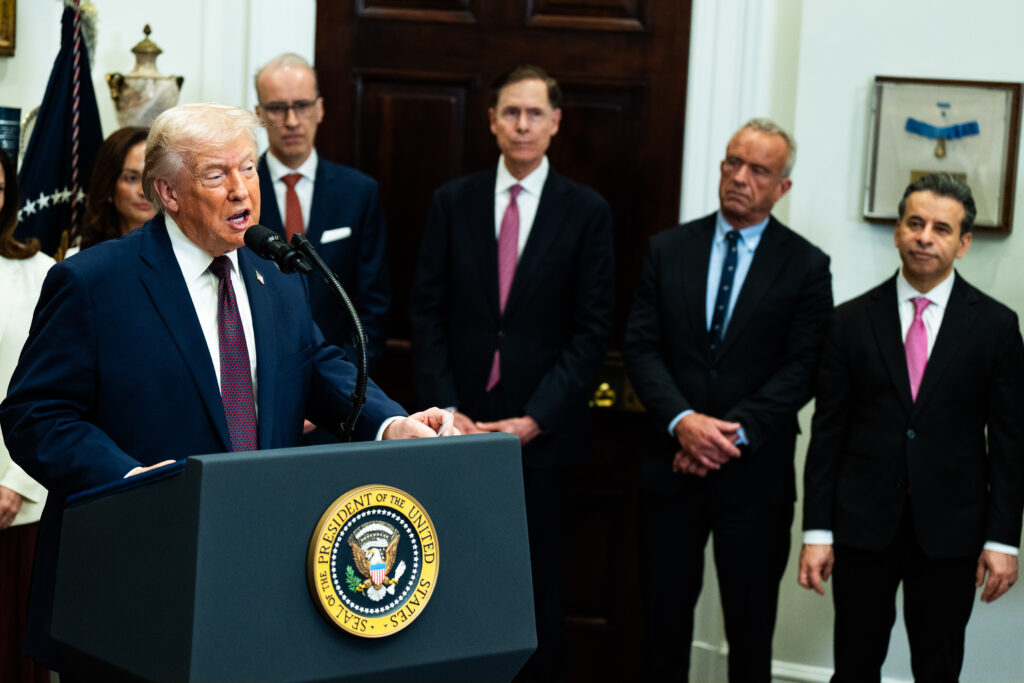
Trump announced the withdrawal of the U.S. from the WHO at the start of his second term, citing what he called the agency’s “mishandling” of the coronavirus pandemic, failure to adopt reforms and inappropriate political influence from some members. In his executive order, Trump also criticized the WHO for continuing “to demand unfairly onerous payments from the United States, far out of proportion with other countries’ assessed payments.”
The WHO did not immediately return a request for comment on the new U.S. proposal. The agency said last month that the U.S. withdrawal was “a decision that makes both the United States and the world less safe.”
The departure stunned global health experts and international authorities because the U.S. had been the most influential member of the nearly 200-member organization and played a key role in its establishment in 1948. It had also historically been the organization’s largest financial contributor.
Experts and medical societies have said withdrawing from the preeminent global health alliance is scientifically reckless because global cooperation is key to controlling and preventing infectious diseases. They said exiting the WHO makes the U.S. less prepared to respond to health emergencies such as the coronavirus pandemic or the West African Ebola crisis from 2014 to 2016, which killed more than 11,000 people in the largest outbreak of the deadly disease since the virus was discovered in 1976.
Outbreaks of viral hemorrhagic fevers — including Ebola, Marburg virus, Lassa fever and yellow fever — have quadrupled since the mid-1990s, according to figures cited in the proposal for a U.S. alternative to the WHO. Another pandemic on the scale of the coronavirus could incur economic costs of an estimated $375 billion a month, according to figures cited in the proposal.
Whether the federal government can build a worldwide disease-monitoring system comparable to the WHO — and how long it would take — remains uncertain.
Democratic leaders in California, Illinois, New York, Wisconsin and New York City have announced they are joining the WHO’s Global Outbreak Alert and Response Network, an international system that detects and responds to emerging health threats.
Public health and infectious-disease experts have long said stopping diseases at their source is cheaper than emergency responses in the United States.
During a briefing last month with reporters, a senior HHS official said U.S.-led global health efforts going forward will rely on the presence that federal health agencies, such as the Centers for Disease Control and Prevention, the National Institutes of Health, and the Food and Drug Administration, already have in 63 countries and bilateral agreements with “hundreds of countries.”
“I just want to stress the point that we are not withdrawing from being a leader on global health,” the official said, speaking on the condition of anonymity under ground rules for the briefing.
The new initiative envisions expanding that footprint to more than 130 countries, according to the officials briefed on the proposal. But it comes as global health expertise in federal government under the Trump administration has been depleted by repeated layoffs, deferred resignations and retirements.
The U.S. is also still determining how it will participate in select WHO technical meetings, including the influenza strain-selection session later this month that informs the composition of the annual flu vaccine.
Jeff Stein contributed to this report.
The post After leaving WHO, Trump officials propose more expensive replacement to duplicate it appeared first on Washington Post.