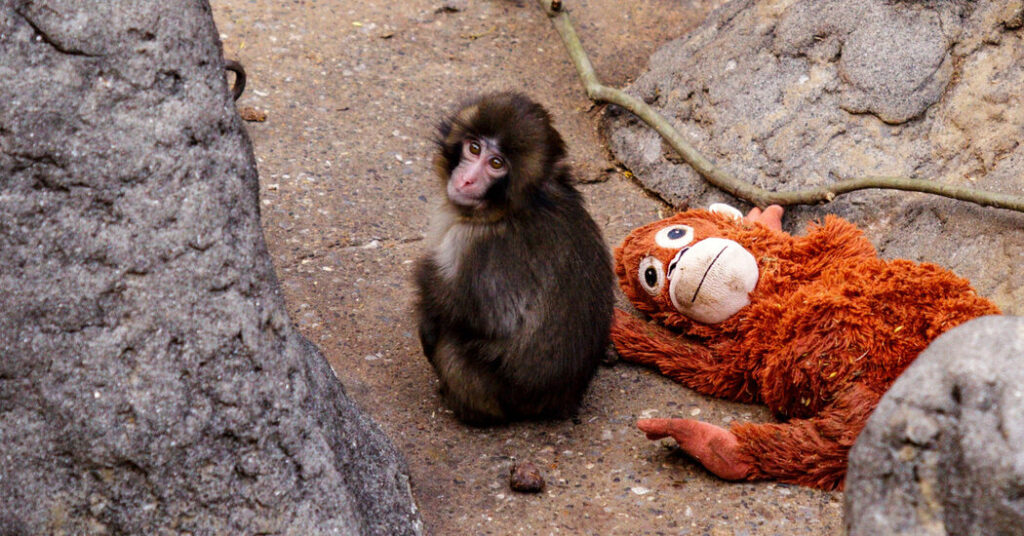
Punch, a 7-month-old macaque monkey, had no friends.
His mother abandoned him. He wasn’t quite fitting in with the other monkeys at Ichikawa City Zoo, outside Tokyo. The closest thing he had to loved ones were the zookeepers who look after him, and a stuffed animal from IKEA.
But a series of widely shared posts showing his predicament — including a hashtag started by the zoo, #HangInTherePunch — have put Punch in the global spotlight and made him somewhat of an internet celebrity.
Legions of fans from around the world have been cheering Punch on, welcoming him as a bright spot during intense current events. There’s little question as to why: Punch is adorable. And there are signs he has started to gain confidence with the other monkeys.
Born in July at the Ichikawa City Zoo, about 20 miles outside Tokyo, Punch was abandoned by his mother, most likely because of a difficult labor during a heat wave, according to zookeepers. He was nursed by staff.
He was reintroduced to the troop at the zoo’s monkey enclosure, called monkey mountain, in January, but without a mother to show him the way, Punch had a difficult time integrating. Videos showed Punch getting swatted away by adults when he tried to approach them, and frequently playing by himself.
“My mission in life now is to rescue Punch from the horrible monkeys he’s with and make him my baby,” one social media user wrote.
He wasn’t totally alone: Punch was given a now-famous stuffed orangutan toy to build muscle strength.
He cuddles, tugs and plays with the orangutan, dragging it around the monkey mountain like he would a best friend.
However, things may finally be looking up for young Punch.
Videos recently shared online show Punch climbing on the back of another monkey, getting groomed, sitting with the adults and receiving a hug — all signs that he is finally learning how to make friends.
Takashi Yasunaga, who leads the Ichikawa municipal government’s zoo and botanical gardens division, said via email that Punch had been wary of the other monkeys when first introduced to them last month. But he is gradually acclimating.
Punch’s mother is with the others at monkey mountain, Mr. Yasunaga said. It’s not uncommon for some Japanese macaques (pronounced muh-kak) to abandon their babies for a number of reasons, he said. Punch’s mother was 4 years old when she gave birth to Punch, which is on the older side for a monkey; Punch was her first baby; and it was also very hot when he was born — all factors that could have led to his abandonment.
But now, Punch has “an active and fearless personality,” Mr. Yasunaga wrote, and will “proactively try to communicate with other monkeys.”
Punch is, no surprise, the star of the zoo.
About 8,000 people visited the zoo last weekend, more than double the number of visitors on the same Saturday and Sunday of the previous year, Mr. Yasunaga said. More are expected this weekend.
Shunpei Miyakoshi, an animal keeper at the zoo, told ANN News in Japan that baby monkeys cling to their mothers for security and to build muscle strength. The zoo tried rolled-up towels as a substitute, Mr. Miyakoshi said, and even a giraffe. But Punch particularly liked the toy primate.
Mr. Miyakoshi named him Punch after a famous Japanese cartoonist, Kazuhiko Kato, who went by Monkey Punch, he told the outlet Oricon.
Kosuke Kano, another animal keeper at the zoo, told TBS News Dig that Punch almost immediately took to the stuffed animal and it has now become a sense of security. That was evident in a video that surfaced on Thursday of a senior macaque going after Punch, only for the little monkey to run away to be comforted by his plush toy.
The zoo has two versions of the toy, and has received many other stuffed animals as gifts, including a batch from IKEA, where the toy is listed as a best seller. “Over the past few days, we have seen a clear increase in sales of the Djungelskog orangutan toy, particularly in Japan, the U.S. and South Korea,” IKEA said in a statement, though the company would not say how many toys had been sold.
“What matters most to us is not that he holds on to our product,” Karin Blindh Pedersen, a leader on IKEA’s children’s toy team, said of Punch in a statement, “but that he is supported at his own pace — and that his soft toy friend can continue to help him cope until he is fully ready to let go.”
Hiroko Masuike contributed reporting.
Remy Tumin is a reporter for The Times covering breaking news and other topics.
The post A Lonely Baby Monkey Wins Hearts, and Even a Few Friends appeared first on New York Times.