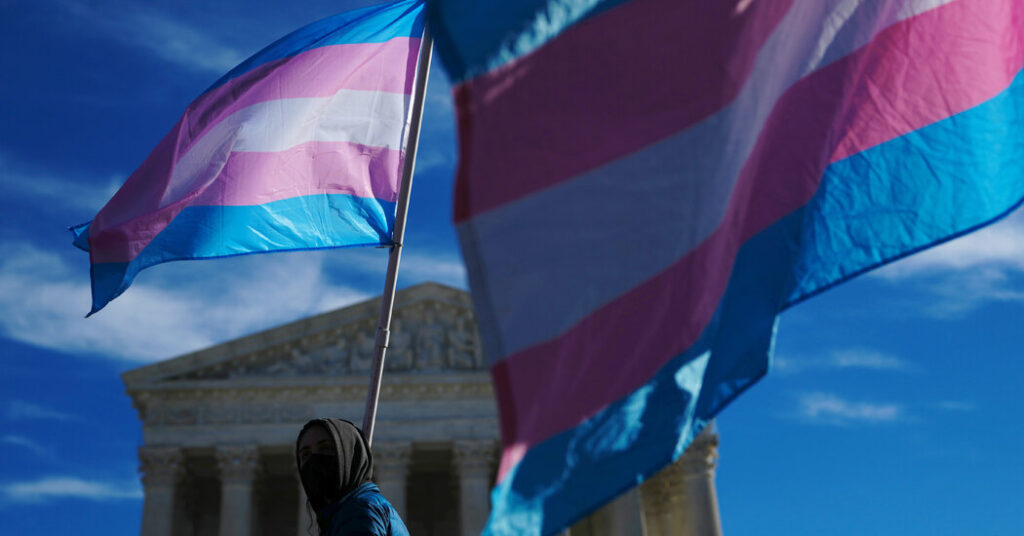
After a year in which the Trump administration has pressed to limit the ways Americans can identify as transgender in public life, Republicans are pushing the issue at the state level with new zeal.
With legislative sessions underway in most states, hundreds of bills restricting transgender rights are under consideration as social conservatives seek to capitalize on Trump administration tailwinds and a shift in public opinion to codify an understanding of sex and gender as binary and fixed.
In Kansas, lawmakers voted on Wednesday to invalidate the driver’s licenses of transgender residents who changed the gender markers on their licenses under a state policy that started allowing such changes almost two decades ago.
Idaho’s House of Representatives this week advanced a bill that would allow people to sue private businesses that allow transgender people to use restrooms consistent with their gender identity.
In Utah, legislators are weighing removing transgender people from groups protected by a state law barring discrimination in housing and employment.
Oklahoma lawmakers are considering expanding the state’s ban on gender-transition medical treatment for minors to include adults, and a Florida House panel has advanced a bill prohibiting public sector employers from requiring workers to use the preferred pronouns of transgender co-workers.
The barrage of bills follows a six-year stretch in which 27 state legislatures controlled by Republicans focused restrictions mainly on health care and sports for transgender minors. This year’s proposals are more sweeping: They address trans adults as well as youths, seek to close loopholes in earlier laws and mandate harsher penalties for violations.
In statehouses where lawmakers have previously sparred over specific scenarios — whether a trans girl who has not gone through male puberty has an advantage in track, for example — debates now revolve around the essential validity of transgender identity. Instead of arguing over whether transgender 16-year-olds should wait until age 18 to get access to cross-sex hormones, the question being posed in states like Kansas is whether, for the purposes of state law, someone can be trans at all.
President Trump issued an executive order last year asserting that a person’s sex is determined at conception and cannot be changed, but most efforts by federal agencies to carry out that order are being challenged in the courts. That has left much of the immediate action on the issue to the states.
May Mailman, a lawyer who helped to craft Mr. Trump’s executive order, said that the federal government has leverage on the issue, “but your day-to-day life is going to be governed by the states.”
Sponsors of these bills say they are necessary for protecting women, ensuring fair competition and shielding teenagers from medical transition that they may later regret. They also frame their proposals in broader terms, arguing that biological sex is the most meaningful way to categorize individuals and that affirming gender identities that don’t line up with a person’s sex is a denial of reality, which comes with its own harms.
Supporters of transgender rights say they view this year’s state proposals as a concerted effort to chip away at protections of trans people at the state level to build support for even broader limits at a national level.
“There’s a clear pathway between the states and federal policies under this administration,” said the Rev. Jasmine Beach-Ferrara, executive director of Campaign for Southern Equality, an L.G.B.T.Q. advocacy organization based in North Carolina. “Our general analysis is that they will go as far as they think they can in enforcing what’s fundamentally a very narrow ideological position — that being transgender does not exist. That it is not a reality.”
Indeed, conservative activists said that raising the prospect of broader restrictions at the state level could pressure Democrats in Congress to help enact limits on access to sports and medical transition for minors nationwide.
“The more states pass these common-sense protections, that helps create the momentum for ultimate federal action,” said Matt Sharp, director of legislative advocacy for Alliance Defending Freedom, a group that has crafted legislation on sports limitations that many red states have enacted. “We would love to see these protections no matter where a woman lives, whether she’s in California or Florida.”
Over the last decade, many Democrats have argued that gender identity is central to who someone is, and that excluding transgender people from sports and public accommodations is a form of discrimination. Starting in 2015, Democrats sought to amend the Civil Rights Act of 1964 to include gender identity as a protected class.
But since 2024, as trans issues became a focus of Mr. Trump’s campaign, Democratic strategists have debated the party’s approach. Last year, a handful of Democrats in a few states, including five state lawmakers in Pennsylvania and two Texas Democrats in Congress, crossed party lines to support trans athlete bans.
With midterm elections looming this year, Republican strategists said that the prospect of tighter restrictions at the state level could help portray Democratic candidates as out of step with voters on transgender issues. Terry Schilling, president of the American Principles Project, an advocacy group, said his group plans to spend $20 million on advertising focused on transgender policies this year to replicate what it saw as success in appealing to a critical sliver of voters in 2024.
Polling has found that Americans have become more supportive of restrictions on trans people in recent years. A majority still want to see trans people protected from discrimination in jobs, housing and public spaces, but two-thirds of Americans favor barring trans athletes from women’s sports, and about half support requiring trans people to use public bathrooms that match their biological sex.
Republican voters are overwhelmingly in favor of outlawing health care professionals from prescribing medication for gender transition to minors. More than one-third of Democrats now favor that approach, up from about a quarter in 2022, according to a 2025 Pew Research poll.
Supporters of transgender rights attribute the shift largely to Republican political ads and to the Trump administration, which in executive orders and agency policies has called it a “false claim” to identify as transgender, declared transgender Americans unfit for military service, and portrayed teens who undergo gender transition hormone therapies as “mutilated.”
The shifting sentiments may be reflected in this year’s state legislative sessions in Democrat-led states, which are for the most part considering incremental protections for trans rights rather than sweeping new policies. In New Jersey and Hawaii, for example, Democratic lawmakers are pressing for additional layers of protection for the privacy of transgender patients’ health information. New York’s State Senate has advanced a bill that would allow buildings to more easily convert single-sex bathrooms to all-gender bathrooms.
Only a fraction of the transgender-related bills under consideration in state legislatures are likely to be enacted, and some of the same proposals have failed in previous sessions. But even the prospect of a broad debate over limits on transgender people, across many states and over many issues, can make it harder for people to openly identify as transgender, supporters of trans rights said.
Logan Casey, who tracks transgender-related legislation for the Movement Advancement Project, an L.G.B.T.Q. advocacy group, said that the expansion into trying to limit so many areas of transgender life suggests that the goal is not to solve a specific policy concern, like fairness in sports, but to regulate gender nonconformity more broadly. His tracking over the last six years found that states that adopted a restriction on transgender people had always gone on to pass more of such limits.
In Kansas, the measure barring trans people from changing gender markers on driver’s licenses followed a long fight. The newly adopted law also allows people to seek financial damages from transgender Kansans who use a bathroom that does not match their biological sex. Republican lawmakers this week overrode a veto by Gov. Laura Kelly, a Democrat, on the measure, which reflected a significant expansion of restrictions in a longstanding fight over trans identity in the state.
In 2023, Kansas was the first state in the nation to codify into state statute definitions of “sex,” “woman” and “man,” which supporters said could prevent trans women from claiming access to women-only spaces and sports teams based on their gender identity. Republican leaders argued that the definitions should apply to driver’s licenses, too, but courts sided with state officials who said that driver’s licenses sought a person’s “gender,” rather than “sex.”
Under the new driver’s license measure approved this week, lawmakers also redefined the words in the state’s 2023 law to say that both “sex” and “gender” mean a person’s “biological sex, either male or female, at birth.”
State Representative Lindsay Vaughn, a Democrat, said at a hearing last month that the measure is “about discriminating against trans people.”
Representative Susan Humphries, a Republican and the bill’s sponsor, countered, “No, it’s about sex — the definition of gender and sex.” The bill, she added, “has to do with truth.”
Mr. Casey of the Movement Advancement Project, who is transgender, said that the Kansas measure drew his attention for what he sees as an element of humiliation. Under the new law, the licenses of several hundred transgender Kansans will become invalid once it takes effect in the coming days, and they must “surrender” the old licenses to the state motor vehicles agency.
“That trans people in Kansas who have been able to legally follow the rules and update their gender marker are now being required to come in and surrender that document — I just think it’s really remarkable,” Mr. Casey said.
Ruth Igielnik contributed reporting.
Amy Harmon covers how shifting conceptions of gender affect everyday life in the United States.
The post With New Momentum, Republican States Push Broader Limits for Trans Americans appeared first on New York Times.