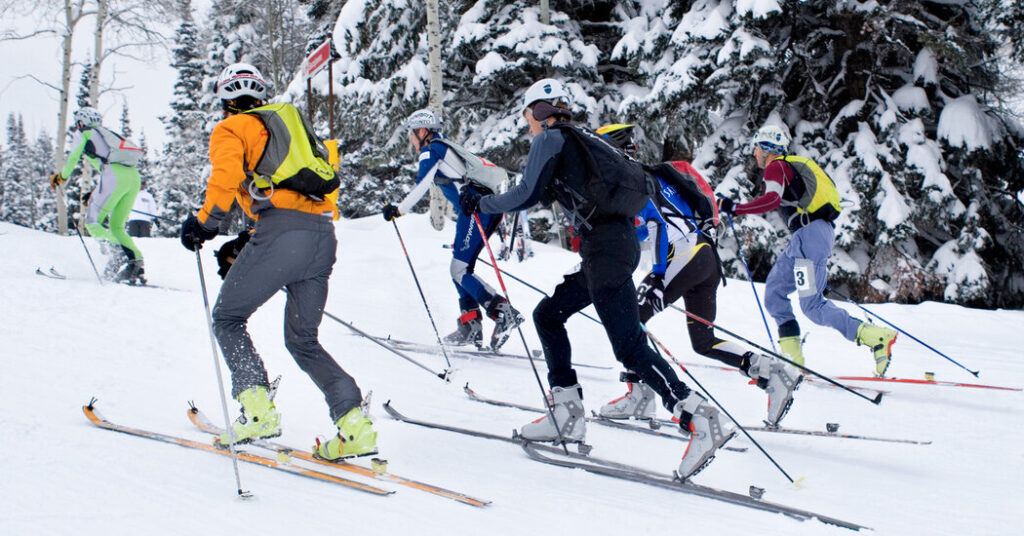
Long before mechanical lifts, snow machines or winter resorts with après-ski comforts, hardy Alpine people trudged up icy peaks under their own power, not for sport but because it was the only way to get around. It was a necessity of rugged mountain life: Merchants wore skis to trade goods, and soldiers wore skis to fight battles.
That tradition, once essential for survival, is at the heart of ski mountaineering, which makes its debut as an Olympic event on Thursday in some of the same mountains where the sport was born.
In skimo, as it is known to its devotees, competitors climb uphill on skis and then on foot before racing downhill. It is a punishing exercise that requires strength, technique and endurance, which is exactly why ski mountaineers love it.
“You have to be powerful, explosive, fast, and also be able to repeat these climbs over and over again,” said Cameron Smith, who is the most decorated American ski mountaineer and one of two U.S. athletes competing this week at the Winter Games in Northern Italy. “So it’s a super physically demanding sport.”
Skimo is the first new Olympic winter sport since snowboarding in 1998. (Skeleton debuted in the 1920s before becoming a fixture at the Games in 2002.) Organizers have not announced whether skimo will be included in the 2030 Games in the French Alps, but supporters of the sport say its roots and popularity in Italy, France and Switzerland help its chances.
The sport is relatively young in the United States, but the International Ski Mountaineering Federation is also working to secure a spot for the event at the 2034 Winter Games in Utah.
An early American champion was Nina Silitch, who embraced the sport while living in France and won two gold medals in skimo World Cups, including the first medal in the event for a North American. After returning to the United States, she founded a skimo club in Park City, Utah, and worked to expand the sport, with an eye on getting it into the Winter Games.
“Slowly, these youth programs started to build support from parents and then create that structure in North America,” she said. “For it to be in the Olympics is the result of lots of people who are passionate about the sport being committed.”
Smith and his U.S. teammate, Anna Gibson, qualified for this year’s Olympics after an unexpectedly dominant performance won them first place in a mixed relay World Cup event in December. Besides the mixed relay, the Olympics will have men’s and women’s individual sprints.
In the sprints, competitors climb up the course on skis, take them off to continue on foot and then put the skis back on to make the final ascent, reaching a height of about 230 feet. Then they race downhill. Each sprint takes about three minutes.
In the mixed relay, the female member of the pair completes two ascents, reaching 400 to 500 feet, and two descents before the male athlete goes through the same course. Then they each repeat it. That race takes about 30 minutes.
One tip for viewers at home: Watch the athletes’ transitions from climbing uphill on skis to going on foot to getting back on skis and then going downhill. Racers affix skins to the bottoms of their skis to provide traction as they ascend, then must take them off and reattach their skis before heading back down.
Races are often won or lost based on how nimbly athletes handle the transitions, Smith said. Competitors devote part of their training exclusively to those moments, he added, describing creative setups using yoga mats and uneven steps in an effort to mimic course conditions.
In warmer months, many ski mountaineers are trail runners or cyclists. The three sports share similar physical requirements, train similar muscles and fulfill a similar desire to move freely through mountains at any time of year.
Smith said he got hooked on skimo in part because he could “access places that, once they’re covered in feet of snow, normally are really hard to get to.”
Some of the highest peaks of the Italian Alps around the town of Bormio are so snowy that ski mountaineers are able to practice six months a year, said Marco Colombo, who is a local ski mountaineer and guide.
The roughly 15-mile Stelvio Pass, the shortest route by car to neighboring Switzerland, is closed in winter. The pass, above the ski center course of the same name that will be used in Olympic skimo, is one of the places where Italian and Austro-Hungarian soldiers fought on skis during World War I, in brutal, high-altitude combat that became known as the White War.
Italy’s three Olympic ski mountaineers live in nearby Albosaggia, population 3,000, where a local sports academy has nurtured young people in the sport.
“There has always been a great tradition here since the postwar period,” said Alessandro Piani, the president of the academy, Polisportiva Albosaggia, which enrolls about 350 children in a range of mountain sports, including skiing and cycling. He cited the closure of many small ski lifts in the area, which forced locals to figure out how to get up the mountains under their own power.
But ski climbing in pristine backwoods can be treacherous, so building the sport in places like Bormio has required clearing space for trails in snowy areas near existing downhill slopes. Colombo, the guide, helped lead a project with the local tourism bureau, where he now works, to create five skimo trails close to the foot of the Stelvio ski course.
One of the practical challenges his team faced was striking a deal between go-it-alone ski mountaineers and ski lift operators, who typically charge to take skiers up the mountain and use those funds to pay for the slopes’ upkeep. The compromise was a seasonal pass that charges ski mountaineers for one lift ride a day so they can practice high up in the mountains early in winter, when there is usually not enough snow to climb up from the foothills.
Smith, the American ski mountaineer, said he hopes that the sport becomes more popular as more people are exposed to it. He acknowledged that a lot of people he knows don’t understand the discipline he competes in.
“Now that it’s in the Olympics, people I grew up with — youth sports coaches, people I’ve worked with — are starting to understand it,” he said. “And get more excited about it.”
Patricia Mazzei is the lead reporter for The Times in Miami, covering Florida and Puerto Rico.
The post When Just Skiing Downhill Isn’t Enough: Meet Skimo, the Newest Olympic Sport appeared first on New York Times.