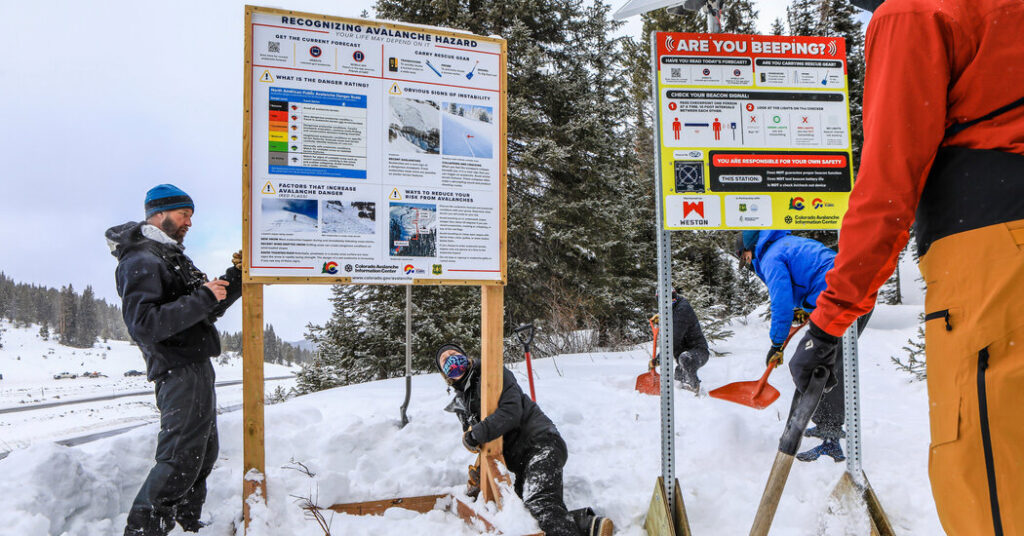
The deep, powdery snow and rugged terrain of the backcountry attract skiers, snowboarders and snowmobilers. But wild ranges and slopes also carry the risk of avalanches. This week, the perils of the winter befell a broad swath of the Sierra Nevada in California, as rapid snowfall teamed up with strong winds to blanket an area near Castle Peak.
Forecasters had warned of avalanche conditions in the northern Sierra amid heavy snow and strong winds. In the 48 hours leading into the morning of Feb. 17, nearly three feet of snow had accumulated.
A group of 15 people, including four guides, was caught in an avalanche. Six of them were rescued, while nine others remained missing as searches spilled into the next day. The slide could become one of the deadliest avalanches in the United States in decades.
Here are some things to keep in mind if you’re heading into the backcountry.
Check conditions and be aware of risks.
Advance knowledge of conditions is crucial. Even experienced backcountry enthusiasts can get caught in potentially deadly conditions, which can be hard to predict. A person can trigger the slide of weak snow by walking, skiing, snowshoeing, snowmobiling or snowboarding.
Avalanches kill 25 to 30 people in the United States each winter, according to avalanche.org, a partnership between the American Avalanche Association and the U.S. Forest Service National Avalanche Center.
In the 2025-2026 season so far, at least six people, some on snowmobiles, skis and snowboards, died in avalanches, according to the Colorado Avalanche Information Center.
One of the most dangerous years for avalanches came in 2021, when skiers, snowboarders and snowmobilers sought a reprieve from the stresses of the pandemic and headed off into the backcountry of the Salt Lake and Uinta regions. At least 26 people died in avalanches in the United States, compared with 23 deaths in the previous season, the Colorado Avalanche Information Center said.
That winter, the Utah Avalanche Center’s map of risk indicated there was “extreme” danger of certain natural and human-triggered avalanches.
Heavy snowfall early in the season was followed by a long dry spell, leaving a “sugary” base of weak snow, under feet of powder from snowstorms.
“No matter what your experience level is, it’s very easy to get caught off guard,” Chad Brackelsberg, executive director of the Utah Avalanche Center, said in an interview in 2021.
Get trained in avalanche safety.
Many avalanche centers offer virtual educational programs, such as the Utah center’s Know Before You Go online modules. But they are no substitute for a class that is on the snow.
In-person avalanche classes, such as those using curriculum from the American Institute for Avalanche Research and Education, teach people how to identify potential hazards in the backcountry — like a weak snowpack — and how to recognize avalanche terrain, among other skills. The institute maintains a list of the classes, which are mostly provided by private outdoor guide companies.
Get the right equipment, and learn how to use it.
Avalanche safety experts agree that anyone going into the backcountry should carry a shovel, a beacon and a probe. There are different types of safety communication devices. One type of beacon emits a radio signal and allows other people to find you, should you be caught in an avalanche. A collapsible metal probe can be used to poke through the snow to locate someone buried, who can then be dug out with a shovel.
Avalanche bags, another survival tool, deploy like large airbags, giving users some breathing room amid snow and debris and helping them stay near the surface of the snow. They can be powered electronically or by a canister of compressed air.
But simply having the right gear isn’t enough to head into the backcountry safely. In addition to taking an avalanche course, “practicing and training on your own,” Mr. Brackelsberg said, “is critical.”
A “beacon training park” created in 2020 in the White River National Forest near Minturn, Colo., has beacons buried in the snow that can be turned on by a control panel, allowing trainees to simulate searching for someone with a beacon.
Decide when, and whether, to venture out.
People should check the local avalanche forecasts every day — not just the days they plan to go into the backcountry — to become familiar with avalanche conditions in the area, Mr. Brackelsberg said. That and other factors such as skill level and conditions will help inform whether to go into the backcountry, to ski inbounds at a resort or to just stay home.
In 2021, Mr. Brackelsberg said that the Utah Avalanche Center had seen an “unprecedented” level of activity on its website, which posts daily forecasts.
Christine Hauser is a Times reporter who writes breaking news stories, features and explainers.
The post What You Need to Know About Avalanche Safety in the Backcountry appeared first on New York Times.