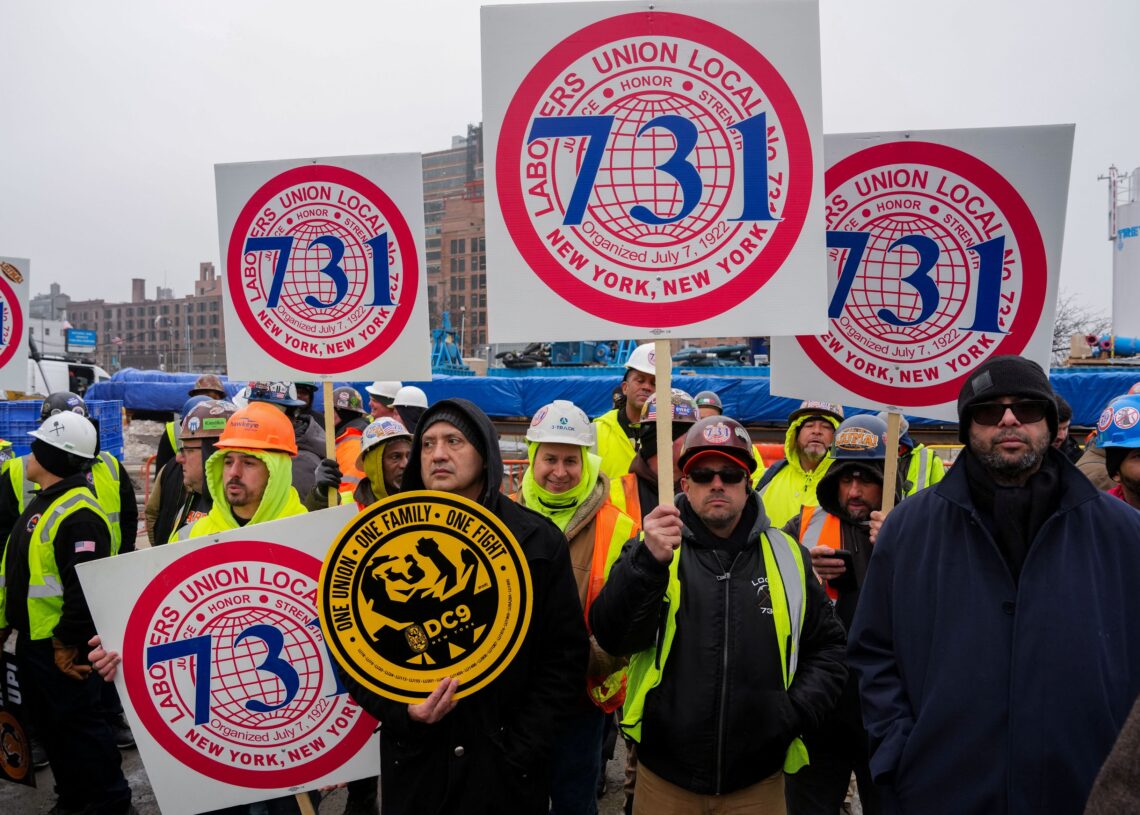
The share of American workers in unions edged up in 2025, the first rise in years despite the Trump administration’s attacks on federal government unions and the agency that enforces collective bargaining rights.
Union membership increased by a tenth of a percentage point to 10 percent last year, because of successes in union organizing and slower labor market growth.
About 14.7 million workers were union members in 2025, an increase of 410,000, according to data released by the Labor Department on Wednesday.
Meanwhile, the number of workers represented by unions rose to the highest level since 2009. That figure, which represents workers covered by union contracts generally, is higher than union membership numbers, because some workers opt out of membership in unionized workplaces, even though they receive the benefits of a union contract.
Last year’s union gains coincided with numerous actions by the Trump administration aimed at weakening organized labor’s power. President Donald Trump stripped millions of federal workers of their collective bargaining rights and canceled federal union contracts. He also fired a member of the National Labor Relations Board without cause, for the first time in the agency’s 90-year history. For most of the year, the board lacked a quorum necessary to consider cases alleging violations of the National Labor Relations Act.
Despite the attacks on federal government unions, union membership in the public sector grew in 2025 and continued to be about five times higher than the private sector, at 32.9 percent. That boost came, in part, from a rise in union membership in the federal government, as tens of thousands of civil servants joined unions amid attacks on their jobs from the Trump administration.
“Even in our current broken system of labor law and policy … we’re seeing this increase in union density,” said Celine McNicholas, director of policy and government affairs at the left-leaning Economic Policy Institute. “It’s clear that workers want union and are winning unions.”
Health care, retail, education and construction also posted strong gains in union membership. Meanwhile, some traditional blue-collar industries — including manufacturing, mining and transportation — saw declines in union membership.
Among major racial groups, Black workers continued to have the highest rates of union membership in 2025, at 11.4 percent, compared to 9.9 percent for White workers.
Union membership had hit an all-time low in 2023 and again in 2024, despite efforts by President Joe Biden to expand union workers’ power. That’s partly because millions of nonunion jobs were created coming out of the pandemic as the economy reopened. But in 2025, the labor market grew at its slowest pace outside of recessions since the early 2000s.
Declines in union membership across the United States have been attributed to the shift toward a service-based economy, the influx of right-to-work laws and employer opposition to unions. Support for unions has soared over the past decade and was at 68 percent in 2025, near levels not seen since the 1960s, according to Gallup polling.
The post Union membership edged up in 2025 despite attacks from Trump administration appeared first on Washington Post.