Behind the high-profile speeches about shared values and strategic interests at the Munich Security Conference last weekend, a different, more profit-oriented set of conversations was taking place. At breakfast, a German official advised a French defense contractor on how to get into business with the military in Berlin. At lunch, a senior executive for a major Asian arms manufacturer ticked off for his table mate the advantages his company has over European and American competitors. In the crowded halls of the Bayerischer Hof hotel, which hosted the conference, American defense contractors were everywhere, networking in search of deals.
A bristling military buildup is gaining momentum in Europe and everyone is trying to get a piece of the action. It’s a race for real money — Germany alone plans to double its military spending by 2029 to as much as $190 billion per year.
But European rearmament is more than a business story. Something bigger that is underway. Whatever the difference, if any, between the good cop routine delivered at Munich this year by Secretary of State Marco Rubio and the bad cop version by Vice President JD Vance at the event last year, the effect of American policy is the same: The world is changing, for real, and the primary driver of that change is Donald Trump.
It took a long time for many Americans to realize just how disruptive Mr. Trump is, but by now it is painfully obvious. The United States is in many ways unrecognizable from what it was 10 years ago when he was first elected. During his first term, Mr. Trump latched onto real, longstanding problems like a broken immigration system, deindustrialization and increasing economic inequality that politicians on the left and right had identified but failed to fix. After failing to fix them himself, Mr. Trump’s second-term answer has been an increasingly brazen attack on the rule of law, civil liberties and constraints on the presidency.
Now, as is often the case with second-term presidents, Mr. Trump is turning his attention abroad. He is determined, he says, to tackle old problems like China’s trade cheating, the Iranian nuclear program and countries that don’t spend enough on their militaries. The outlines of Mr. Trump’s international disruption are already clear: the collapse of multilateralism, a shift away from the liberal democratic values established after World War II and an embrace of a might-makes-right approach to national security. Those may sound like abstractions, but the changes they engender are just as likely to be felt on the streets of America as Mr. Trump’s domestic upheavals.
For all the complaints about the Trump administration at Munich — and there were plenty — even Democrats admitted behind the scenes that some good is coming of Mr. Trump’s foreign policy approach. After years of trying, America will not only get a fairer division of the costs of NATO from Europe’s rearmament, but a more dynamic defense industry for the alliance that can innovate at a time when the nature of war is changing fast.
The effects go beyond Germany. Britain and France are also scaling up their military spending. Japan is increasing its defense budget. South Korea is doing the same and is even building up shipyards and other facilities in the United States.
Ideally, all that activity would free the United States to invest in the kinds of new weapons and capabilities that it needs to deter Chinese expansionism in the Indo-Pacific. But as Americans have learned, Mr. Trump’s cure for long-running problems is often worse than the disease.
Mr. Trump’s embrace of far-right nationalists across Europe, for example, casts German rearmament in a particularly troubling light. One former European ambassador to NATO worried about what would happen if a remilitarized Germany fell into the hands of the far-right Alternative for Germany party, some of whose leaders are Nazi apologists and which leads in some national polls. One reason for the French and British military buildups is their alarm at Germany’s rise, and what it might mean for their security.
At the same time, Mr. Trump’s erratic behavior is driving non-nuclear countries to look for protection outside the American nuclear umbrella. Germany’s chancellor, Friedrich Merz, is in early talks with Paris about receiving protection from France’s nuclear arsenal. Poland and the Baltic States have already embraced such talks with France. Nuclear proliferation was long considered a nightmare scenario: Now even Japan and South Korea are talking about possibly acquiring nuclear weapons, albeit only notionally.
Much of Europe now believes that America no longer shares either its values or its interests. Mr. Rubio’s speech was softer in tone that Mr. Vance’s but after a year of attacks, including Mr. Trump’s effort to take Greenland, words have limited value.
That deepening sense of alienation is already undercutting America’s goal of constraining China. On tariffs, national security and digital security, the Europeans and Canadians are increasingly going their own way with China and other Asian powers. The European Union and the largest Indo-Pacific trading bloc, the Trans-Pacific Partnership, are in early talks about cooperating in the face of Mr. Trump’s tariff policies.
It may also affect success or failure of Mr. Trump’s next challenge: Iran. Speaking to reporters in Munich, Mark Warner of Virginia, the ranking Democrat on the Senate Intelligence Committee, listed a number of ways Europeans could help America in Iran, but aren’t, from intelligence sharing, to pressuring Tehran to cut a deal, to smuggling in Starlink satellites to help dissidents safely communicate. “We really need our European partners, many of which still have relations with Iran, to ratchet up pressure,” Mr. Warner said.
There is a better way to address America’s long-frustrated goals abroad. Tariffs could be structured to reward those countries that align their pressure policies against China with America’s. Rebuilding trust around shared values like human rights, the rule of law and multilateral agreements would make it easier to hang together on intelligence sharing and pressuring adversaries. European rearmament would be less destabilizing if the United States weren’t openly backing far-right candidates.
As American politicians begin considering their foreign policy positions ahead of the 2026 and 2028 elections, it’s worth noting that there’s broad consensus for these ideas not just among Democrats but among Republicans, too. Now that Mr. Trump has set his sights on breaking the international system, the candidates have an opportunity to rebuild it for the preservation of American interests — and values.
That’s not where we’re headed in the short term. Mr. Trump is a wrecking ball and he’s only getting started. It’s not clear he has entirely lost his appetite for taking Greenland from Denmark. Mr. Trump could sell out Taiwan for domestic political interests when he meets with the Chinese president Xi Jinping in April. Mr. Trump may cave to those hawks, like Senator Lindsey Graham, who are pushing hard for regime change in Iran. Mr. Rubio’s moderate tone in Munich is easily undone.
Finding consensus on how to rebuild America’s alliances isn’t just a political opportunity — it’s a necessity. These are not problems that are going to stay abroad. Military competition between powers in Europe drew the United States into two world wars in the previous century and Americans will feel the cost of going it alone against China in their bank accounts.
As we lose our alliances and instability spreads, America is headed for more, not fewer, international entanglements. That may be a surprise for those who thought Mr. Trump was going to be an “isolationist.” They, and his opponents, should all start working on how to limit that damage and pick up the pieces.
Massimo Calabresi is an Opinion editor at large.
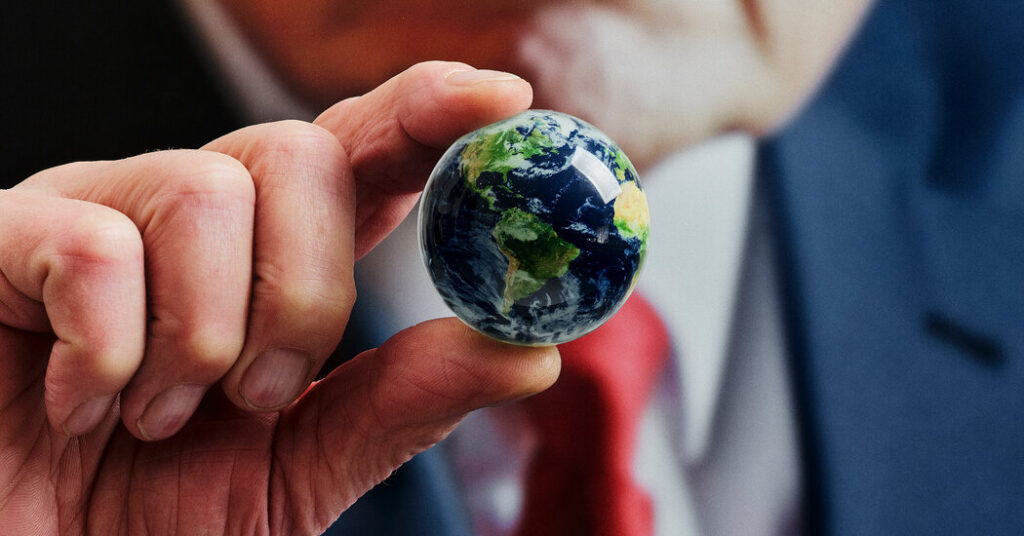
Source photograph by Damon Winter/The New York Times.
The Times is committed to publishing a diversity of letters to the editor. We’d like to hear what you think about this or any of our articles. Here are some tips. And here’s our email: [email protected].
Follow the New York Times Opinion section on Facebook, Instagram, TikTok, Bluesky, WhatsApp and Threads.
The post Trump Has Changed America. Next Up, the World. appeared first on New York Times.