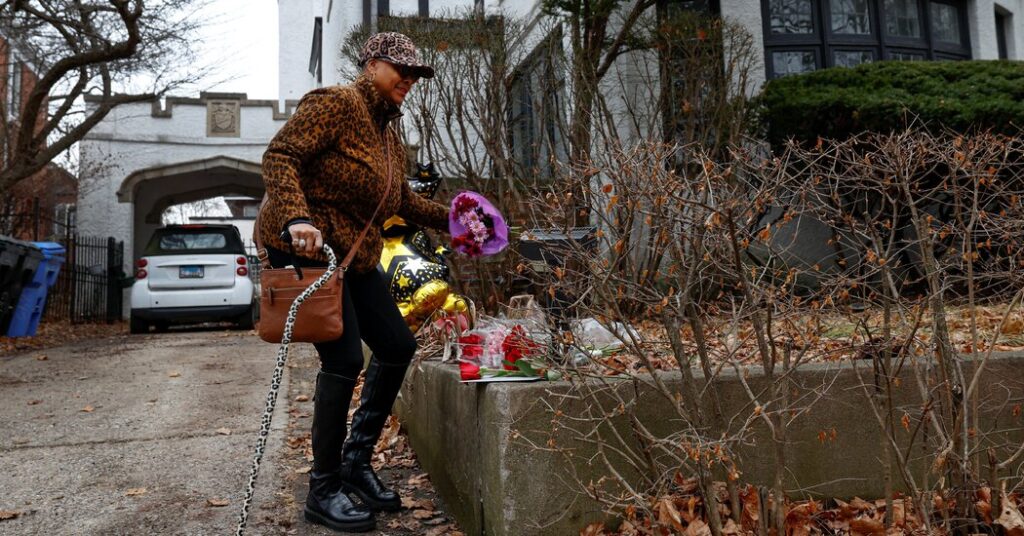
By the early afternoon on Tuesday, mourners had left around half a dozen bouquets of flowers and a few balloons outside of the Rev. Jesse Jackson’s Tudor-style house on Constance Avenue in the South Shore neighborhood.
Next door, Junelle Speller said she had bought her home because she fell in love with the house, but living beside Mr. Jackson was a wonderful bonus. “It was always surreal for us to be living next door to a civil rights icon, someone my husband and I both studied in school here in Chicago,” Ms. Speller said.
Despite Mr. Jackson’s larger-than-life persona and soaring oratory skills, Ms. Speller soon discovered that in person the civil rights leader “was very grounded, very down to earth, approachable, personable and vibrant.”
“He had a deliberate but very inspirational way of speaking,” she said. “You’d be kind of awestruck. But he was at your level, meeting you and sharing those stories, providing motivation for this period of time, for the African American community.”
Anita O’Neal, 67, stopped by the Jackson home and showed reporters gathered outside the house a wrinkled photo of herself from 1968. She was 11 years old in the picture, wearing a prim, white outfit for a flight from Chicago to Cape Girardeau, Mo.
Sitting in a seat and looking up at her is a young Mr. Jackson, who at the time was a protégé of the Rev. Dr. Martin Luther King Jr.
Ms. O’Neal said she had come to appreciate the experience only later on in life. “ I read about who he was and understood who he was. It was quite an honor for me,” she said.
Ms. O’Neal recalled Mr. Jackson’s quieter side. When he would attend services at St. Sabina Church in the Auburn Gresham neighborhood on Chicago’s South Side, he wouldn’t draw attention to himself, she said.
“He wouldn’t come with fanfare,” she said. “He would just walk in, walk down the center aisle, and just go on and sit down.” The pastor, Michael L. Pfleger, would introduce him, she recalled, but Mr. Jackson “didn’t want any recognition. He was there for service.”
Joy Jones, 66, said she had come straight to Mr. Jackson’s house after working an overnight shift at a hospital in the Bronzeville neighborhood on the city’s South Side. Still dressed in her purple scrubs, said she hoped someone would follow in Mr. Jackson’s footsteps just as Mr. Jackson picked up Mr. King’s fight for civil rights after his assassination.
“I’m praying that someone will stand up and will continue the movement forward,” Ms. Jones said. “Because it seems this administration is trying to make us take some steps backward, but I really hope that someone — male, female, someone — will stand up and say, ‘We’ve got to keep moving. We’ve got to keep going.’”
Among the other Chicagoans who dropped by to pay their respects was Delores Brown, who set down a bouquet of flowers next to the small shrine that had been growing on the Jackson family’s front lawn. He had been a role model, she said, for people in the South Side community where she lived, especially for young Black men.
“He’s also been a person that has spoken for us on so many levels when we were not able to speak for ourselves,” she said.
The post To a Resident on the Block, Jackson Was Simply a Friendly Neighbor appeared first on New York Times.