It’s one of the defining dilemmas of our time: Birthrates are falling, and Western countries increasingly depend on immigrant labor. At the same time, there is a backlash against immigrants at the ballot box, prompting not just populists but many mainstream parties to restrict the number of immigrants and step up deportations.
But one country is doing something different: Spain is giving hundreds of thousands of undocumented migrants the opportunity to stay and work — and so far at least, it has avoided a massive backlash. Today my colleague Amanda Taub explains why.
Spain’s immigration fix
By Amanda Taub
Few topics are more politically charged than immigration. Although many countries face shrinking work forces, accepting large numbers of immigrants risks voter backlash and political instability.
The result: Many wealthy countries are working to keep immigrants out, even as central bankers and economists urge more immigration to supplement the labor supply and increase tax revenues.
That’s a seemingly intractable dilemma. But Spain, which has one of the lowest birthrates in Europe and a shrinking native-born work force, may have found a way through that impasse.
Last month, its center-left government said it would give hundreds of thousands of undocumented migrants a path to obtain legal status.
“Migration is the only way forward,” Borja Suárez Corujo, Spain’s secretary of state for social security and pensions, said in an interview. “If we want our society to maintain and to make progress, we do need people for that.”
The center-right Popular Party, however, said the policy would overwhelm public services. A spokeswoman for Vox, Spain’s far-right party, said it “attacks our identity.”
Changing policy could still be a gamble in a country where Vox’s support in the polls has risen from zero to nearly 20 percent in the last decade.
But Spain’s government has drawn on a broad societal coalition, including many business leaders and the Roman Catholic Church, to enact a policy that has become politically unthinkable in the United States and many other rich countries.
Avoiding triggers
Spain has long allowed undocumented immigrants to gain legal status within a few years of arriving if they could prove they had roots in the community via employment, family or social ties. Citizens of many Latin American countries have been able to travel to Spain on visa waivers or tourist visas, and then stay.
Since 2019, nearly 40 percent of all new jobs in Spain have been filled by immigrants, according to government statistics.
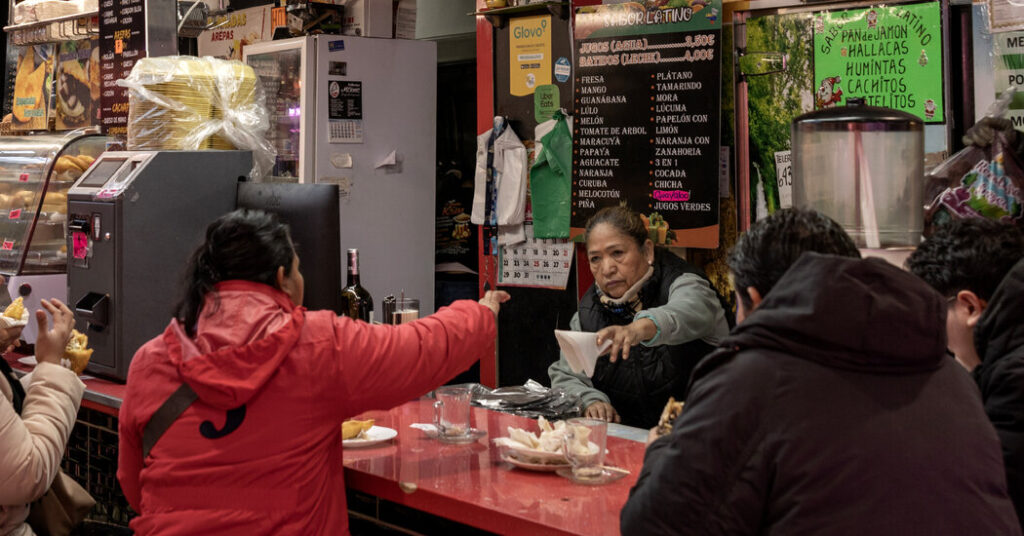
“We came to Spain to work, not to ask for handouts or depend on anyone, ” said Marita González, 35, who arrived from Peru as a tourist with her two daughters and stayed. “We need to work, and for that we need papers.” Today, she earns 750 euros a month caring for two older adults.
Spain’s relatively liberal immigration policy, including the recent amnesty, avoids some of the biggest triggers for anti-immigrant sentiment.
Data from More in Common, a political research group studying polarization in the U.S. and Europe, suggests that public support for immigration is often predicated on two things: People must believe that immigration is under control, and that immigrants are contributing to the economy and national interests.
The government and pro-immigration campaigners have framed the new amnesty as a “pro-law” measure that will bring more immigrants into the formal economy, where they will pay taxes and be subject to legal obligations.
The perception of control
The data from More in Common shows that when people feel that their borders are not secure, support for immigration falls. In the U.S., the perception that President Biden lost control over the southern border fueled hostility toward immigration, said Tim Dixon, the group’s C.E.O.
The way that undocumented migrants enter a country matters a lot for public opinion. The vast U.S.-Mexico border can create fears of uncontrollable immigration when crossings surge.
Unlike the U.S., Spain has relatively low numbers of asylum seekers who cross land or sea borders without authorization. Undocumented migrants tend to arrive legally as tourists on visa waivers, and then overstay. That avoids provoking the sense that the borders are uncontrolled, because the government could close that pathway at any time.
Activists say Spain’s warm welcome doesn’t extend to many Africans even while acknowledging that Spain is an outlier on a continent closing its doors. It finances, equips and trains Morocco and other countries to stop migrants before they reach Europe via the Canary Islands, and has heavily fortified crossings in Ceuta and Melilla, two Spanish cities in North Africa.
Could it work elsewhere?
Spain has some unique attributes, particularly its large pool of potential immigrants in Latin America who share its language and religious heritage. But its framing of the immigration debate around the public’s need for order suggests a template that could travel widely.
One big lesson: If people feel confident that the government has its borders under control, they will often accept high levels of immigration. “When they feel that control has been restored, then they normalize,” Dixon said.
Australia set up offshore detention centers for asylum seekers, provoking criticism from other countries. But once the public became convinced the government was in control of its borders, sentiment shifted, Dixon said. Today, more than 30 percent of the Australian population was born overseas.
Given its connection to Latin America, Spain has an advantage that is difficult to replicate. But Dixon believes its strategy — demonstrating control over borders while making the economic case for immigration — may offer a solution to a knotty problem that is shared by nearly every wealthy nation.
MORE TOP NEWS
U.S. diplomacy without diplomats
President Trump’s most trusted envoys — his real estate friend Steve Witkoff and his son-in-law Jared Kushner — are at the center of negotiations on Iran and Ukraine. It’s a strategy of “diplomacy without diplomats,” my colleagues David Sanger and Anton Troianovski wrote.
In Geneva on Tuesday, Witkoff and Kushner held indirect nuclear talks with Iranian officials in the morning before sitting down with the Russians and Ukrainians in the afternoon. A second day of talks yesterday, which they did not attend, ended after only two hours, indicating a lack of progress.
On another diplomatic front, Trump’s “Board of Peace” will have its inaugural meeting in Washington today, where its officials hope to finalize a demilitarization plan for Gaza.
Emptied ISIS sites in Syria
My colleagues this month visited Shaddadi prison that held Islamic State fighters and the sprawling Al Hol camp that housed the families of ISIS fighters — more than 20,000 women and children.
They found that Shaddadi was deserted. In Al Hol, entire sections of the camp appeared uninhabited. The system of high-security prisons and camps in the northeast was upended last month when Syrian government forces seized territory there from the Syrian Democratic Forces, or S.D.F. The Kurdish-led S.D.F. had worked for years with a U.S.-led coalition to combat ISIS and guard camps and prisons.
In the chaos, ISIS helped some of its members break out of the prison and the camp, according to a researcher. Other detainees may have been evacuated to camps in other parts of Syria. Here’s what else happened to the ISIS inmates.
OTHER NEWS
-
Trading of Japanese government bonds is roaring back to life as fears of the country’s debt have sent yields surging.
-
Saudi Arabia’s state-backed A.I. company, Humain, said that it had invested $3 billion in Elon Musk’s xAI.
-
Eight out of nine skiers missing since Tuesday were found dead after what has become the deadliest avalanche in modern California history.
-
South Sudan appointed a dead man to a panel meant to prepare for long-delayed elections.
WHAT ELSE IS HAPPENING
-
Zohran Mamdani, New York City’s first Muslim mayor, ushered in a new tradition: Ramadan in City Hall.
-
Top of The World: The most clicked link in your newsletter yesterday was about the Chinese-made Labubu toy.
WINTER OLYMPICS
Skiing: Mikaela Shiffrin took gold in the women’s slalom, her last event, ending her Olympic medal drought.
Hockey: Canada narrowly beat the Czech Republic 4-3 in overtime, and the U.S. faces Sweden. Follow the game live.
Skimo: Ski mountaineering, an endurance sport that involves climbing uphill before racing down, makes its debut at the Games today.
NUMBER OF THE DAY
0.04 seconds
— That’s the slim lead that allowed the American skier Breezy Johnson to beat Emma Aicher of Germany for the gold medal in women’s downhill. At the Winter Olympics, the difference between a gold and a silver medal can be razor thin. See how Johnson pulled ahead.
MORNING READ
The highway that links Kabul and Kandahar used to be among the most dangerous roads in Afghanistan — littered with bomb craters and trenches. But on a recent road trip between the two large cities, my colleagues encountered only order and security. And not a single pothole.
In the four years since the Taliban returned to power, they have worked to strengthen security on the road, Highway 1, expanding it with two extra lanes and strictly enforcing weight limits on trucks to preserve the new asphalt. Some of the damage from generations of war is beginning to fade. Take a look.
AROUND THE WORLD
A culinary triumph in Botswana
Tshephiso Marumo runs two food stalls in Botswana’s capital, Gaborone, that have become a hit by serving traditional village cooking. Her venture has turned the unglamorous work of roadside food vending into something fashionable: She now has a large social media following and prominent customers, including politicians, musicians and influencers.
Yet the same qualities that have aided Marumo’s rise — persistence, candor and stubbornness — have also made her an increasingly outspoken and divisive figure. She feels compelled to speak about women’s issues because of her own experience overcoming obstacles, she said. Read more.
RECOMMENDATIONS
Watch: Don’t expect tired Irish stereotypes in “How to Get to Heaven From Belfast,” the new show from the “Derry Girls” creator Lisa McGee.
Listen: Enjoy Beatles covers by Black artists, including Little Richard and Ella Fitzgerald.
Prep: Here are tips for a speedy approach to breaking fast this Ramadan.
Admire: A Norwegian surfer’s house was restored to its midcentury origins without sacrificing modern comfort. Take a look.
RECIPE
Try this standout fish recipe from the chef Yotam Ottolenghi to brighten Lent, which began yesterday. He simmers pearl couscous in a spiced tomato base until it develops a crispy bottom, much like a tahdig does, before gently steaming sea bass fillets on top and finishing with a Cantonese-inspired flourish of hot garlic oil.
WHERE IS THIS?
Where is this walking path?
TIME TO PLAY
Here are today’s Spelling Bee, Mini Crossword, Wordle and Sudoku. Find all our games here.
You’re done for today. See you tomorrow! — Katrin
Amanda Taub was our guest writer today. José Bautista contributed reporting from Spain.
We welcome your feedback. Send us your suggestions at [email protected].
Katrin Bennhold is the host of The World, the flagship global newsletter of The New York Times.
The post The Country Betting on Immigrants appeared first on New York Times.