Republicans are brawling, Democrats are dreaming of being competitive and money is pouring in.
It must be election season in Texas.
Indeed, we are now less than two weeks out from the first major Senate primary contests of the year. In recent days, both the Republican and Democratic Senate primaries in Texas have kicked into high gear, so it seems like a good moment to take stock of the races as early voting gets underway.
Let’s start with the Democrats, who have spent the last three decades losing at the statewide level — but who can’t help hoping that this year, in this environment, against the right Republican opponent, could be different.
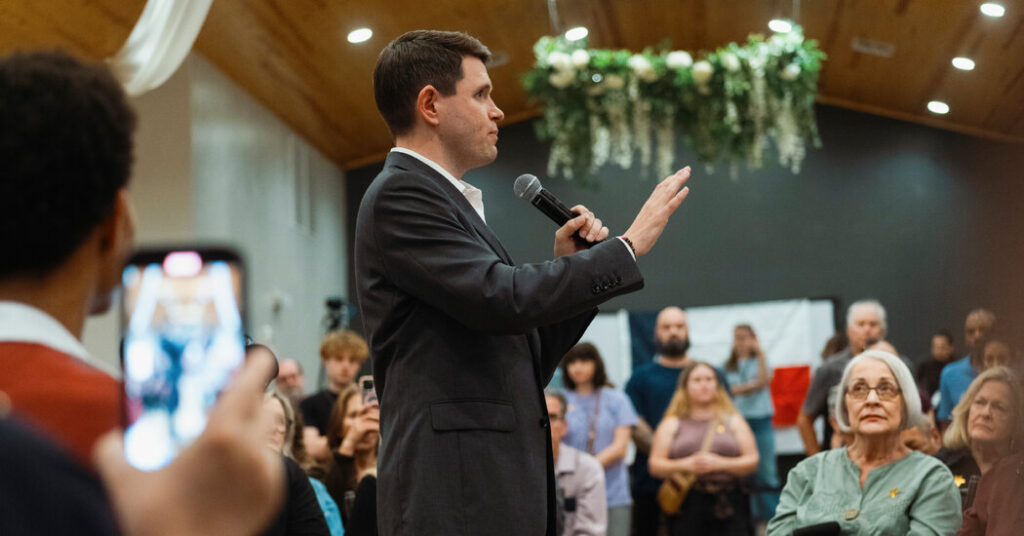
State Representative James Talarico, a Democratic candidate for Senate, made national headlines this week thanks to Stephen Colbert.
Colbert said on his late-night show that his network, CBS, stopped him from airing an interview with Talarico because of Trump administration guidance about equal airtime for political candidates. CBS contested this account.
But one thing is indisputable: The dust-up turned Talarico into a national Trump foil at a critical moment in the race — and Democratic activists love nothing more than a candidate at odds with the president.
Talarico’s team announced on Wednesday that his campaign had raked in “$2.5 million in a 24-hour period after his censored ‘The Late Show’ appearance — marking the largest fund-raising day of his entire campaign.”
It’s a dose of momentum just as voters are really tuning in — something his chief opponent, Representative Jasmine Crockett, seemed to acknowledge in an interview on MS Now.
“It probably gave my opponent the boost he was looking for,” conceded Crockett, who has separately also suggested that there is more to the story than Colbert’s account indicated.
But asked if she had had any problem with the prospect of the Talarico interview airing, she said she did not.
Spurts of national stardom do not always translate for Texas Democrats, and this contest remains wild, ugly and unpredictable.
Available polling is all over the place. Some surveys show Talarico up, others have Crockett ahead.
Crockett is very popular with Black voters, a crucial part of the Democratic coalition — and she established herself long ago as a Democratic firebrand willing to take the fight to Republicans, sometimes using provocative language to do so. Crockett, a Black woman, has said efforts to question her electability amount to a “dog whistle.”
Republicans are talking about November, too, with Senator John Cornyn warning increasingly urgently that the scandal-tarred Ken Paxton, the Texas attorney general, could hand Democrats a Senate seat and hurt down-ballot Republicans if he unseats Cornyn for the G.O.P. nomination.
(This, by the way, is the Democratic hope — that the hard-right Paxton, with his history of legal troubles, would be unacceptable to enough voters that a serious Democratic candidate could make a credible run for the seat.)
Limited available polling, however, has generally shown Paxton with a lead, even as the Republican establishment and other veterans of state politics, like former Gov. Rick Perry, have gone all-in for Cornyn.
Representative Wesley Hunt is also running and taking a share of the non-Paxton vote.
President Trump, whose endorsement would be meaningful, especially if he went to bat for Cornyn, instead declared this week that “I support all three.”
It seems likely the primary will go to a runoff.
We’ll continue following Texas closely in the lead-up to the March 3 races. In the meantime — for our readers in Texas and beyond — I’d love to hear how you’re thinking about these contests, and if you have a favorite candidate. I’m at [email protected].
Republicans in Congress push for voter ID
The G.O.P., fearing significant midterm losses, is leaving no stone unturned.
The strict voter identification measure that Republicans pushed through the House last week, my colleague Annie Karni writes, is their first step in a broad legislative effort to keep control of Congress and help amplify Trump’s false claims of mass voter fraud in case they lose.
Next up? A “Make Elections Great Again Act,” which would require proof of citizenship to register to vote and give the Department of Homeland Security access to voter rolls.
In One Graphic
The first primary contests for the 2026 midterm elections will happen in early March, but state lawmakers from both parties are still scrambling to redraw maps for the U.S. House of Representatives, where Republicans have a slim majority.
While legal challenges remain, my colleague David Chen has a detailed breakdown of states that have redrawn their maps or taken action to make changes.
Number of the Day
$65 million
That’s how much Meta, which owns Facebook, is preparing to pour into campaigns for state politicians who are friendly to the artificial intelligence industry, beginning this week in Texas and Illinois.
It’s the biggest election investment the tech giant has made to date, driven by concerns that states will introduce legislation to regulate A.I. more stringently and potentially hurt the industry’s bottom line. My colleagues Theodore Schleifer and Matt Zdun have the scoop.
ONE LAST THING
The new fireside chats: Zohran Mamdani videos
Zohran Mamdani, the mayor of New York City, is walking a delicate balance as the city’s “first real influencer mayor,” as my colleague Emma Goldberg put it.
Pivoting from the glossy, whimsical videos that defined his mayoral campaign to serious ones now that he is in office — conveying the gravitas of issues like the city’s multibillion-dollar budget gap and fear of an impending immigration crackdown — is a challenge.
But all across the city, from Y.M.C.A.s to homeless drop-in centers, Emma reports that the steady stream of videos is finding an audience.
Taylor Robinson and Ama Sarpomaa contributed reporting.
Katie Glueck is a Times national political reporter.
The post Texas Election Season Is Getting Spicy appeared first on New York Times.