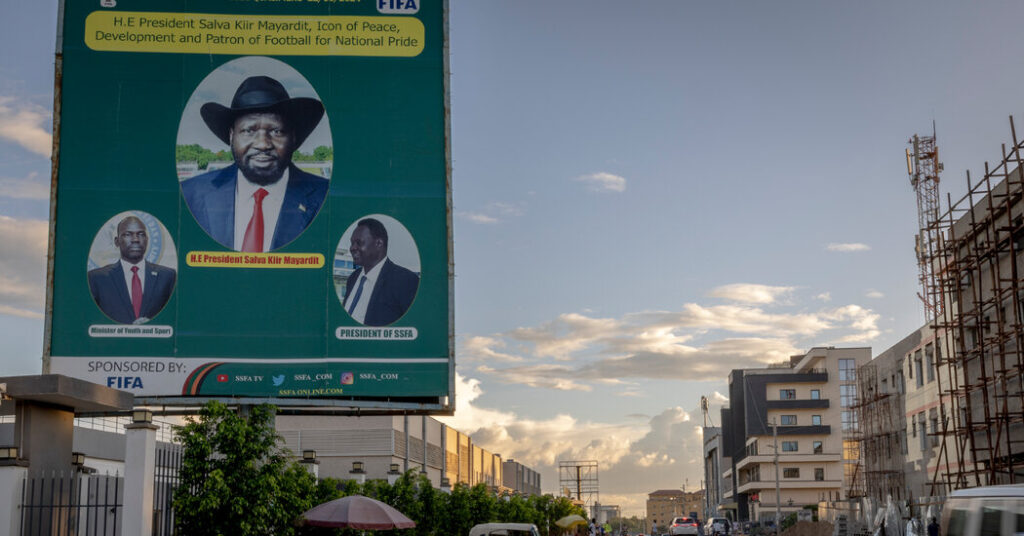
When President Salva Kiir of South Sudan announced a panel to prepare for long-delayed elections in his country, one name stood out.
Steward Sorobo Budia, an opposition politician, was one of about 70 people appointed to the panel last month. But Mr. Budia couldn’t serve on it because he had died five years earlier.
The striking mistake, later corrected by embarrassed government officials, was another sign of the chaos that has enveloped South Sudan in recent months, as Mr. Kiir tries to bolster his beleaguered government while the country slides toward a new civil war.
Mr. Kiir has fired or rotated numerous senior government officials over the past 18 months, some within days of their appointment. He has arrested and put on trial the country’s vice president, Riek Machar, endangering a 2018 peace deal between the two men that underpins South Sudan’s political stability.
Mr. Kiir has also openly clashed with the United States, which accuses his government of undermining peace efforts and sabotaging humanitarian aid.
South Sudan initially tried to placate President Trump, becoming the first country in Mr. Trump’s second term to accept third-country deportees from the United States last summer. Despite that, relations with Washington have deteriorated.
The political crisis in the capital, Juba, has stoked fighting between government forces and Mr. Machar’s supporters in the northeast of the country, particularly in the states of Jonglei and Upper Nile.
As fighting pushed toward Juba in recent months, the military responded with brutal tactics, including an airstrike on a hospital run by Doctors Without Borders on Feb. 3, the aid group said in a statement.
More recently, the government has appeared to push the rebels back, with claims it had recaptured key towns in the northeast.
Critics accuse Mr. Kiir’s government of gross incompetence and say that his authority has become dangerously weak. The episode involving the deceased election official suggested he was “out of touch, relying on outdated information and a shrinking pool of trusted allies,” said Daniel Akech, a senior analyst at the International Crisis Group, a conflict-resolution research organization.
Mr. Kiir’s frequent purges of senior aides have weakened the country’s security apparatus and left him increasingly isolated, and have even led to gunfire on the streets of Juba.
The firing of Mr. Kiir’s powerful spy chief, Akol Koor Kuc, in 2024 was an early sign of the turmoil. In November, Mr. Kiir also fired another vice president and his presumed successor, Benjamin Bol Mel, who is under U.S. sanctions.
At the African Union’s annual summit last weekend, President Cyril Ramaphosa of South Africa called on Mr. Kiir to release Mr. Machar, who has been under house arrest for almost a year.
Since September, Mr. Machar has been on trial on treason charges, which his spokesman has called a “political witch hunt.” Mr. Kiir has also fired from his cabinet Mr. Machar’s wife, Angelina Teny, the interior minister and a powerful figure in her own right.
This month, President William Ruto of Kenya tried to revive a moribund peace effort for South Sudan that was based in Nairobi. So far, those efforts have been fruitless.
Until last year, South Sudan’s fragile peace agreement was underwritten by the 2018 deal between Mr. Kiir and Mr. Machar, who are also leaders of two powerful ethnic groups. But elections, delayed since 2015, have yet to take place. And more recently, Mr. Kiir has unilaterally amended key sections of the 2018 deal, which analysts say could endanger it entirely.
Elections are now scheduled for December, but as fighting spreads, analysts say a vote looks increasingly unlikely.
Last year, a United Nations helicopter came under attack from an opposition militia, and a crew member and a South Sudanese general were killed. More recently, hundreds of civilians have been killed in fighting, bringing accusations of war crimes from human rights groups.
The world’s youngest country, South Sudan has struggled with waves of famine, conflict and political turmoil since it achieved independence in 2011 after seceding from Sudan. The United Nations estimates that 280,000 people have fled their homes so far this year, and 40,000 children suffer acute malnutrition.
More than 400,000 people died during the five-year South Sudanese civil war that ended in 2018.
The country’s woes are compounded by the conflict in its northern neighbor, Sudan. South Sudan’s economy is hugely dependent on revenues from its oil fields, but most of that is exported through pipes that cross Sudan, and they have been compromised or cut off during the Sudanese civil war.
Mr. Kiir’s authority has also been challenged by new rebel groups that have threatened to topple him. In the past two months, one such group withdrew from its peace deal with the government.
Wilson Deng Kuoirot, a former deputy military chief, has threatened to start his own group if Mr. Kiir does not resign. The United Nations has warned that incendiary remarks from senior government officials could lead to more atrocities.
Declan Walsh is the chief Africa correspondent for The Times based in Nairobi, Kenya. He previously reported from Cairo, covering the Middle East, and Islamabad, Pakistan.
The post South Sudan Appoints Dead Man to Election Panel, in Sign of Political Crisis appeared first on New York Times.