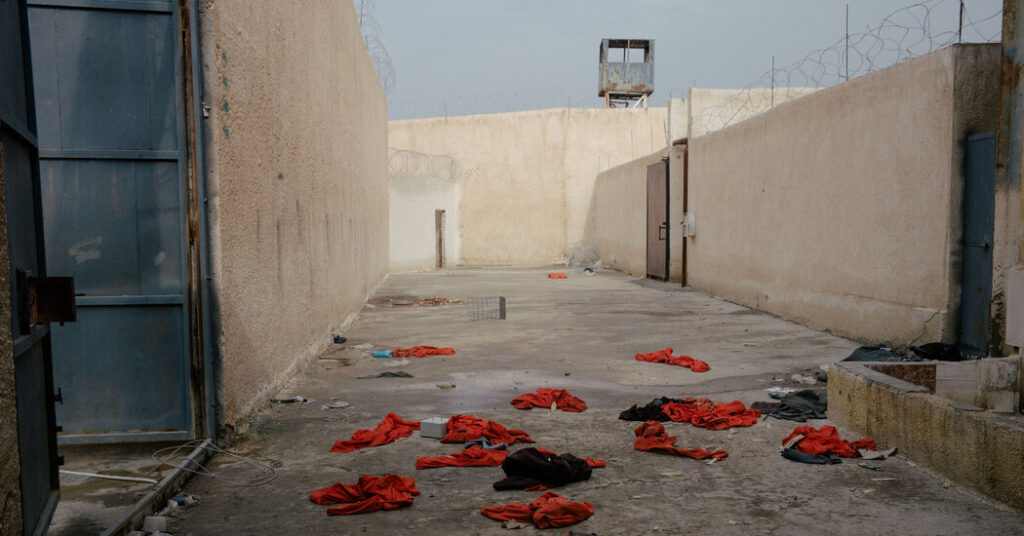
Orange jump suits lay strewed on the ground, dropped in a trail as the prisoners made their escape, the only sign left of the former inmates. The guards’ quarters were abandoned and the prison gates swung in the wind.
The prison break in January just outside the town of Shadaddi in northeastern Syria was a stark example of the sudden change of power that has upended a system of two dozen high-security prisons holding thousands of members of the terrorist group the Islamic State.
In recent weeks, Syrian government forces seized control of a wide swath of territory in northeastern Syria from the Syrian Democratic Forces, or S.D.F., a Kurdish-led force that had worked for years with a U.S.-led coalition to combat the Islamic State and to guard camps and prisons.
The change has now made the problem of the prisoners one for President Ahmed al-Sharaa, testing his commitment to fighting extremism. It has also forced a rapid recalculation by the U.S.-led coalition and many other states of what to do with the thousands of detainees and families held in prisons and camps since the defeat of the Islamic State in 2019.
Shortly after the breakout at Shadaddi prison on Jan. 19, the U.S. military began a complex operation to transfer thousands of adult male detainees to detention facilities in Iraq, starting with those considered the most dangerous.
The Syrian government took control of several prisons and detention camps, including Shadaddi prison and a sprawling camp known as Al Hol, which housed more than 20,000 women and children, some displaced by the war but many of them families of fighters from the Islamic State, also known as ISIS.
A team from The New York Times visited both facilities earlier this month. Shadaddi was deserted. In Al Hol, entire sections of the camp appeared uninhabited, with tents in shreds and a school building in one section abandoned.
The Syrian government has made it clear that it would not continue to run the prison system the way it had been. After it took over Al Hol, it allowed thousands to leave and announced on Tuesday that it had evacuated or relocated the last families from the camp.
“Al Hol includes many families who are not ISIS,” including women and children displaced by the war, Badri al-Masloukh, the deputy governor of nearby Deir al Zour Province, said in an interview. “Keeping them there is not a solution.”
But the government also blamed the S.D.F. for withdrawing from Al Hol without coordinating a handover of the camp. Government forces arrived 10 hours after the S.D.F. had left, which it said created a security vacuum that allowed hundreds of families to escape.
In the chaos, the Islamic State was primed and ready to break out some of its members, according to Bashar Hassan, an independent researcher in Syria who follows the group. The Islamic State had sleeper cells in Syria, but operatives also arrived from Iraq around Jan. 19, apparently to take advantage of the disarray, he said.
“That mess was useful to them,” he said. “The first thing they focused on was seizing weapons.”
Mr. Hassan saw a lot of chatter on ISIS communication channels and media statements, he said, confirmed by his own sources close to the movement. Those who escaped included a woman, known as Um Fahad, who was considered the leader of ISIS families in the camp.
Mr. Hassan showed a reporter posts about Um Fahad’s escape on a private ISIS chat group. “There was a lot of congratulating each other,” he said.
There were also Lebanese families who were known to have been in Al Hol and who were celebrating their return recently on a social media group, he said.
Those early breakouts from Al Hol were aimed at freeing specific families, which indicated a level of planning by ISIS, as did the swift travel of families across the border into Lebanon, Mr. Hassan said.
“How did they reach Lebanon?” he said. “It is more than 800 kilometers, so it indicates that something organized happened. It was not just accidental.”
Aid organizations that worked at Al Hol warned that the sudden mass departure raised a host of security questions, not just about those who had escaped but also about whether some in the Syrian security forces helped open the gates for the detainees.
President al-Sharaa, who led a group affiliated with Al Qaeda in Syria during the civil war, has been accused of harboring extremists and Islamists who sympathize with ISIS in his own ranks. Government officials have denied that, saying that the government has come under attack from ISIS members and that it is sincere in its opposition to the group.
A vast camp, Al Hol is divided into sections, with the annex housing 6,000 women and children who were neither from Syria nor Iraq. The majority were Chinese, Russians and Turks. Aid workers visiting the camp in recent days said the annex had been emptied out.
The government said it was monitoring the families of ISIS fighters with foreign nationalities who had left the camp to head off any potential security threats.
There was a steady flow of Syrian and Iraqi families leaving the camp, helped by a convoy of vans, pickups and buses up until last weekend. A post on an Al Hol chat group on Telegram on Sunday described families camped on the roads begging rides and friends and volunteers helping them return to their families.
One guard said the government had organized what he described as large-scale evacuations of inmates in recent days.
According to him, about 5,000 women and children were evacuated in buses from Feb. 7 to Feb. 9 to camps in Idlib Province in northwestern Syria. Others thought to have links to ISIS were being transported to another camp in Aleppo Province, he said.
Syrian inmates, who include people displaced by the war, were being released if a relative came to vouch for them, he said. One relative was allowed inside to help them pack up their belongings and dismantle their tent, he said.
The guard denied that there was much smuggling of inmates, saying that two smugglers who had tried to take out people had been arrested. The guard spoke on the condition that his name not be published because he was not allowed to talk to the media.
At Shadaddi prison, there were some signs that the breakout had occurred with outside help. The outer camp occupied by guards showed no sign of fighting or violence, but bullet holes on two sets of inner metal gates indicated that people had shot out the locks from the outside.
The Syrian government played down the importance of the breakout, saying it had recaptured all but 20 of the escapees.
The American operation that unfolded in the days after took place under heavy security.
Warplanes circled overhead as American troops in armored vehicles escorted a convoy of five buses from a prison in the northeastern city of Hasakah earlier this month. The buses transferred prisoners to military bases for flights to Iraq, an S.D.F. official said.
Within three weeks the U.S. military said it had moved out 5,700 detainees, starting with those considered “high value.”
The men were to be held in Baghdad and tried under the supervision of the Supreme Judicial Council, Khalid Shawani, the Iraqi minister of justice, said in a statement issued Feb. 12.
The majority of the detainees were not Iraqis but will be tried in Iraq and then transferred to their home countries, he said.
The government also took over control of the Aqtan prison, on the edge of the city of Raqqa, in late January after a days-long armed confrontation with S.D.F. guards. Eventually, the guards were provided safe passage out.
But then families mobbed the prison demanding the release of their relatives inside, just as prisons had been emptied after the fall of the dictator Bashar al-Assad in December 2024.
“Prisons are a sensitive issue in Syria,” said Judge Aboud Saleh Humaidan, the head of a committee of 11 judges sent from Damascus to review the prisoners’ cases. “The hardest thing has been managing popular opinion.”
The judges’ work was hampered by the failure of the S.D.F. to hand over any files on the inmates, Judge Humaidan said. Among the prisoners were a number of people who had been accused of being ISIS members but had not been convicted, the judge said.
The judges released 126 minors found at the prison and several media activists immediately, and were working through the rest, he said.
Eric Schmitt contributed reporting from Washington, and Alissa J. Rubin from Paris.
Carlotta Gall is a senior correspondent, covering the war in Ukraine.
The post Power Shift in Syria Upends an Archipelago for ISIS Prisoners appeared first on New York Times.