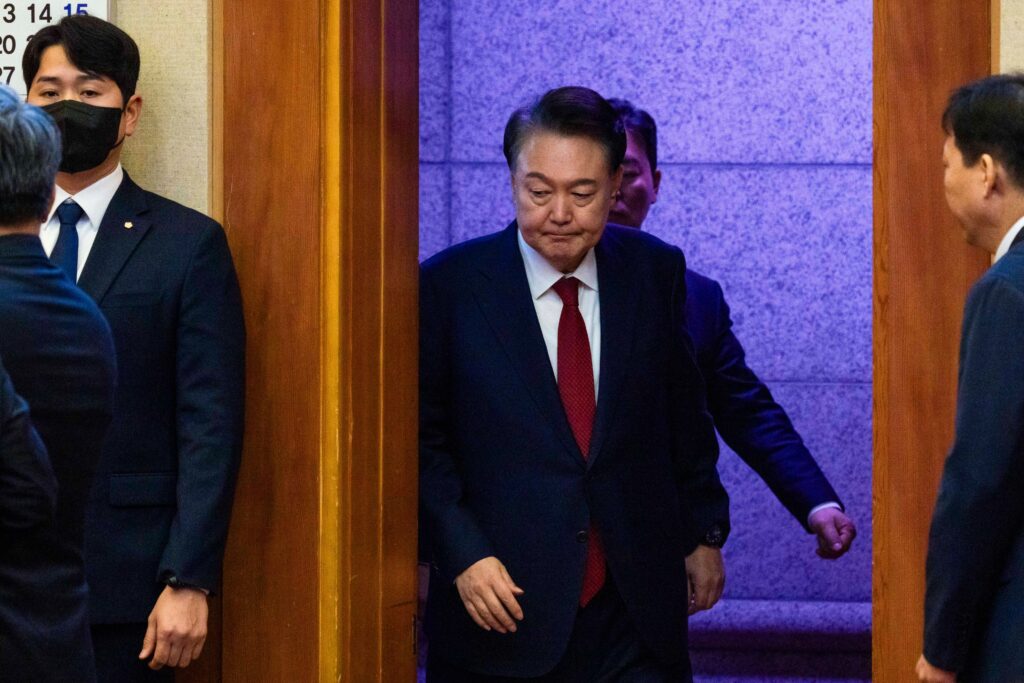
SEOUL — A South Korean court is set to issue its verdict Thursday in the insurrection case against the country’s impeached president, who declared martial law in an alleged power grab in late 2024, and now faces the death penalty or life imprisonment if convicted.
The impeached president, Yoon Suk Yeol, has been on trial for his failed attempt to install a military-led government in the democratic country late one night in December 2024. Yoon is charged with numerous crimes, including organizing an insurrection — which under South Korean criminal law carries possible sentences of life imprisonment, with or without labor, or death.
Prosecutors have requested the death sentence.
The case marks a pivotal moment in South Korea’s relatively young democratic history, which dates to 1987 after a democratic uprising toppled a brutal military-led government under Chun Doo-hwan. Chun was sentenced to death in 1996 after being convicted on similar insurrection charges for seizing power during a coup in 1979. On appeal, the sentence was commuted to life imprisonment, and he was later pardoned.
Yoon’s conviction would uphold the rule of law and reaffirm the nation’s democratic system and principles, democracy advocates and experts say.
“The conviction of an ex-president demonstrates that no one is above the law,” said Andrew Yeo, a senior fellow at Brookings Institution’s Center for Asia Policy Studies in Washington, adding: “The conviction of Yoon through the judicial process reflects South Korea’s democratic resilience.”
If convicted, Yoon, too, ultimately could be spared execution.
South Korea has not carried out an execution since 1997 and is widely regarded as a country where, for all practical purposes, the death penalty is banned.
A death sentence for Yoon, nonetheless, would be highly symbolic as delivering accountability for a head of state who went rogue and attempted to use military force to halt operations of the legislature, seize control of the National Election Commission and arrest political opponents.
“In practical terms, a death sentence would almost certainly remain symbolic, but the symbolism would be immense,” said Hannah Kim, a political scientist at Sogang University in Seoul. “It would reflect a judicial judgment that a ‘palace coup’ led by the constitutional guardian of the state is not just political misconduct, but a direct attack on constitutional sovereignty and the democratic order.”
A lesser sentence of life in prison would still convey the seriousness of Yoon’s actions but would reflect “a degree of pragmatism among the justices,” Yeo said, especially in a deeply polarized country still reeling from the fallout of the declaration of martial law.
Two top aides to Yoon have been convicted on charges related to the decree of martial law. Former prime minister Han Duck-soo was sentenced last month to 23 years in prison for his role. Han is appealing the ruling. And former interior minister Lee Sang-min last week was sentenced to seven years in prison. He is also appealing the ruling, according to national media reports.
In both cases, the court deemed the declaration of martial law an act of insurrection, which legal experts said was a key determination that could seal Yoon’s conviction Thursday.
Yoon is facing eight separate trials stemming from his decree, but the insurrection case to be decided Thursday is the most consequential. Last month, a Seoul court sentenced him to five years in prison for abuse of power, obstruction of justice and falsifying documents, meaning Yoon will not go free even if acquitted.
For many South Koreans, Yoon’s insurrection trial may feel familiar.
Yoon is expected to stand in Courtroom 417 of the Seoul Central District Court, the same room where Chun, wearing a light blue prison jumpsuit, was sentenced to death nearly 30 years ago.
During their sentencing request last month, prosecutors argued Yoon deserved the harshest possible penalty, citing the need to stop “history from repeating itself.” They referred to Chun’s case and South Korea’s authoritarian past.
Yoon has denied all charges and contends that martial law was a legitimate exercise of the president’s emergency powers. Yoon has said that he declared martial law to confront the opposition-controlled National Assembly, which he said was paralyzing his administration through repeated efforts to impeach top officials. He has denied that the brief deployment of troops to the National Assembly was an act of insurrection.
Yoon’s late-night decree on Dec. 3, 2024, made in a televised address, prompted thousands of protesters to mass outside the National Assembly and demand a return to democratic governance.
As soldiers and police surrounded the National Assembly complex, lawmakers scaled the walls to bypass them. In defiance of the decree’s ban on political activity, they voted to reverse Yoon’s decision. And despite a gag order on the press, reporters from traditional and independent media alike flooded the scene and delivered live reports.
Yoon lifted his order six hours later, but the incident shocked and outraged the nation — now a thriving democracy where political protests and marches of all stripes are a weekly occurrence — and it spurred South Korea’s most harrowing political crisis in decades.
Yoon was impeached with his presidential powers suspended less than two weeks later, and ultimately removed from office.
Yoon, formerly the nation’s top prosecutor, was a divisive president during his more than 2½ years in power. Rather than seeking to unify the deeply divided nation, Yoon instead appealed to his conservative base, exacerbating polarization and often deadlocking with opposition lawmakers.
South Korean presidents are often disgraced. Nearly every president since South Korea’s democratization has become embroiled in scandals involving corruption, bribery, embezzlement or abuse of power.
Yoon’s downfall, however, stands apart even by South Korean standards, as the first democratically elected president to impose martial law and the first sitting president to face a criminal investigation.
The post Ousted South Korean president faces death penalty in insurrection case appeared first on Washington Post.