This year’s midterm elections, which will determine control of the U.S. House of Representatives, have ignited a redistricting war across the nation, with several states redrawing their voting maps to give Republicans or Democrats a greater edge.
Partisan redistricting is hardly new in the United States — the term gerrymandering dates to 1812 — but in modern history, it traditionally has not been done in the middle of a decade, and not to this degree.
America often views itself as a model of democracy for the rest of the world. But other democracies have tried to put in more safeguards in place to prevent the kind of redistricting fever taking hold in the United States.
Here’s a quick look at a few things that make other democracies different on this issue — and one country with similarities to the United States.
They rely on independent commissions.
In the United States, where elections and redistricting are governed by individual states, the process for redistricting can vary widely from state to state.
In other countries, redrawing political maps is a responsibility that is typically handled by independent commissions. They are largely run by neutral government employees, not partisan legislatures as in most of the United States.
In Britain, politicians cannot play any role in redistricting. Boundary reviews, the British term for redistricting, are conducted by independent boundary commissions (one for each country in the United Kingdom), which are politically independent, said Charles Pattie, a politics and international relations professor at the University of Sheffield. Any past or present political affiliations effectively rule out the selection of a member of the commission.
Also in other countries, the rules are often established at the federal level, unlike the United States, where everything is handled by the states (though federal courts can overrule a map). So even if redistricting is done by the equivalent of state or local governments, the rules are more uniform.
There tends to be a stronger preference for keeping communities together.
In many countries, even in the United States, the criteria for redrawing maps often includes stipulations about keeping so-called communities of interest together: groups with similar social, cultural, economic or geographic ties, like Latino or Black enclaves.
But other nations tend to keep these communities intact in redistricting more than in the United States. Part of the reason is that in many cases, those countries are less racially diverse. So an entire town or city might be considered a community and not get split into different shapes. In New Zealand, for instance, some seats in Parliament are reserved for the country’s Indigenous population, said Lara Greaves, a political scientist at Victoria University in New Zealand.
The bar for gerrymandering is higher.
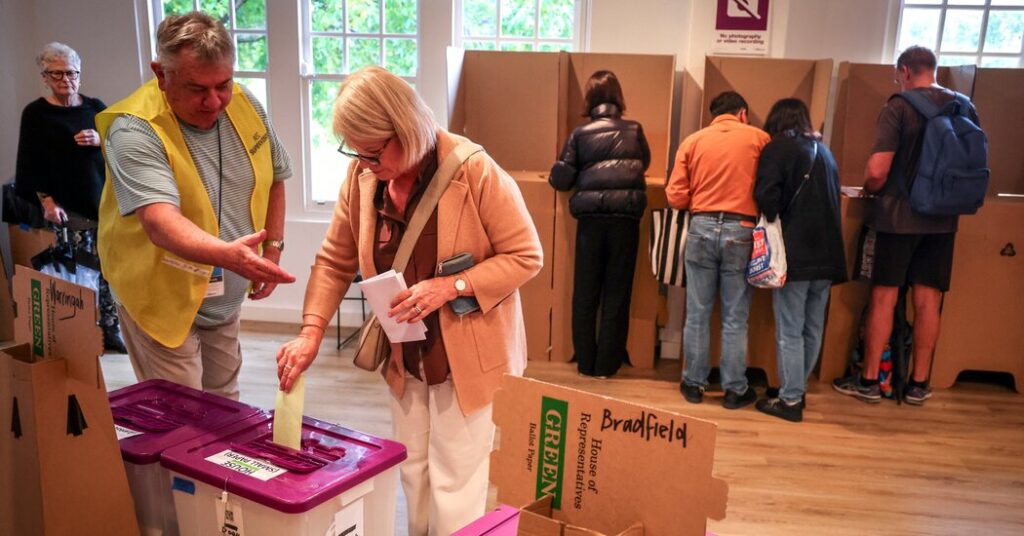
In France and Australia, politicians can still play a small role in the redistricting process, but there are checks and balances to prevent maps from favoring one party or another.
District maps in France are typically redrawn using specific criteria if there are significant changes in population, said Vincent Pons, a French economist and professor at Harvard University whose research examines the foundations of democracy. The ruling power running the federal government, through the interior ministry, is in charge of drafting those changes.
An independent commission weighs in on the changes, which are usually also assessed by a council that ensures that the modifications are in line with the French Constitution. And France’s Parliament has to approve the government’s redistricting changes.
There have been accusations of political bias in past redistricting efforts, but changes to the electoral map in France are usually less overtly partisan than those in the United States.
“You never see in France a government drawing a map and saying, ‘Oh, we’re doing this because we think it’s going to help us win additional districts,’” Mr. Pons said. “This would be like completely unacceptable.”
Other countries’ systems also contain multiple layers of independence. In Australia, an independent elections commission, which oversees the process of redrawing political maps, includes several appointees, like a judge and a statistician, said Antony Green, a renowned elections journalist in the country.
The group first takes suggestions from the public and political parties about the redistricting process. Then a proposed map is drawn, returned back to the public for comments, reviewed again and then submitted as the final boundaries.
They have made adjustments after gerrymandering cases.
Before Canada established the independent commissions it now has, much of the redrawing process was partisan and strongly disliked by voters, said Kelly Saunders, a professor at Brandon University in Manitoba. Before an electoral law was passed in 1964, the political party in power would redraw maps in its favor. This back-and-forth exhausted voters, and eventually, politicians from both sides agreed that the process needed to be nonpartisan.
Now, maps there are redrawn using a formula determined by the country’s nonpartisan chief statistician that shows where population shifts have occurred after the census is complete, and what the electoral districts should be.
That is similar to the process in the United States, which also typically uses census data every decade to redraw its maps. But unlike in other countries, U.S. states retain control of redistricting. Legislatures have different processes and can practically gerrymander at any time.
Hungary is an outlier.
Since 2010 in Hungary, Viktor Orban, the country’s right-wing prime minister, and his allies have won more votes than any rival in every election. And redistricting has played a key role in Mr. Orban’s party winning many more seats, increasing his margins of victory.
Balint Madlovics, a political scientist at Central European University, said that changing boundaries helped Mr. Orban “engineer the supermajority for himself.” This is what authoritarian leaders do, he said. They “want to change the constitutional system to their liking.”
A simple majority in Parliament is all that is needed for Hungarian politicians to change constitutional law and redistricting. And under Mr. Orban, voting districts that had historically leaned to the left were reshaped to include around 5,000 more voters than districts that traditionally leaned right, according to an analysis by a Hungarian think tank. This meant that leftist parties needed more votes to win a seat than the right-wing ruling party did.
Supporters of Mr. Orban, including President Trump, assert that Hungary is a model of successful conservative politics. But the European Parliament, the legislative body of the European Union, said in 2022 that Hungary, one of its member nations, could no longer be considered a full democracy, describing it instead as an “electoral autocracy” in which elections are held but respect for democratic norms is absent.
Patrick Kingsley, Aurelien Breeden and Andrew Higgins contributed reporting.
Christina Morales is a national reporter for The Times.
The post Other Democracies Don’t Redraw Voting Maps Quite Like the U.S. Here’s Why. appeared first on New York Times.