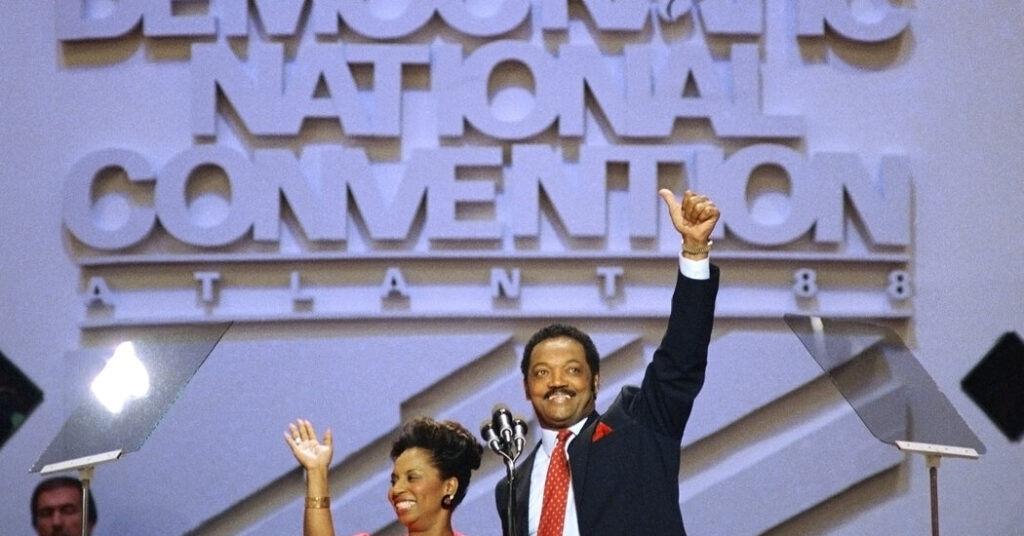
The Rev. Jesse Jackson was in his element when he spoke to a large audience, and his speeches at the 1984 and 1988 Democratic conventions were master classes in powerful, sermon-like oratory that cast a moral spotlight on parts of the party’s base that often felt marginalized or neglected.
At the 1988 Democratic National Convention in Atlanta, his speech moved many delegates to tears. It was a clarion call to take action on social justice issues, as he paid homage to the Rev. Dr. Martin Luther King and recounted his own upbringing in poverty and segregation in South Carolina.
Yet he also called for unity, saying the liberal and conservative factions in the party needed to come together. “Progress will not come through boundless liberalism nor static conservatism,” he said, adding, “It takes two wings to fly.”
He closed his remarks with a chant that would echo in future campaigns, including Barack Obama’s victory in 2008: “Keep hope alive! Keep hope alive! Keep hope alive!”
Four years earlier, Mr. Jackson had delivered another rousing speech with a similar theme at the 1984 convention in San Francisco, coining the idea of a “rainbow coalition.” Having come in third in the primaries behind Gary Hart and Walter Mondale, he argued that the party should expand to include “the desperate, the damned, the disinherited, the disrespected, and the despised.”
“Our flag is red, white and blue, but our nation is a rainbow — red, yellow, brown, black and white — and we’re all precious in God’s sight,” he said. “America is not like a blanket — one piece of unbroken cloth, the same color, the same texture, the same size. America is more like a quilt — many patches, many pieces, many colors, many sizes, all woven and held together by a common thread.”
The metaphor of a patchwork quilt was one he would repeat four years later in Atlanta, after a second-place finish in the primaries behind the Massachusetts governor, Michael Dukakis. He called on different groups — workers, farmers, women, gays and lesbians, Blacks and Hispanics — to work together, saying each group’s issue, their “patch,” was not big enough to prevail on its own.
“When we form a great quilt of unity and common ground, we’ll have the power to bring about health care and housing and jobs and education and hope to our nation,” he said. The delegates gave him a standing ovation.
The convention speeches were only two of many that Mr. Jackson gave in his political life, and many contained the central themes of finding common ground and building diverse coalitions held together by mutual respect.
In a statement on Tuesday, Mr. Obama, who became president with another unifying message, said he had stood on Mr. Jackson’s shoulders. For six decades, Mr. Obama said, Mr. Jackson led some of the most important social movements in the country’s history, adding that “he was relentless in his belief that we are all children of God, deserving of dignity and respect.”
James C. McKinley Jr. is a Times editor in New York who covers breaking news.
The post Jackson’s Convention Speeches in 1984 and 1988 Were Soaring Calls for Social Justice appeared first on New York Times.