PARK CITY, Utah — Let’s get this out of the way at the start. Politics has made Hunter Hess a name at the Milan Cortina Winter Olympics. But it’s proprioception that could gain him a medal.
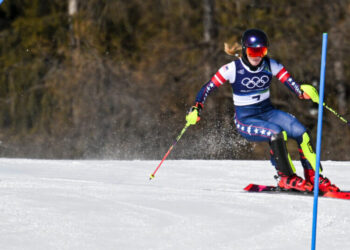
One of the best halfpipe freeskiers in the world, Hess, 27, throws 1620s, double cork 1260s, triple corks and a wild array of other flips, twists, grabs and upside-down or sideways midair tricks — on skis — while whizzing up and down the 22-foot-high walls of an icy halfpipe.
In his first Olympics, he’s considered a strong bet to medal during the men’s halfpipe freeski competition. Qualifying for the event begins Thursday, with finals the next day.
But Hess put his mark on these Games early, in a news conference during the Olympics’ opening weekend, when he and his U.S. Ski and Snowboard teammates talked about representing a riven America. “There’s obviously a lot going on that I’m not the biggest fan of, and I think a lot of people aren’t,” Hess said.
A few moments later he added, “Just because I’m wearing the flag doesn’t mean I represent everything that’s going on in the U.S.”
The reactions back home were swift and split. President Donald Trump called him “a real Loser” on Truth Social. Sen. Bernie Sanders (I-Vermont) tweeted in reply that Hess is “a proud American.”
The bitter partisanship is typical for our times. But it’s ironic for Hess, since, as an athlete, he’s built his entire career around being balanced.
An Olympian’s balance training
“He trains like a maniac.”
That’s Mark Dyer, the athletic development coordinator for the U.S. freeski team, fondly describing Hess. (The Olympics offer three freeski events: big air, slopestyle and halfpipe. All involve high-speed, high-amplitude tricks in a steep halfpipe or on a mountain slope. Hess competes in freeski halfpipe.)
In the summer, Hess runs, uses inline skates and lifts for hours to prepare for the winter season. But the foundation of his training, the building block for his podium finishes — versus tumbling crashes — is balance and proprioception practice.
For those not familiar, proprioception and balance are related but distinct bodily systems. Proprioception is your sense of where your limbs and entire self are in space, even without visual cues. It relies on specialized cellular sensors in muscle tissues and elsewhere that send signals to the cerebellum and other portions of the brain. These constantly synthesize and interpret that intel to alert your body to where, for instance, your foot is in relation to the ground as you walk, or where your nose is if you close your eyes and want to touch it.
Balance is a broader, umbrella sense, incorporating proprioception as well as visual cues and input from the vestibular system in our inner ears. It allows us to maintain posture and stability as we move through the world.
A native of Oregon, Hess now lives in Salt Lake City, close to an Olympic training facility in nearby Park City. Inside, there’s a trampoline and gym and, a few miles away, a year-round artificial ski slope, consisting of a long, steep ramp covered with a surface as slick as snow. Freeskiers can practice there even on warm, sunny days in mid-August.
Which is where and when I caught up with Hess and Dyer, to discuss and observe Hess’s typical balance-and-proprioception workout.
Both balance and proprioception decline with age and after certain injuries or conditions, such as ankle sprains and arthritis.
But as Hess knows, balance and proprioception can be improved substantially with, among other moves, a little time spent on one leg.
“My balance was pretty good as a kid,” Hess told me. “I did a lot of slacklining. It’s better now.” (Slacklining is moving across a thin band stretched between trees or other anchors.) As we spoke, Hess, tall and goofy with a floppy mop of auburn hair, casually storked on one leg atop a swaying Bosu balance ball in the Olympics center gym. Dyer circled him, prodding the Bosu, while Hess slightly readjusted his position throughout. He barely wobbled.
There are many ways to improve balance and proprioception. Hess’s training program, as designed by Dyer, is Olympian in its objectives and execution. In other words, it’s mind-bogglingly difficult. At one point, Hess held a heavy medicine ball, squatted and adjusted as Dyer pulled and waggled the ball, trying to topple him. Then he closed his eyes and used one foot to pick out the hands of an imaginary clock on the floor. He next hopped onto and lightly down from a high box, and held a 10-pound medicine ball as he hinged a single leg backward and to the sides atop a tall step.
Those were his warmup moves.
5 tips for your own balance routine
Happily, the rest of us don’t need to emulate those precise exercises, Dyer said, or own a Bosu or medicine ball, or even have access to a gym to improve our proprioception and balance.
We can just steal a few principles from Hess’s routine, he said. These include:
1. Spend time on one leg
“This is a core aspect” of balance and proprioceptive training, Dyer said, requiring your brain to note and rapidly adjust your posture to keep you upright. Stand near a wall, chair or spouse to clutch if needed. Raise one leg and hold. You can do one-legged practice during daily activities like brushing your teeth or standard exercises, such as squats. The pistol squat is a classic, if advanced, example: Extend one leg in front of you as you slowly squat down and rise back up.
2. Close your eyes
Having no visual cues challenges proprioception and balance, Dyer said, even while you stand still. Too easy? Stand on one leg with your eyes closed. Aim for at least 10 seconds to start, working up to 30 seconds or more on each leg.
3. Add tiptoes
Balancing up on the balls of your feet is tough. Practice a few times a day, Dyer said, holding the position as long as possible. Then do it with your eyes closed.
4. Shed the shoes
Working out barefoot (or in stocking feet), if possible, allows you to feel the ground, aiding proprioception. It also removes the shoes’ support, which requires your body to work a little harder and build balance.
5. Get unstable
Soft, wobbly surfaces mean constant recalibration of posture. A balance ball is one option, or a thick foam pad, Dyer said, or even a pillow. Practice standing on an uneven surface a few times. Then move to one leg; then one-legged with your eyes closed; then barefoot; then up on tiptoes on one leg, barefoot, with your eyes closed. Work up to at least 30 seconds, and you’re practically ready for the next Olympics.
The coming storm
Against a backdrop of gunmetal storm clouds, Hess corked through the air, his skis beneath, then beside and finally crossed in an X above him as he rotated and soared. It was midafternoon on the day I visited, his gym workout firmly behind him, and he had joined the rest of the freeski team at the artificial slope to spend a few hours skimming across the sky.
Hess started skiing when he was about 6, on the wide slopes of Mount Bachelor near Bend, Oregon. Alpine racing didn’t stick. But he threw a somersault during his first midget freeskiing competition, and that was that. Olympic dreams bloomed.
Waiting in line now at the Olympics facility’s artificial slope behind other Olympics hopefuls (the team roster wasn’t finalized until January), he joked with the skier ahead of him, then told me he was “super stoked” by the idea of going to the Olympics. “It’s what this is all for,” he said, gesturing around him. Controversy and unexpected presidential attention were far in the future. But a more-literal storm was on the horizon. Thunder grumbled. I looked dubiously at the sky, thinking about heading to my car. But Hess grinned, fist-bumped the skier ahead of him, moved closer to the top of the slope and called, “Isn’t this great?” as more thunder rolled, and he prepared to step into his skis and ride.
Do you have a fitness question? Email [email protected], and we may answer your question in a future column.
About this story
Video and photography by Kim Raff. Art direction and design by Maya Valentine. Story editing by Theresa Tamkins. Additional video and design editing by Drea Cornejo. Copy editing by Carey L. Biron.
The post How Olympic skier Hunter Hess gets his superhuman balance appeared first on Washington Post.