Wagner’s four-part, monumental “Der Ring des Nibelungen” seems to be all over Europe this year, the 150th anniversary of its premiere. And here in Vienna, a hub of opera tourism, it is bound to be a hot ticket when it comes to the State Opera soon.
But that’s not the only adaptation in town of the “Nibelungenlied,” a foundational classic of epic poetry and German culture. At the Konzerthaus last weekend, Fritz Lang’s two-film, silent colossus “Die Nibelungen,” a kind of anti-Wagnerian treatment of the story from 1924, was presented, specially and even crucially, with its original soundtrack performed live by the ORF Vienna Radio Symphony Orchestra.
Gottfried Huppertz’s score for “Die Nibelungen,” which spent decades in states of neglect, is not the most breathtaking music; it’s likely that no one would rank it above Wagner’s operas. But it is impressive, sometimes infectious, in its own way. And Huppertz’s writing is so tightly entwined with the storytelling onscreen, giving each scene its very heartbeat, that it’s hard to imagine the future of Hollywood’s great soundtracks without him.
The “Nibelungen” films (“Siegfried” and “Kriemhild’s Revenge,” which together run about five hours) were Lang and Huppertz’s first collaboration, before their masterpiece “Metropolis” a few years later. At the time of production, both men were living in Berlin. Lang was from Austria, where he came of age in the gilded pressure cooker of fin-de-siècle Vienna; Huppertz, a little older and from Cologne in the west of Germany, had moved to the big city to sing in operettas.
Germany’s film industry was suffering at the economically precarious start of the 1920s, and in an effort to fend off a Hollywood incursion, Lang proposed an adaptation of the “Nibelungenlied,” seeing it as a wellspring of national pride. His second wife, Thea von Harbou, wrote a two-part script that drew from different versions of the epic, more faithful to the original’s series of adventures, romances and conflict, but not so different in approach from Wagner’s amalgamative version for opera.
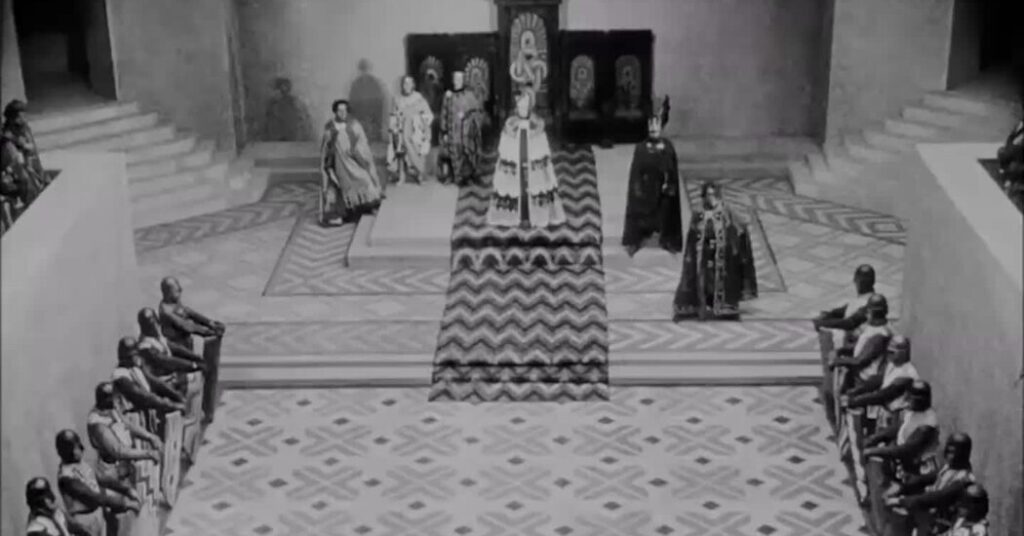
It was always known that “Die Nibelungen” would be ambitious, but it was a drain on both bank accounts and morale at the UFA studios near Berlin. Each scene is a spectacular work of art, often inspired by painters like Caspar David Friedrich and Arnold Böcklin; some of the sets, made of twigs matted against painted surfaces, resemble mixed-media canvases by Anselm Kiefer today. Buildings blended a modernist fantasy of primitivism with Art Deco ornamentation. Brunhild’s hair and costume design rendered her a walking Klimt portrait.
The mythic nature of the story called for a host of special effects, such as when Alberich’s minions slowly turn to stone as they hold up a pile of treasure. Less successful, even in the 1920s, was the dragon slain by Siegfried. There were 10 people playing the creature inside a silly costume that the New York Times critic Mordaunt Hall described back then as “anything but real.”
Still, a lot of people labored on the production, and with such long hours, they didn’t have time to make it to the grocery store for essentials. So UFA became a market of its own, buying food at the beginning of the week and selling it at prices that tended to be more favorable than elsewhere as inflation spun out of control.
Lang worked on the film even as it was being premiered. Huppertz didn’t have time to change the score for last-minute edits, so the orchestra repeatedly played out of sync with the projection. (In that sense, the recent performances in Vienna were better than the original.) By the end of the night, the audience members were offered refunds.
The reputation of “Die Nibelungen” improved, though it divided German audiences for years. It was taken up with ambivalence even by the Nazi Party. Despite being the work of an Austrian Jew, it was hailed by Joseph Goebbels and praised by the Führer. But after Hitler’s rise to power in 1933, they only made “Siegfried” and not the darker, more pessimistic “Kriemhild’s Revenge” available to the public. (Unable to catch a break, Lang also took heat from the cultural critic Siegfried Kracauer, who wrote that the films were a triumph of the fascistic “mass ornament” over the human.)
Lang left Berlin, eventually joining Hollywood after trying to fend off its influence in Germany. He and von Harbou divorced, and she joined the Nazi Party, continuing to work in film under the Third Reich’s blessing. Huppertz joined, too, but seemingly more to preserve his career before dying of a heart attack in 1937.
Over the years, “Die Nibelungen” survived mostly intact but nevertheless incomplete. It was screened with improvised music on a piano or organ, or sometimes a small ensemble. Lang vocally loathed the different versions of his film that arose and especially hated hearing about a cut that had been presented with excerpts from Wagner’s “Ring.”
It wasn’t until 2010 that “Die Nibelungen” was restored, reuniting Huppertz’s freshly recorded score with Lang’s complete films. That version is easy to stream online, and it’s the one that came to Vienna last weekend, with the ORF Vienna Radio Symphony Orchestra under Frank Strobel, who lent the music sensual irresistibility and operatic drama.
At the Konzerthaus, where “Siegfried” was presented on Saturday, followed by “Kriemhild’s Revenge” on Sunday, the films exuded the grandeur of a modern-day blockbuster. Dragon aside, “Die Nibelungen” is still a marvel of craft and storytelling, and Huppertz’s score is central to its effect, prefiguring the majestic, symphonic soundtracks to come by Max Steiner in the 1930s and John Williams today.
Truly a rejection of Wagner, Huppertz’s score is more French and late Romantic than a rehashing of the “Ring”: more “Pelléas” than “Parsifal.” He does borrow Wagner’s innovative use of leitmotifs, or musical themes attached to specific characters and ideas. Kriemhild is often accompanied by a flowingly elegant sound that turns dark in the second film. Something similar happens with Siegfried and Gunther’s friendship, whose jovial cue turns mournful at the scene of Siegfried’s death.
The two films share motifs but also have distinct sound worlds, the French-horn heroism of “Siegfried” giving way to minor-key bloodshed in “Kriemhild’s Revenge,” which in introducing Huns also adopts folky themes with the jangling percussion of Dvorak. Huppertz’s music is also sometimes diegetic, part of the scene: the hammering of a sword, the ringing of a bell, the rollicking ballad form of a story around the fire.
Through it all, the music gives the film its pace and tone, as expressive as the faces onscreen. In the clearest indication of how prophetically woven the soundtrack and image are, moments of the highest drama are shockingly silent, such as when Siegfried is impaled by Hagen’s spear.
It’s a luxury to take in “Die Nibelungen” with the treatment it had in Vienna: the way Lang meant for it to be seen and heard. But even at home it’s a wonder, a record of cultural history in the making. The awe it inspires, I imagine, is not unlike what you feel at a performance of Wagner’s “Ring.”
Joshua Barone is an editor for The Times covering classical music and dance. He also writes criticism about classical music and opera.
The post Fritz Lang’s Silent Epic, the Way It Was Meant to Be Heard appeared first on New York Times.