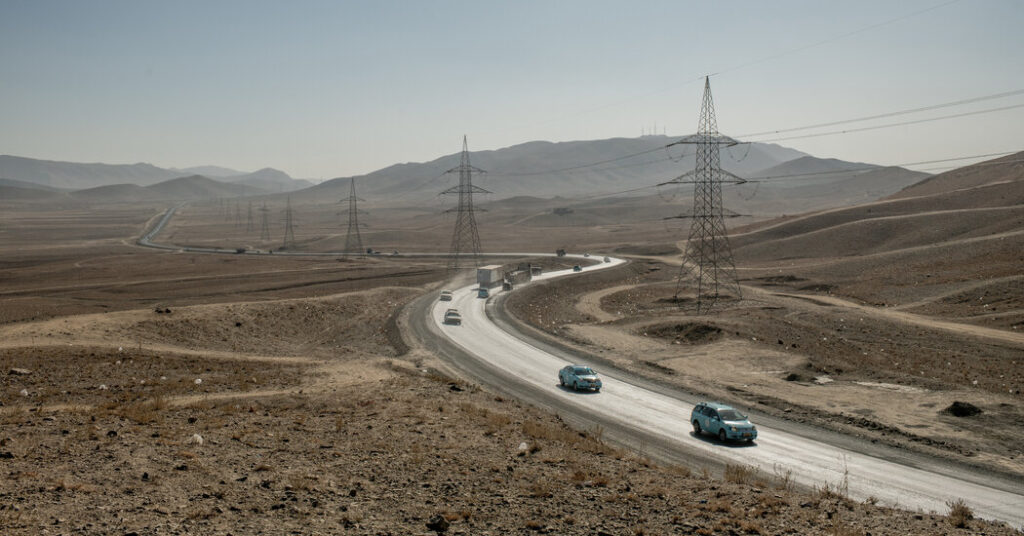
Highway 1 was once among the most dangerous, damaged arteries in Afghanistan.
But on a recent 300-mile road trip between Afghanistan’s two largest cities, Times journalists only encountered order and security — and not a single pothole.
Since the Taliban returned to power in Afghanistan in 2021, they have worked to replace the violence that largely defined this highway, and the country, with strengthened security and administration.
Once littered with bomb craters and trenches dug by overweight trucks, the road is now smooth enough for travelers to nap while riding through the barren plains of Afghanistan’s east.
Seen through car and bus windows, some of the damage from generations of war is beginning to fade.
On a recent evening, we watched a man training his pigeons as the sun set. Bus and truck drivers queued at shiny gas stations before stopping for a bite of lamb kebab. Young boys cycled past solar-panel-covered religious schools, some of them nested in former military outposts.
This is the Afghanistan that the Taliban government has rebuilt over the past four and a half years, after the United States withdrawal. It is what the Taliban want the world to see as they try to attract foreign investment and recognition. There is order, security and signs of an economic rebound, they say. The Afghan economy grew by 4.3 percent last year, according to the World Bank, up from 2.5 percent in 2024.
“All the heavy weapons and the money of the previous government didn’t accomplish much,” said Iqbal Noori, the owner of a mobile phone shop in Kandahar, Afghanistan’s second-largest city. “We have to trust the Taliban. We don’t have another option.”
Highway 1 was once the showpiece of the U.S. reconstruction effort in Afghanistan. But it also became a symbol of squandered billions in Western aid. In 2016, an audit by the Special Inspector General for Afghanistan Reconstruction found that 95 percent of the paved roads had been damaged or destroyed. Amid frequent fighting, the 300-mile trip between Kabul and Kandahar could stretch to 18 hours.
Travelers can now complete the journey in eight.
The Taliban are now renovating what they once sought to dismantle during their insurgency. They are expanding Highway 1 with two extra lanes and strictly enforcing weight limits on trucks to preserve the new asphalt. They are erecting a mosque every 40 miles and urging real estate developers to build around them.
In the evening, we stopped at a roadside stall where Nasibullah Khaksar sold almonds and dried apricots. Growing up next to Highway 1 meant a life of constant interruption, where playing outside or going to school was often impossible. “The sight of a Taliban patrol was a sign that fighting would start soon,” he said.
Now, Mr. Khaksar said, he can ride his motorcycle at night without fear, and he never locks his shop.
The fields nearby are just fields, not battlefields.
But the flawless asphalt can be a thin veneer. From the hills, the road looks like a lonely snake cutting through a parched landscape. Farmers say their fields have grown barren because of drought and contaminated groundwater.
Women and girls were all but invisible on the journey save for a few glimpsed in the back of passing taxis and buses. The Taliban have effectively erased them from public life, banning them from most jobs and school beyond sixth grade, and forbidding them to travel long distances without a male companion. The Afghan economy may be losing $1.4 billion every year because of it, according to World Bank estimates.
The men we encountered at every stop shared concerns about their livelihoods. Truck drivers and fruit sellers, welders and butchers all said that better security was welcome but not enough. They kept asking about the development needed to lift Afghans out of deprivation.
“The youth are jobless and sit at home doing nothing. We need factories,” said Noor Agha Rahmani, a carpenter working by the side of the road in Ghazni Province.
More than 40 percent of the population faces acute malnutrition, according to the World Food Program.
“There was no security before, but work was OK,” Mr. Rahmani, the carpenter, said about opportunities under the old U.S.-supported government. “Now there’s security but far fewer jobs.”
As we approached Kabul, military bases in ruins lined the route. So did rows of abandoned houses.
In a village in Maidan Wardak Province, a handful of the 300 houses are inhabited. The mosque has also been abandoned, its walls peppered with bullet holes.
The war is over, but in many places, those who remain said the silence of peace was paired with the quiet of neglect.
“If you don’t know anyone in the higher ranks, you’re not getting anything,” said Gul Rahman Himayat, a former Taliban fighter, as he stood before the ruins of his home.
The war took his mother and two siblings, Mr. Himayat said, but at least he was fighting for a cause — the establishment of Taliban rule. Now that it is here, “there is nothing for us.”
Safiullah Padshah and Yaqoob Akbary contributed reporting.
Elian Peltier is The Times’s bureau chief for Pakistan and Afghanistan, based in Islamabad.
The post Flawless Asphalt, Empty Homes: A 300-Mile Drive Through Afghanistan appeared first on New York Times.