Just about everyone close to Tshephiso Marumo condemned her when she chose to sell ears of corn door-to-door a decade ago after earning an honors degree from a university in her native Botswana. It was the sort of thing that people in the southern African nation looked down upon as poor people’s work, not something for a sophisticated graduate with dreams of becoming a journalist.
One of her former professors was so dismayed that he derisively nicknamed her Mmammidi, a Setswana term that roughly translates to Corn Lady.
Ms. Marumo, 33, shrugged off the criticism and has since turned that humble beginning into what many people in Botswana call a tale of triumph and inspiration: She has opened two roadside food stalls in the capital, Gaborone, that have become a hit, selling traditional village cooking that you almost never find in urban areas.
Her venture has turned the unglamorous work of roadside food vending into something fashionable, earning her a large social media following and prominent customers, including politicians, musicians and influencers.
Yet the same qualities that have aided Ms. Marumo’s rise — persistence, candor and stubbornness — have also made her a divisive figure. The more prominent she has become, the louder she has spoken out online about hot-button issues, like parenting and drug addiction, earning her a reputation among some as a social media bully.
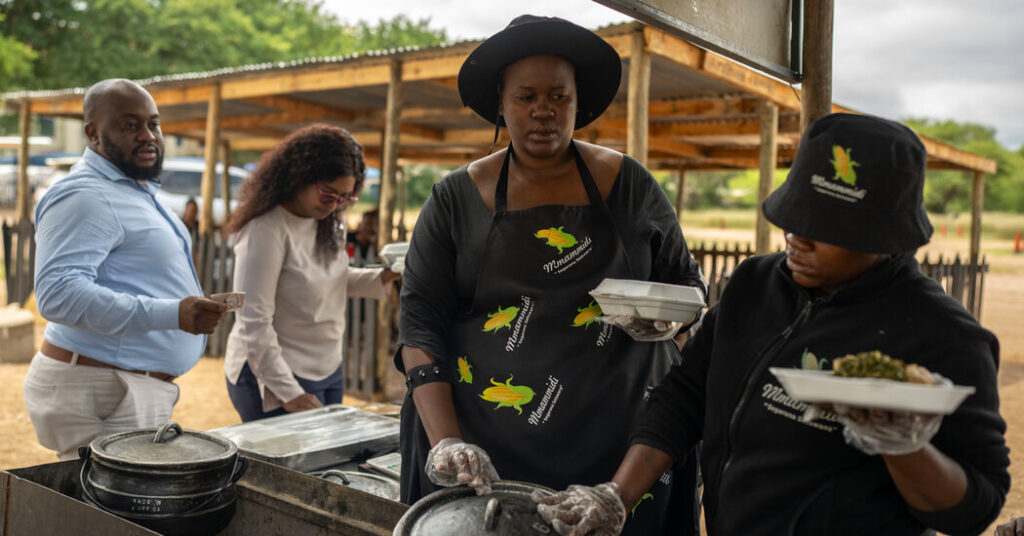
On Facebook, one of Botswana’s primary social media platforms, Ms. Marumo has more than 240,000 followers, the equivalent of nearly 10 percent of Botswana’s population. She called the business Mmammidi, after the former professor’s nickname, and plastered it onto T-shirts, aprons and two company cars.
“There are so many things I have done, but they have never given me a brand or a name or an identity,” she said. “But through the corn, I got an identity.”
Ms. Marumo likes to say she sparked controversy even before she was born. Her mother became pregnant with her as a teenager, upsetting many family members.
Growing up, Ms. Marumo bounced between Gaborone, where her mother worked as a police officer, and Kalamare, a village three hours away where she stayed with her grandmother. Her grandmother ran an illegal tavern out of their home, something that was frowned upon in the community.
But Ms. Marumo said she had no shame in the family business because she was always well taken care of. Her grandmother taught her how to cook, and that interest grew when she took home economics in school.
Ms. Marumo started her cooking business after building a following with her corn sales. She began hosting dinners at her home, cooking Tswana food in the traditional style — in three-legged cast iron pots over a wood-fired flame. The dishes are seasoned mostly with just salt and natural fats, a traditional technique meant to bring out the true flavors of the meats, starches and vegetables.
Her dinners became so popular, she said, that in late 2019 she cleared out a bushy field at a busy intersection near her home and set up her first food stall. Offering village cooking on a street corner near Gaborone’s central business district, Ms. Marumo’s enterprise was a welcome departure for many locals from the usual fare of westernized food showered in spices served up by chain restaurants.
“I’m passionate about my heritage, where I’m from and what my ancestors consumed before me,” a satisfied Orebotse Makgolo, 37, said after eating at Ms. Marumo’s stall for the first time recently. “Unfortunately, we consume a lot of Western food, and it’s always nice to be in touch with the local side of yourself.”
In January, Ms. Marumo opened a second food stall. Both are unfussy stands made of wood with flat, tin-sheet roofs sitting on dirt lots. She now employs 11 workers. They come to her modest bungalow every morning at 6, where they fire up about 30 pots under a shelter in the backyard, cooking the day’s menu in a swirl of heat and eye-burning smoke.
The result on a recent day was a spread that included a shredded beef dish known as seswaa, a similar version mixed with tripe called mokoto and bogobe jwa lerotse, a thick porridge of sorghum and melon juice.
Two years ago, Ms. Marumo ventured into a new enterprise, holding the first of what she said would be annual women’s empowerment seminars.
But given her reputation as an online bully, many are unconvinced that Ms. Marumo is a true champion of women.
On social media, she has criticized how some mothers raise their children and questioned the wisdom of some people’s decision to have children in the first place. Online commenters have, in turn, attacked Ms. Marumo with negative comments about her body. They have criticized her food as “soily,” meaning it tastes like dirt.
Thato San, a Botswana native who owns a beauty brand, said she was shocked last year when Ms. Marumo suggested online that Ms. San may have been complicit in the drug addiction of one of her friends, a rapper who had recently died. Just months earlier, Ms. San said, she had nominated Ms. Marumo for special recognition at a Women’s Month brunch.
“It was disappointing because I looked up to her,” she said. “Her presence on social media, a lot of people would say is very, very negative.”
Ms. Marumo argues that she is misunderstood and that her words are often twisted. Her success, she said, had bred contempt and made people feel that they could say anything about her.
She feels compelled to speak about women’s issues because of her own experience overcoming doubters, she said. Mothers often contact her for help with their children, and she has volunteered with and raised funds for an orphanage — experiences that Ms. Marumo said have given her a motherly instinct, even though she does not have children of her own.
“I am known by many people, but I’m still human,” she said. “I want my freedom. I need my freedom of expression.”
Since college, Ms. Marumo has always done things her way, said Benah Sekgabo, who met her in 2011 when they studied together. Ms. Marumo had a unique hairstyle and would design her own shoes, earrings and clothes, saying that she couldn’t buy the same off-the-rack items as her classmates.
The social media controversies don’t seem to have hurt business, so far. For some, Ms. Marumo’s brashness is part of her appeal.
“She’s a very confident person,” said Losika Mooketsi, a 20-year-old accounting student as she tucked into a plate of Ms. Marumo’s stewed meat. “She doesn’t let anyone bring her down. People can start rumors about her, and she won’t let that faze her.”
Behind the steely exterior, though, Ms. Marumo said the withering criticism can be painful. She starts each day reading the Bible and writing motivational messages on sticky notes, which now form a colorful collage on her bedroom door.
“Pray for those who have caused me pain,” reads one note.
“Thank you God for P1,000,000,” says another, a reference to her goal of earning at least a million Pula (about $76,000), which she said she was still working toward.
And then there’s one from a popular Psalm that might sum up her approach to life: “I will fear no evil.”
John Eligon is the Johannesburg bureau chief for The Times, covering a wide range of events and trends that influence and shape the lives of ordinary people across southern Africa.
The post ‘Corn Lady’ Builds a Culinary Empire, With a Side of Scorn appeared first on New York Times.