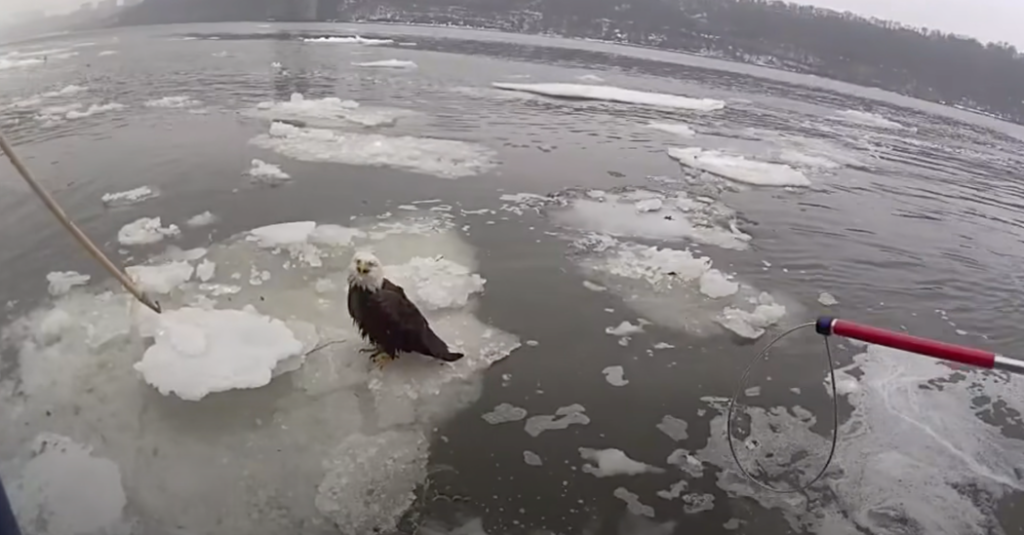
Over 16 years with the Harbor Unit of the New York City Police Department, Officer Michael Russo has rescued people in distress, and dogs, too. But never a bald eagle. Until Tuesday morning.
Officer Russo and three colleagues were patrolling the frigid Hudson River near the George Washington Bridge when they noticed an injured bald eagle on a chunk of ice. The squawking bird was soaking wet, had blood on it, and its wings were not flapping in unison, Officer Russo said.
“Something was definitely wrong,” he said. “It was definitely doing a cry for help.”
The officers devised a rescue plan. One stayed at the controls of the boat, keeping it steady, while another used a long pole to hold the chunk of ice in place. Then Officer Russo reached out with a catch pole, a tool that has a cable noose on the end. He placed it gently around the bird’s chest, securing its wings, and drew it closer to another officer, who reached out and wrapped the bird in a yellow plastic sheet, covering its eyes to prevent it from lashing out.
“All right, buddy, we got ya,” one of the officers reassured the bird on body-camera footage released by the department.
Once on the boat, the eagle was shivering but not attacking anyone with its talons, as Officer Russo had feared. “The bird was very cooperative,” he said. “It never gave us a hard time and tried fighting us.”
Its lack of fight indicated the eagle might have consumed some kind of poison or gotten ill, said Kevin J. McGowan, an ornithologist at the Cornell Lab of Ornithology. “No wild animal would allow you to just put a noose around its chest,” he said, adding, “That bird was not well.”
New York Department of Environmental Conservation officers took the eagle to the Raptor Trust, a wild bird rehabilitation center in Millington, N.J., where it was in “very serious condition,” Christopher D. Soucy, the executive director of the trust, said in an email on Wednesday.
“We are doing our best to keep the bird stable, and should it improve, we will do further diagnostics, X-rays and bloodwork to help determine a course of action going forward,” he said. “At this time, we are providing appropriate supportive care in the hopes that we can stabilize the patient for further treatment.”
A band on the eagle’s leg showed it was at least 20 years old and not a newcomer to the Hudson. It had been banded as a juvenile in Stony Brook, N.Y., in 2005, and had nested successfully for many years along the Palisades, the steep cliffs that stretch for about 20 miles along the west shoreline of the river.
Officer Russo said he had seen red-tailed hawks on the Hudson before, but never a bald eagle.
But the majestic birds are not an uncommon sight on the river, as the population in New York City and nationwide has rebounded over the last 75 years, said Dustin Partridge, director of conservation and science at the NYC Bird Alliance.
By the mid-20th century, estimates suggested only a few hundred bald eagles remained in the United States, as the birds had been killed off largely by widespread use of the insecticide DDT. But through protection and conservation efforts, and the banning of DDT in 1972, the bald eagle recovered and was removed from Endangered Species Act protection in 2007.
New York State, Dr. Partridge said, is home to about 400 nesting pairs, and the Hudson River is a good place to spot them.
Dr. McGowan said that “bald eagles are looking for open water to catch fish, and they don’t really want to go that far, like South America or Florida.” He added, “A lot of them only go as far as they have to, and if they can find fish, they will stick around. The cold doesn’t really bother them.”
Sandra Critelli, who has been birding around New York City for 20 years, said she was walking on Saturday along the Hudson River from 70th Street to 125th Street and spotted 14 bald eagles, including one eating a fish.
“Occasionally you see them flying, but 14? I was shocked,” said Ms. Critelli, who posted photos of the birds. “It was beautiful — really beautiful.” Maybe, she said, one of them was the eagle that was rescued.
Kirsten Noyes contributed research.
Michael Levenson covers breaking news for The Times from New York.
The post Bald Eagle, Marooned on Ice Chunk in Hudson, Is Rescued by Police appeared first on New York Times.