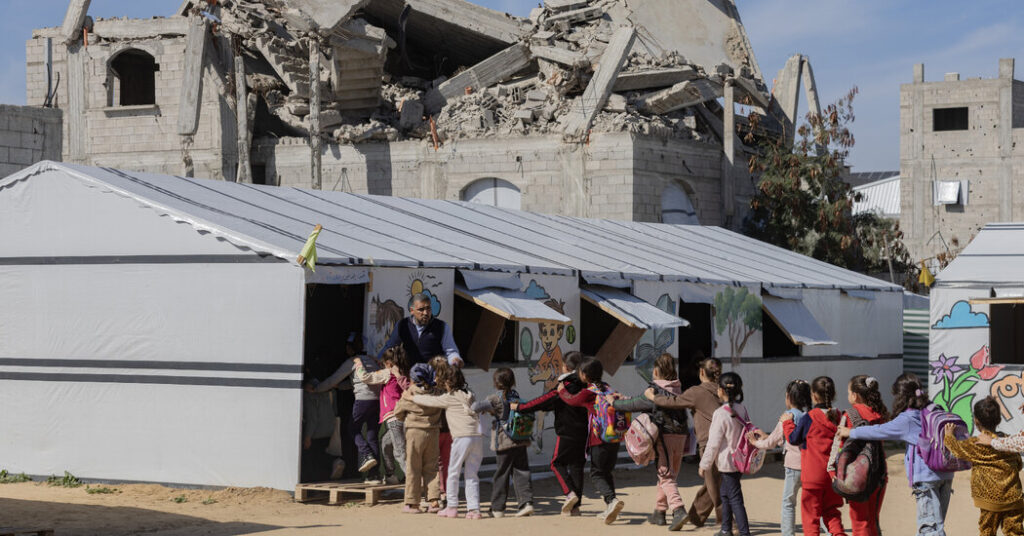
In the midst of a crowded camp for displaced Palestinians in southern Gaza, a gate with a jarringly upbeat poster of a bright red cartoon racing car sticks out. Inside, a passageway to a compound of tent classrooms is adorned with children’s drawings more reflective of real life.
One shows an orange and yellow home, green grass and olive trees over the handwritten words “I had a house, but today I have nothing.”
Raseel al-Shaer, 12, pauses to tell a visitor how good it feels to be learning alongside other children again in al-Mawasi. “Here, it is safe,” she says. “No drones or bombs. The best thing is sitting at a desk and seeing the teacher and the board, and holding a pencil again.”
Quietly, and despite considerable risk, a network of free private schools for war orphans and other children has sprouted in the Gaza Strip. The schools, called Academies of Hope, are the brainchild of a Palestinian American neurosurgeon, Dr. David Hasan, who first visited Gaza on medical relief missions soon after Israel invaded Gaza in the wake of the Hamas-led attack on Oct. 7, 2023.
Though he hasn’t been back to Gaza since early 2024, he has built the institutions by forging partnerships with humanitarian groups on the ground, hiring Palestinian staff over WhatsApp and raising money — largely from Jewish donors — in the United States and Israel.
Some 9,000 pupils in grades one through nine are attending classes in five campuses in southern Gaza. They cycle through the schools in three-hour shifts and receive hot meals and medical and psychological care.
Operating schools in any war zone is hard enough, and schools across the enclave are struggling to rebuild. But Dr. Hasan has compounded his challenges. He revamped a much-criticized national curriculum and worked to keep Hamas from endangering his schools. He also verifies that none of his staff have ties to militant groups, a charge Israel has leveled against the United Nations agency caring for Palestinians in Gaza and some international aid groups.
The schools teach a modified version of the Palestinian Authority’s curriculum, which is taught in the Israeli-occupied West Bank and Gaza, but without any lessons demonizing Jews or glorifying perpetrators of violence against Israel. Dr. Hasan said the curriculum changes were made without the authority’s permission, prompting threats of reprisal from its education ministry. A ministry spokesman did not respond to repeated messages seeking comment.
Israel, the United States and the European Union have long complained that the authority’s textbooks inculcate hatred and antisemitism. The authority says that its schools appropriately teach Palestinian nationalism, history and culture.
Before-and-after excerpts from the curriculum illustrate the changes:
A math problem comparing the number of “martyrs” killed in the first and second intifadas has been replaced with one involving attendance at a West Bank soccer match.
A reading comprehension selection praising Dalal Mughrabi — a woman who led a 1978 massacre that killed 38 Israelis, 13 of them children — has been replaced with one about Hind al-Husseini, a pioneering Palestinian educator.
And in an Islamic studies class, a reading about an attempt by Jews to kill the Prophet Muhammad has been replaced with one about the prophet’s expressions of respect for Jews.
Dr. Hasan’s team also added new weekly lessons on “peace building” that teach ideals like tolerance and respect for differences, the golden rule and conflict resolution.
In a video recorded by a school employee during one lesson recently, a boy draws pictures of the Palestinian and Israeli flags side by side. “I wish there will be no more wars so that we can live,” he says.
Dr. Hasan acknowledged that his peace-building curriculum was politically fraught and that some of his teachers were fearful of blowback from Hamas as it re-establishes its control over much of Gaza. Some faculty members have quit or been fired over such concerns, he said.
He said he was even exploring installing cameras in classrooms to ensure that the curriculum changes are upheld.
On social media, some Gazans have asked whether Dr. Hasan’s agenda is overly aligned with Israel’s. Others, embittered by Hamas, have retorted that it’s better to teach tolerance than to teach children to sacrifice themselves.
Discomfort with the subject was clear in interviews with faculty members, most of whom had not been hired from other schools — they were either teaching for the first time or were retired principals. They emphasized that they were using the standard Palestinian curriculum, though when pressed, acknowledged some deletions.
Alaa Sabbah, 35, who was guiding a class through the basic components of a cell, said he wasn’t teaching only science.
“We teach respect, tolerance and accepting others,” he said. “We teach them how to rise again, like a phoenix, and how to come back to life from under the rubble. We teach them to love people and to socialize.”
When the first school opened last July, Dr. Hasan said he gave the Israeli military the school’s coordinates, hoping to protect it. In August, the staff received a warning of an Israeli attack and evacuated. An airstrike soon after hit militants next door. The school suffered little damage but soon found a new site, Dr. Hasan said.
That first school had space for 200 students, he said. On the first day, 500 showed up. “Some hadn’t had food for days,” he said.
“The kids were so excited — for the first time they were thriving,” he added. “And they didn’t want to go home. We had to kick them out in the evening.”
Last summer, as malnutrition was taking hold under an Israeli blockade, Dr. Hasan said, he bought tons of flour on the black market for people living in Deir al-Balah. Having earned the gratitude of local elders, he said, he persuaded them to give him space for a school.
Since then, he said, leaders of big families in Gaza have helped him obtain space for more schools. “The way we did it is by gaining trust,” he said.
One way is by ensuring those families — as well as the Israelis and his donors — that his staff has no ties to militant groups. Dr. Hasan said that every employee had been cleared with the Israeli authorities and checked against a U.S. government sanctions list.
He also makes clear that his donors include Israelis. “I told the elders, ‘I work with the Israelis,’” he said. “They said, ‘As long as they don’t want to brainwash our kids, we’re fine.’”
A researcher and professor at Duke University’s medical school, Dr. Hasan, 53, had no background in humanitarian aid before the 2023 attack. Nor was he particularly connected to Palestinian life.
Born in Kuwait to Palestinians from the West Bank, he left the Middle East at 18 to attend college in Texas. At 19, he dropped his given name, Emad, and called himself David.
He said he felt stirred to action by the war. In December 2023, he was in Gaza on a medical mission, performing 20 operations in 10 days, often without anesthetics or antiseptics. He recorded video of maggots crawling out of unhealed wounds. Every patient he operated on, he said, eventually died of infection.
He returned the next April with more medical supplies, and had better results.
But he couldn’t get over the number of children being orphaned — like a 10-year-old girl whom he watched quickly take charge of her younger siblings after their parents had been killed.
“The kids, they’re the victims of this war,” Dr. Hasan said from his home in Durham, N.C. “They had no decision in it.”
He said he had not returned to Gaza since April 2024 because he had aroused suspicion. When he wasn’t operating, he said, he was poking into hospital storerooms and asking questions, trying to learn if Israeli hostages might be on the premises. He fled, he said, when he was alerted that armed militants were looking for him.
He has also persuaded José Andrés, the celebrity chef behind World Central Kitchen, to provide meals for the students, along with desks, benches and bookshelves.
Mr. Andrés said he had also donated $500,000 to Dr. Hasan’s project and planned to give another $500,000.
“Sometimes big problems have very simple solutions that can be solved by somebody with endless energy and not taking no for an answer,” he said in an interview. “It’s OK to dream big because Gaza requires people like David dreaming big.”
Dr. Hasan’s sixth school is set to open east of the southern city of Khan Younis with space for 10,000 children, some college classes and even a tiny zoo. And he wants to keep opening schools, with a goal to serve as many as 250,000 youngsters by the end of the year.
For Shireen Mohammed, 34, the schools have been a godsend to her children.
“This is the best thing that has ever happened to us,” she said. “Before this place, we were afraid to let our children go anywhere. Now it is safe and productive for them — emotionally, socially and educationally.”
Outside the classrooms in al-Mawasi, Aisha Abu Marzouq, 9, who was displaced from Rafah, said she hoped her new school could add a playground. But she had no complaints.
“I don’t want to leave this place,” she said. “My first day here was the best start to life again.”
David M. Halbfinger is The Times’s Jerusalem bureau chief, leading coverage of Israel, Gaza and the West Bank. He also held that post from 2017 to 2021. He was the politics editor from 2021 to 2025.
The post At These Gaza Schools, ‘Peace Building’ Is Part of the Curriculum appeared first on New York Times.