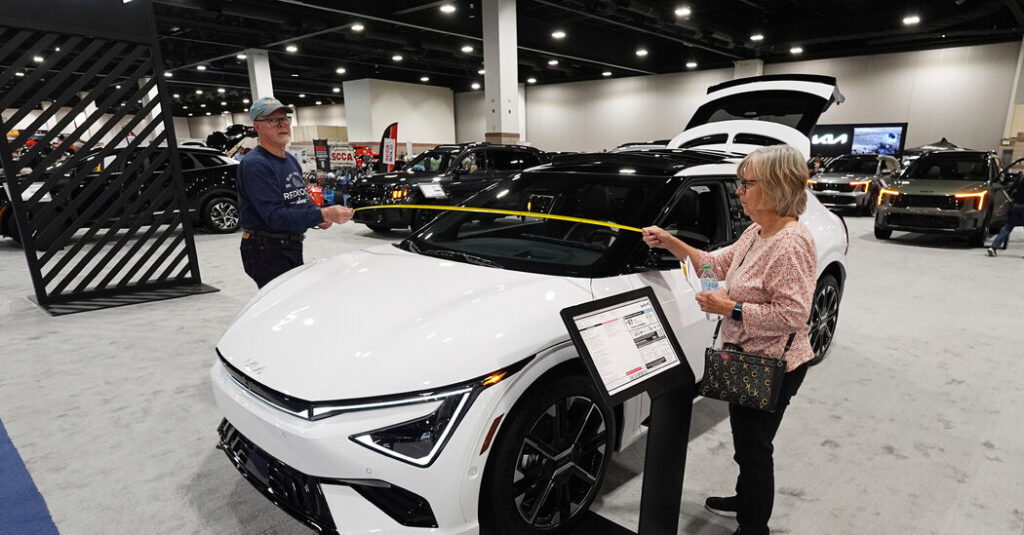
In Colorado, historically a hub of coal mining, legislators are planning to give drivers a $2,000 discount on new electric vehicles, more than double the current amount offered by the state.
In Virginia, where data centers are driving a record surge in electricity demand, lawmakers want to make it easier for counties to approve sprawling solar farms.
And in California, a longtime leader in environmental policy, legislators want fossil fuel companies to help cover soaring home insurance costs caused by wildfires and other climate disasters.
Across the country, Democratic-led states are accelerating their efforts to address climate change as action stalls at the federal level. Their initiatives took on newfound urgency last week, when the Trump administration moved to stop regulating greenhouse gases from the burning of fossil fuels, the main driver of Earth’s dangerous warming.
Experts said a patchwork of state climate policies was no substitute for federal leadership. But they added that state action would be crucial for the United States — historically the largest emitter of greenhouse gases — to continue shifting away from fossil fuels and toward cleaner energy while President Trump remains in office.
“The transition to cleaner, nonfossilized fuel is happening very rapidly even though Donald Trump is trying to slow down this progress,” said Jay Inslee, a Democrat and the former governor of Washington State. “The states are tremendous powers in this clean energy transition we’re going through.”
The Environmental Protection Agency on Thursday overturned the scientific determination that carbon dioxide, methane and four other greenhouse gases were a threat to public health and welfare. Known as the endangerment finding, the ruling had required the government to limit these gases from passenger cars and trucks, oil and gas wells, power plants and other industrial facilities.
The end of federal greenhouse gas limits is an obstacle, but not a death knell, in the fight against climate change on the state level, experts said.
Colorado helps explain why.
In 2019, Gov. Jared Polis, a Democrat, set an ambitious goal of reducing the state’s greenhouse gas emissions 50 percent by 2030, from 2005 levels. Colorado is now on track to meet this goal by 2032, a two-year delay for which local leaders have largely blamed the Trump administration’s environmental rollbacks.
Will Toor, the executive director of the Colorado Energy Office, said the erasure of greenhouse gas limits on cars was an especially big blow. Transportation is the largest single source of greenhouse gases in Colorado and in the United States.
To get more drivers into electric vehicles, Colorado legislators are trying carrots rather than sticks. In the coming weeks, they plan to introduce a bill that would provide a $2,000 tax credit toward new electric vehicle purchases starting in 2027, up from the current amount of $750. (Colorado already expanded an additional rebate of up to $9,000 for low- and moderate-income households to buy new E.V.s after the Republican-controlled Congress repealed a federal incentive of up to $7,500 last summer.)
“Trump is slowing down the transition, but the overall trajectory in Colorado will still be toward a pretty rapid reduction in greenhouse gas pollution and rapid adoption of electric vehicles,” Mr. Toor said.
Across the country in Virginia, lawmakers are eager to expand solar energy.
The Virginia House and Senate recently passed a bill that would prohibit local governments from banning large solar projects. The legislation would also provide guidance for localities by recommending that solar projects be built at least 150 feet away from homes and at least 50 feet from roadways.
Opposition to solar projects, as well as wind farms, has grown across the country in recent years. Some critics of solar facilities have falsely claimed that they are expensive and inefficient, while others have raised concerns about the loss of prime farmland to development.
Nearly two-thirds of Virginia’s counties have passed ordinances that effectively prohibit large solar facilities, either through outright bans or unworkable restrictions. For instance, Fluvanna County requires solar farms to be built at least 375 feet from property lines and 500 feet from homes, which is difficult in parts of the region between Charlottesville and Richmond.
The trend could prevent Virginia from meeting its aggressive target of running on 100 percent renewable electricity by 2050. Power demand is also soaring statewide, in large part because of a boom in artificial intelligence data centers, which can use as much electricity as a small city.
“We need to do everything we can to get more cheap energy online, and that means a lot more solar,” said State Senator Schuyler VanValkenburg, a Democrat who sponsored the bill, which is expected to reach the desk of Gov. Abigail Spanberger in the coming weeks.
Representatives for Ms. Spanberger, a moderate Democrat who took office in January, did not respond to questions about whether she would sign the measure.
Besides large solar farms, momentum is also building for small solar energy systems that can fit on balconies and in backyards. Lawmakers in 24 states have introduced bills that would allow homeowners and renters to install these systems, which produce enough electricity to power a laptop or small refrigerator.
“Is it a silver bullet? No,” Liz Krueger, a Democratic state senator in New York, said of the measures. “But is it an opportunity for a huge new set of solar systems, at a cost of $300 per unit? Hello, yes.”
The buzz behind so-called balcony solar units is bipartisan. In Utah, which last year became the first state to allow these systems, State Representative Raymond P. Ward, a Republican who sponsored the bill, said the concept had broad appeal.
“People are like, ‘Oh, I can just buy that and plug it in?’” Mr. Ward previously told The New York Times. “‘Oh yes, I want one of those.’”
When it comes to climate measures among the states, many are looking toward California, which has been a national leader since the 1950s, when severe smog in Los Angeles helped galvanize the modern environmental movement.
Gov. Gavin Newsom, a Democrat, announced one of the nation’s most aggressive climate goals in 2020: banning the sale of new gasoline-powered vehicles by 2035. But last year, Mr. Trump blocked California from enforcing the ban, which 11 other states had intended to follow.
At the same time, Mr. Newsom and Democratic lawmakers backtracked on other green initiatives in an effort to address the high cost of living in the state. For instance, they backed legislation that would keep oil refineries open and make it easier to drill for oil in California.
But some of the biggest climate hawks in the California State Assembly are now promoting a measure that would require oil and gas companies to help pay for home insurance coverage. The cost of this coverage has skyrocketed in recent years because of wildfires, including the devastating blazes that tore through the Los Angeles area last year.
“If your house is burning down and your insurance costs are quadrupling, or you no longer have insurance, your life is now more expensive and worse because of climate change,” said State Senator Scott Wiener, a Democrat who introduced the legislation.
Beyond the insurance bill, Mr. Wiener added, California “needs to triple down on our state-level climate policies now that Trump has just eliminated all of the federal rules.”
It is unclear what tripling down might look like.
Lauren Sanchez, the chair of the California Air Resources Board, the state’s powerful air and climate regulator, said in an email that “we will continue to stand up for the right to breathe clean air and keep driving forward in every way possible.” She did not comment on whether or how the board would continue to reduce greenhouse gases from automobiles. The state is suing the federal government to maintain its own strict clean-car rules.
Casey Katims, the executive director of the U.S. Climate Alliance, a bipartisan coalition of governors working on climate policy, said that from 2005 to 2023, states and territories reduced their net greenhouse gas emissions by 24 percent.
If they continue that trend, Mr. Katims said, states can make up for the loss of the federal government’s support in driving down climate pollution, at least for the next three years.
But “we have our work cut out for us,” he added.
Lisa Friedman contributed reporting from Washington.
Maxine Joselow covers climate change and the environment for The Times from Washington.
The post As Trump Obliterates Climate Efforts, States Try to Fill the Gap appeared first on New York Times.