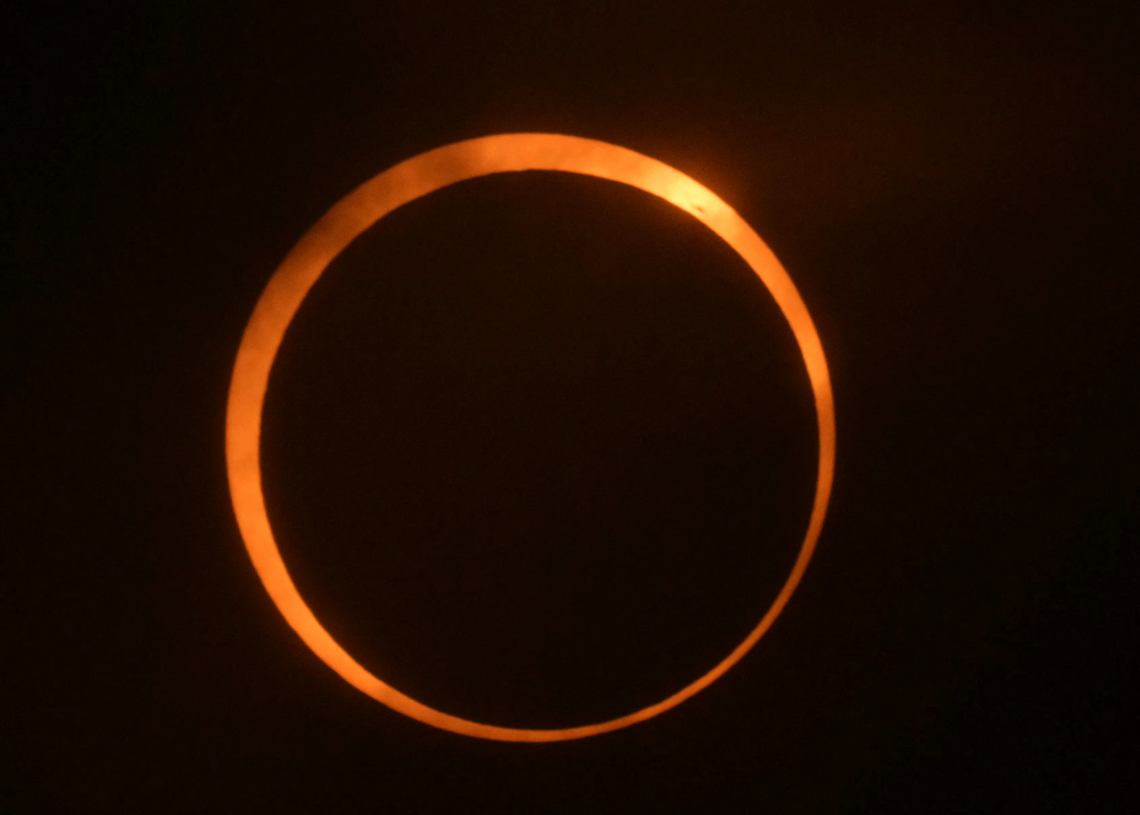
The first solar eclipse of the year didn’t pass over a major city or cut dramatically across a crowded continent. Instead, Tuesday’s annular “ring of fire” eclipse swept across Antarctica, one of the most remote places on Earth, ensuring that almost no one saw it outside of a few Instagram pics.
Its audience mostly consisted of research station crews and animals. The seals and penguins got a helluva show.
An annular eclipse happens when the sun, moon, and Earth align, but with a small caveat: the moon is farther away from Earth in its orbit, making it look smaller in the sky. Instead of fully blocking the sun, it leaves a bright ring around its edges, the so-called “ring of fire,” an eerie sight that likely made several ancient civilizations think the world was ending.
Parts of southern Chile and Argentina caught a partial eclipse, along with areas of southeastern Africa, including Madagascar, Lesotho, and South Africa.
Solar eclipses happen at least a few times every year. The last total solar eclipse crossed North America in 2024. Another total eclipse is expected in August. That one will be visible from Greenland, Iceland, Spain, Russia, and parts of Portugal, with several other regions expected to get partial views.
As with any solar eclipse viewing, please put safety first. Do not look directly at the sun at any point, even during the eclipse itself, as it can permanently damage your vision. You’re going to need a proper set of eclipse glasses that meet ISO 12312-2 standards.
You can always get crafty and make a pinhole projector, as some likely did for this ring of fire solar eclipse. Because if you’re living in Antarctica, you’ve probably got a lot of free time on your hands to squeeze in some arts and crafts.
The post An Annular Solar Eclipse Just Created a ‘Ring of Fire’ in the Sky appeared first on VICE.