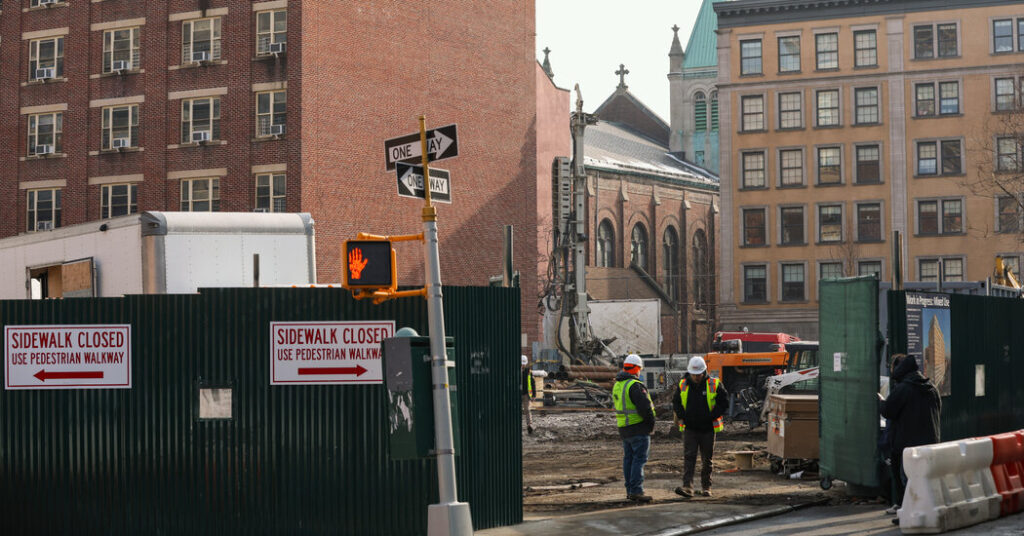
For many years, police officers in East Harlem would park their squad cars in a large lot just outside the 25th Precinct building. Now, officials view that arrangement as a clear example of how not to use New York City land.
Instead, officials are set to host a groundbreaking on Wednesday for a new, 20-story affordable housing building that will be built on the 23,000-square-foot lot on East 118th Street. It will include nearly 100 apartments for formerly homeless New Yorkers and more than 240 additional affordable units.
The building will also have a new garage for the Police Department and a space for the Afro Latin Jazz Alliance, in a nod to the community’s cultural roots.
Every home in the building will be affordable, including more than 61 one-bedroom apartments that rent for around $900, and 44 two-bedroom apartments that rent for about $2,550.
The $255 million project represents the kind of transformation that Mayor Zohran Mamdani wants to encourage as he seeks to address New York City’s housing crisis. In one of his first acts in office, the mayor directed agencies to, by July, find public places — parking lots, office buildings, libraries, hospital campuses — where at least 25,000 homes can be built over the next 10 years.
“It can make a real impact on our overall supply of housing,” said Michael Sandler, the associate commissioner for neighborhood strategies at the city’s Department of Housing Preservation and Development.
Hundreds of thousands of New York City residents struggle to afford their homes as the cost of housing continues to grow. The average monthly rent on a new Manhattan lease, for example, was about $5,711 in January, the highest such figure on record, according to the brokerage Douglas Elliman.
But finding places to build affordable housing can be extraordinarily difficult. Land, particularly in desirable neighborhoods, is expensive, and advocating new development can be politically perilous.
That is why publicly owned sites present a particular allure. The city already owns the land, so it can control the type of housing built there. The land itself is essentially free, making it easier to support more affordable apartments.
Mr. Mamdani is just the latest New York City leader to target publicly owned sites. In 2024, former Mayor Eric Adams issued an executive order “requiring city agencies to review their city-owned and -controlled land for potential housing development sites.” Other former mayors, including Bill de Blasio and Michael R. Bloomberg, included similar strategies in their housing plans.
Over the past 20 years, between seven percent and 10 percent of housing production has been on publicly owned sites, Mr. Sandler said. There are hundreds of similar sites that could be developed, he said.
But there can be challenges to building on those sites, too.
It might be difficult to relocate whatever was already on the land. At the East Harlem site, the city has temporarily moved the police vehicles to other lots in the neighborhood until the new garage is built.
The city still has a long pipeline of projects that have been approved but are awaiting funding. Just because the city has the land and the will to build doesn’t mean construction can start right away, Mr. Sandler said.
The idea for the East Harlem project took shape more than a decade ago. Residents and local politicians wanted to revitalize the neighborhood, leading to a rezoning in 2017 of 96 blocks to encourage more housing and commercial investment.
The East 118th Street development was approved by the City Council in 2024. It is expected to open to new residents in 2028.
Some neighbors are not happy.
Eva Chan, 49, helped create a group called the Harlem East Block Association, which had urged politicians to reject the development.
Ms. Chan, who lived nearby between 2017 and 2024 and still owns a three-unit rental building across from the development, said New York City consistently places projects benefiting low-income and homeless people in East Harlem.
She said she had already noticed an increase in drug use in the neighborhood, especially after the opening of several overdose prevention centers, and she was worried that the operator of the new building would not do enough to prevent drug use or crime from rising.
Other, wealthier neighborhoods should also make way for these types of developments, she argued.
“Why do children on the Upper East Side and Upper West Side have the right to clean and safe streets, and children in East Harlem don’t?” she said.
Mihir Zaveri covers housing in the New York City region for The Times.
The post A Police Parking Lot in East Harlem Will Become Affordable Housing appeared first on New York Times.