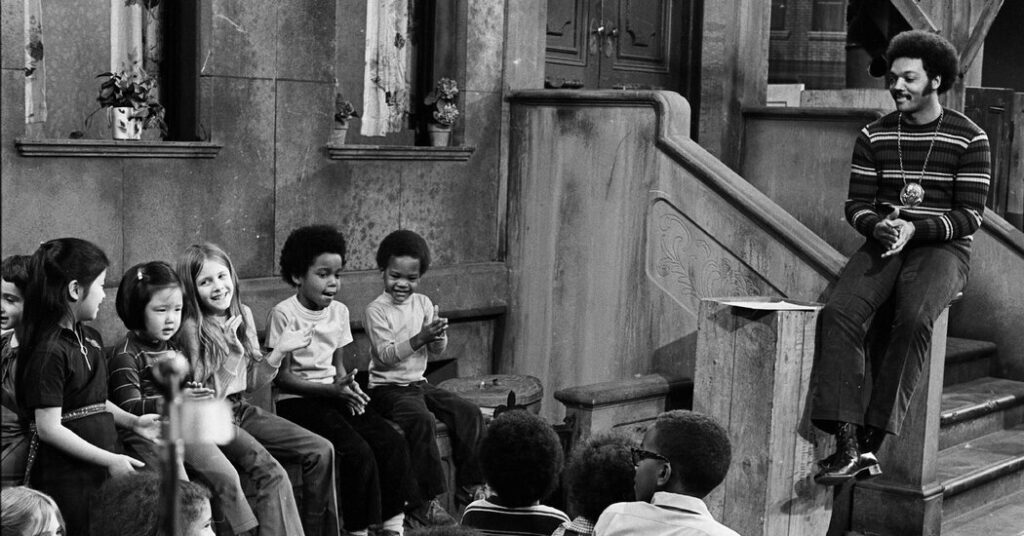
A young Black man sits on a brownstone stoop, his hair in an Afro, a medallion around his neck the size of one of Cookie Monster’s favorite treats. Before him is a crowd of children of different races and ethnicities. “Here we go,” he tells them.
“I am!” he says.
“I AM!” they repeat.
“Somebody!”
“SOMEBODY!”
The young man is the civil rights leader Jesse Jackson. The stoop is on the set of “Sesame Street,” in 1972. The call-and-response is a version of one that Jackson, who died on Tuesday at 84, led at rallies for years and recorded on an album.
And the scene remains one of the most stirring minutes and a half of children’s TV ever produced.
The cultural reach of Jim Henson’s Muppets is so great that we can forget that “Sesame Street,” first and foremost, is a show about kids. The kids here are boys and girls, of many ages and sizes.
But what they are being told is that they are people. They are not learning to be people. They are not playing at what it will be like to grow up and become people. They are people already, with the same entitlement to dignity as any towering grown-up.
They take the message in and belt it back.
“I may be small! But I am! Somebody!”
“I may be on welfare! But I am! Somebody!”
“I am Black! Brown! White! I speak a different language! But I must be respected! Protected! Never rejected! I am! God’s child! I am! Somebody!”
The kids kick their feet and fidget. Some answer with gusto, some mouth the words shyly. But there is something potent in the moment: the tiniest, most vulnerable members of society declaring that they have value and deserve respect. After all, what is a child’s first experience of rebellion and conflict with authority? It’s some version of: I am a person too! You need to listen to me!
It’s hard to imagine the “Sesame Street” of today — whose new episodes now land on Netflix — airing a statement like this (either the references to God or to welfare). But at its inception, “Sesame Street” very much was a statement. It was dedicated, like public TV generally, to reaching every part of the public. It was noticeably inclusive, to the point of encountering racist complaints and bans over its diverse casting.
Jackson’s appearance underlines that message. Here, he does not speak with the fire of a protest leader or a politician. He’s like a hip teacher or youth group leader. He engages and encourages the kids in the tones of a classroom. He is, perhaps, asking us to imagine that this is what classrooms could be like.
The message of Jackson’s litany is the beginning of education, and the beginning of democracy. It says that you have worth as a person, simply because you are a person. It says that you have a voice. And it says that your voice is most powerful when it joins with other voices.
Jesse Jackson was a lot of things as a political figure. What we see here was how much he was a true populist. His politics were centered on people, as people, as a people. And he emphasized that any movement that brought people together had first to affirm the importance of personhood.
Watching the “Sesame Street” video today, I can’t help but think about those kids on the set. They would be well into middle age today. Maybe they have children, even grandchildren. They’ve lived long enough to see that people don’t always live by the lessons they recite in school, that not everyone, in fact, has his or her somebody-ness acknowledged equally.
Chants can’t make the world perfect, nor can educational kids’ shows. They just give you tools for life, like arithmetic and the ABCs. All us “Sesame Street” kids had to go out into the world and apply those tools ourselves. But at least, if there comes a moment when you have to speak up, it helps to remember when a grown-up cared enough to tell you that you deserved to be heard.
James Poniewozik is the chief TV critic for The Times. He writes reviews and essays with an emphasis on television as it reflects a changing culture and politics.
The post When Jesse Jackson Came to ‘Sesame Street’: ‘I Am! Somebody!’ appeared first on New York Times.