President Trump repeatedly promised during his campaign that he would end the war in Ukraine in one day.
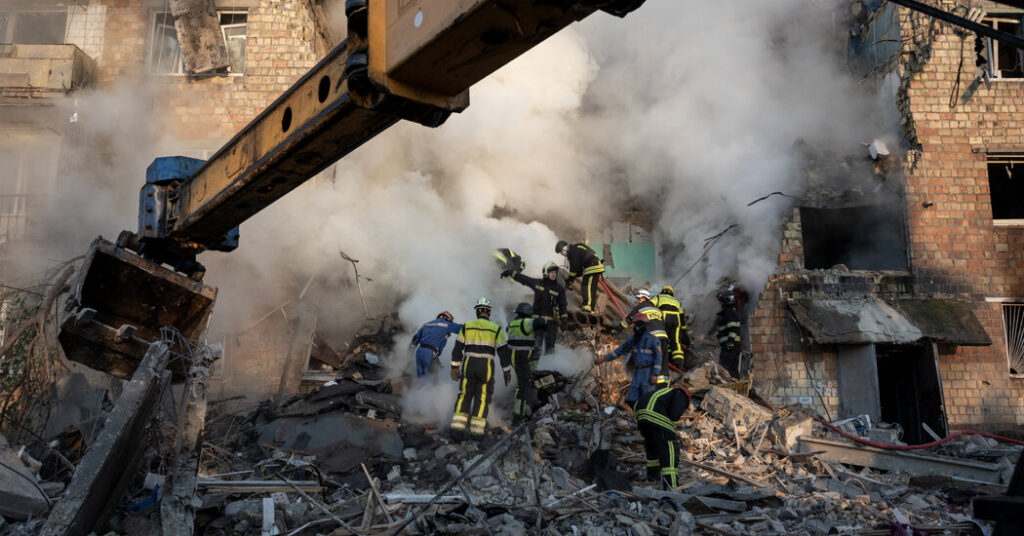
But by most measures, the war has grown worse for Ukrainians since Mr. Trump returned to the White House, not better. More civilians were killed and injured in 2025 than in the previous year. More missiles and drones are hitting city centers. Russia captured more territory in its slow-moving advances in 2025 than in any year since 2022, when it launched its full-scale invasion. Moscow has practically destroyed Ukraine’s power grid during the country’s harshest winter in more than a decade.
“It was a hard year — how else can you imagine it?” said Oleksandr Polishchuk, whose wife was one of 13 people killed when a missile slammed into their apartment building in the Ukrainian capital, Kyiv, in April. “Shelling, having to go to work, dealing with household issues, no electricity, no heating. I think it was very hard, extremely hard.”
After taking office in January 2025, Mr. Trump tossed out the American playbook for the war. He made overtures to President Vladimir V. Putin of Russia, the aggressor in the conflict and an avowed opponent of the West, while distancing the United States from Ukraine. U.S. aid to Ukraine fell by 99 percent in 2025 compared with the year before, according to the Kiel Institute for the World Economy, a German research center. Mr. Trump stopped giving American weapons to Kyiv, unless it or its Western allies paid for them.
At the same time, Russia increased its own production of missiles, drones, shells and mines. Moscow used the weapons at a rapid clip, in part to improve its position in talks pushed by Mr. Trump, who has made no secret of his desire to be credited with ending the war. Delegations from Russia, Ukraine and the United States are scheduled to hold the next round of negotiations on Tuesday and Wednesday in Geneva.
As he has moved away from a Biden administration policy of isolating Mr. Putin, Mr. Trump has succeeded in getting Russia and Ukraine to talk about settlement terms, including in face-to-face meetings in recent weeks. Mr. Trump has largely set aside traditional diplomatic principles that he said had done nothing to end the war, turning instead to negotiators he sees as seasoned deal makers. He has also imposed sanctions that have reduced the oil revenue that fuels Moscow’s war machine.
But Mr. Putin has slow-walked his way through the months of negotiations, using them to buy time to continue his assault. A year into Mr. Trump’s second term and almost four years after Russia’s invasion, Mr. Putin has signaled no retreat from his goals of taking more Ukrainian territory and imposing Russian dominance.
The White House did not respond to a request for comment for this astory.
Mr. Trump has acknowledged that the war is much harder to resolve than he thought it would be. Ukrainian officials have argued that the American president would have to take stronger action for Mr. Putin to change his thinking.
Strength is a quality that Mr. Trump prizes above most others. He has asserted that Mr. Putin “respects” him in a way he did not respect previous U.S. administrations, which he says gives him leverage. Mr. Trump has said numerous times that the war never would have happened had he been president when the full invasion began in 2022.
But Mr. Trump has shown a deference to Mr. Putin that has assuredly not been lost on the Kremlin leader. Mr. Trump has called his relationship with Mr. Putin “fantastic” and has repeatedly said that Mr. Putin “wants peace.” Mr. Trump has at times accepted Mr. Putin’s rewriting of history, including by blaming President Volodymyr Zelensky of Ukraine for starting the war.
Outside of occasional public criticism and the oil sanctions, Mr. Putin has largely dodged Mr. Trump’s threats. In July, Mr. Trump said he would give Russia “about 10 or 12 days” to end the war before imposing new sanctions. Mr. Trump then announced a summit with Mr. Putin in Alaska, and the deadline passed. A month later, Mr. Trump again threatened “massive sanctions.” But he also showed reporters a photograph sent to him by Mr. Putin of the two men in Alaska and called it a sign of honor and respect.
All the while, Moscow’s attacks inflicted a growing toll on Ukrainians. In 2025, Russia killed more than 2,500 Ukrainian civilians, more than in any year since 2022 and a 20 percent increase from 2024, according to United Nations statistics. Russia sent more than 53,000 long-range drones to civilian targets in Ukraine in 2025, almost five times as many as in 2024, according to a data set created by The New York Times using numbers from the Ukrainian Air Force.
Moscow is also increasingly firing on city centers with ballistic missiles, which move so quickly that air-defense systems have difficulty knocking them down. Russia has launched 154 of those missiles at Ukraine this year, according to the data set, about three times the number fired during the same period last year.
Oleksandra Matviichuk, a Ukrainian human-rights activist, said that the human cost of the war had been excised from the peace talks as the Trump administration treats negotiations like a real estate deal that would carve up both Ukraine and its natural resources. To lead the American delegation, Mr. Trump has chosen real-estate developers with a personal connection to him.
“There are no limits for Putin, because a human dimension is not a priority of these negotiations,” Ms. Matviichuk said. “The politicians discuss natural minerals, Russia’s territorial interests, even Putin’s vision of Ukrainian history, but they don’t speak about people at all.”
This month, Ms. Matviichuk, who runs an organization that shared the Nobel Peace Prize in 2022 for documenting war crimes by Moscow, posed a question on Facebook: “Why has Trump’s year of negotiations been the deadliest for civilians in Ukraine since the full-scale invasion?”
The post received thousands of reactions. One woman alluded to Mr. Trump’s publicly stated desire for his own Nobel, asking if he would be more loyal to Ukraine if she gave her prize to him.
Many Ukrainians, however, see Mr. Trump as loyal only to himself, and they have feared that in his rush to end the war, he will force an unjust peace on Ukraine.
Ukraine’s European allies have said that Russia cannot be rewarded for its aggression. But a 28-point peace plan drafted late last year by American and Russian envoys looked to Ukraine like a demand for surrender. Ukrainian negotiators raced to soften its provisions, and the diplomatic dance has continued for months.
Mr. Zelensky has complained publicly that the Trump administration is leaning harder on Ukraine than on Russia to compromise.
“The Americans often return to the topic of concessions, and too often those concessions are discussed in the context only of Ukraine, not Russia,” Mr. Zelensky said on Saturday at the Munich Security Conference.
As Ukrainians suffer through a brutal winter of Russian strikes, few people in the country think that Mr. Putin will agree to stop fighting anytime soon.
Russia devastated Ukraine’s power grid with repeated strikes before the first trilateral talks of the war were held on Jan. 23 and 24 in the United Arab Emirates. On Feb. 3, the day before the talks were to resume, Russia sent a record number of ballistic missiles into Kyiv, including at least five at power plants.
People in the capital have survived on as little as two hours of electricity and heat a day in recent weeks.
Many businesses have struggled this winter, including a cafe that once had the name Trump Pizza Station. The owner changed the name after Mr. Trump berated Mr. Zelensky at the White House almost a year ago, settling on the new name Nolan.
Yuliia Baliosa, 18, a bartender there, said that customers had stopped coming because they were no longer going to nearby offices or to the local university. The generator was expensive. On a recent weekday, the Nolan cafe was out of most food during lunch hours: no pizza, no burgers, nothing hot.
“It’s basically impossible to live,” Ms. Baliosa said. “Just live, really. People have become very angry. Very.”
The name Nolan means noble, a point of inspiration for the cafe’s owner. Nolan “does not embellish reality and does not exaggerate,” the cafe announced when it reopened. But last week, it closed its doors for good.
Constant Méheut contributed reporting.
Kim Barker is a Times reporter writing in-depth stories about the war in Ukraine.
The post Trump Said He’d End the War in a Day, but It’s Worsened for Ukrainians appeared first on New York Times.