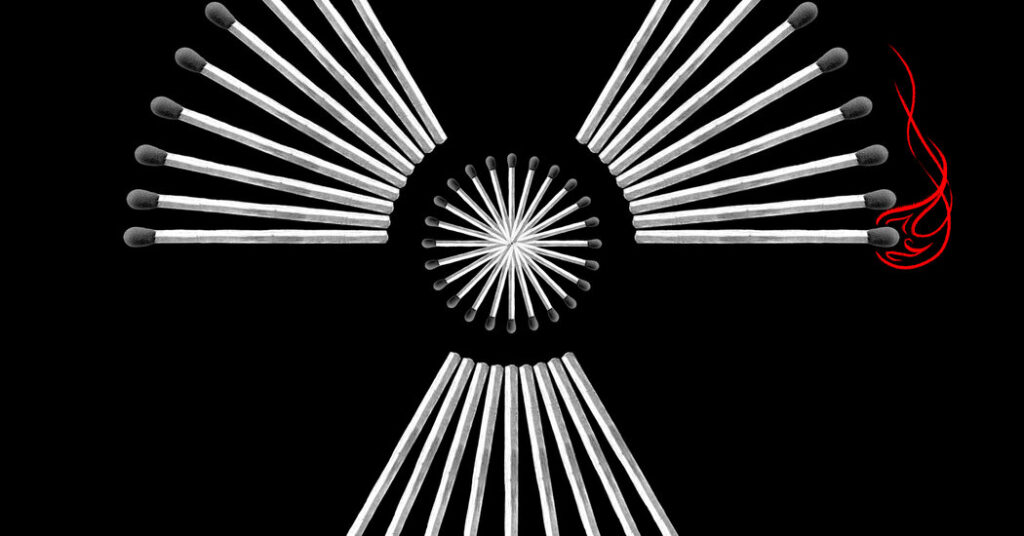
The world is entering a dangerous new nuclear age. This month, the New START treaty between the United States and Russia — the last major restraint on the world’s two largest nuclear arsenals — expired. In its place, the Trump administration is substituting a policy of vague threats and dangerous brinkmanship that portends an unconstrained arms race not seen since the height of the Cold War.
President Trump’s approach to this new, unbound era is alarming in both its words and its mechanics. Rather than preserving the stability that has held for half a century, the administration is weighing the deployment of more nuclear weapons and, perhaps most recklessly, the resumption of underground nuclear testing.
Times Opinion and this editorial board have spent the past two years documenting the terrifying reality of these weapons in our series “At the Brink.” We explored the catastrophic consequences of a single detonation, the forgotten victims of past testing and the fragility of the systems meant to prevent the unthinkable. The intention of that series was to raise public awareness about the dangers of nuclear weapons. Now that lack of awareness is being exploited to abandon the last of the international agreements that helped keep humanity safe for decades and to pursue an unchecked arms race.
The administration seems to think that when it comes to nuclear weapons, more is better. With New START gone, the Navy is studying whether to reopen disabled launch tubes on Ohio-class submarines and load additional warheads on its intercontinental ballistic missiles. The moves could more than double today’s deployed arsenal. Officials have also floated the idea of a “Trump class” warship armed with nuclear-capable cruise missiles.
The logic provided by the State Department is that the old treaty placed “unacceptable” constraints on the United States and failed to account for China’s growing arsenal. Although it is true that China is expanding its nuclear forces, ripping up existing guardrails with Russia in hopes of coercing Beijing into a deal is a strategy that has already failed. China has repeatedly made clear that it has no interest in negotiations while its arsenal is a fraction of the size of America’s. By abandoning limits, Mr. Trump is not forcing his rivals to the table; he is inviting them to sprint alongside him.
His disdain for American allies has also encouraged them to consider expanding their own nuclear promises. European leaders have begun to discuss whether France, which has nuclear weapons, should vow to protect other parts of Western Europe from Russia, given the sudden unreliability of the United States. “As long as bad powers have nuclear weapons,” Prime Minister Ulf Kristersson of Sweden told The Atlantic, “democracies also need to be able to play.” A larger nuclear umbrella for any country increases the chances that a misunderstanding or mistake will lead to devastation.
Especially disturbing is the administration’s signal that it may resume underground nuclear testing. Thomas G. DiNanno, a senior State Department official, recently said in Geneva that the United States must “restore responsible behavior” regarding testing. He was arguing that Russia and China have already been cheating on the testing moratorium — a claim for which public evidence remains scarce and disputed. Mr. Trump has previously stated that he wants to resume detonations “on an equal basis” with our adversaries.
We must be clear about what this means: The United States has not conducted an explosive nuclear test since 1992. To do so now would be strategic malpractice. As we noted in “At the Brink,” the United States has conducted more than 1,000 nuclear tests — about as many as all other nations combined. We possess a trove of data that allows us to maintain our arsenal through computer modeling without detonating a single charge. The technological gains from new tests are negligible compared with the geopolitical damage. It would shatter a global norm and almost certainly trigger reciprocal tests by Russia and China, allowing those countries to improve their own warheads.
Furthermore, the human cost of the testing era cannot be ignored. Our series documented the scars left on the people of the Marshall Islands and those in the American West who suffered from cancer and displacement from the radioactive fallout of the 20th century. To reopen the door to explosive testing is to invite a return to environmental damage and the abdication of our morals.
This administration has options to reverse course. First, Mr. Trump should refrain from ordering a resumption of explosive nuclear testing.
Second, the United States should commit to an informal one-year mutual adherence to New START limits with Russia, even in the absence of a treaty. President Vladimir Putin offered such an extension previously; Mr. Trump should test that offer rather than dismiss it. This would buy time for the better agreement that Mr. Trump claims to want, without unleashing a free-for-all in the interim.
Third, the administration must stop using the potential threat of China as an excuse to start an arms race with Russia. Today, the United States and Russia each have roughly a six-to-one warhead advantage over China — and arsenals that are more than capable of destroying any nation on earth many times over. The notion that New START is a disadvantage to the United States is wrong.
Finally, Congress must reassert its role. The president of the United States currently possesses the sole, unchecked authority to launch a nuclear war. In an era of rising tension and decaying treaties, leaving the fate of the world to the judgment of a single person — whoever it is — is a risk no democracy should tolerate.
Source photograph by NK08gerd, via Getty Images.
This Times Opinion series is funded through philanthropic support from the Carnegie Corporation of New York, the Outrider Foundation and the Prospect Hill Foundation. Funders have no control over the selection or focus of articles or the editing process and do not review articles before publication. The Times retains full editorial control.
The Times is committed to publishing a diversity of letters to the editor. We’d like to hear what you think about this or any of our articles. Here are some tips. And here’s our email: [email protected].
Follow the New York Times Opinion section on Facebook, Instagram, TikTok, Bluesky, WhatsApp and Threads.
The post Trump Risks Igniting a Nuclear Wildfire appeared first on New York Times.