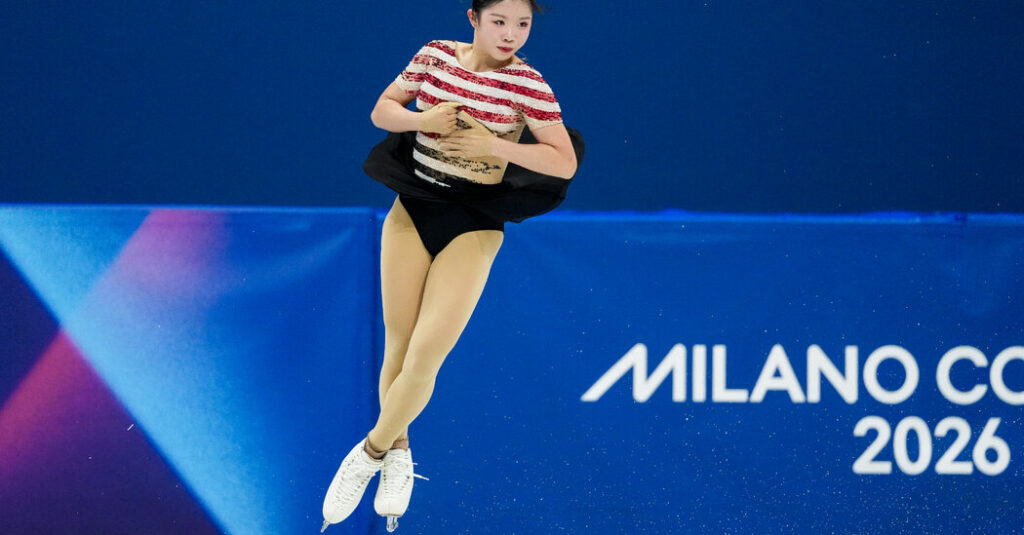
More than almost any other Winter Olympics event, women’s figure skating has had a hold on the public for generations. Though that has not changed, the sport has, evolving from the graceful twirls of Sonja Henie in the 1920s and ’30s to the energetic leaps of Tara Lipinski and Sarah Hughes.
The sport has moved on even more in recent times as women have broken out not just triples, but the hardest one, the triple Axel. That was the backdrop for the women’s short program on Tuesday night in Milan, and the 17-year-old Japanese skater Ami Nakai leaped to the lead ahead of a talented field, including the American Amber Glenn, who also hit a triple Axel but failed to complete a later triple.
The up-and-coming Nakai nailed her triple Axel in a strong program to the music from the Italian film “La Strada.” The pre-event favorite, Japan’s Kaori Sakamoto, is skating in what she says will be her final competition. She has been the best skater in the world, with three world championships, since her bronze the last Games. An elegant performance to “Time to Say Goodbye,” earned her second place.
It seems hard to believe, but the Americans are going for their first medal in this event since 2006. A national champion at just 13, Alysa Liu retired at 16, spent two and a half years away from the sport, and then returned to win a world championship. Now 20, she skated an effervescent, but solid program and nailed the difficult triple Lutz, triple loop combo to finish third.
Amber Glenn was the front-runner much of last season but has had a consistency problem. Like Nakai, she nailed a triple Axel, but dropped a rotation from a later triple and finished 12th. After her routine, she was in tears.
Victor Mather, who has been a reporter and editor at The Times for 25 years, covers sports and breaking news.
The post Triple the pressure, triple the glory. appeared first on New York Times.