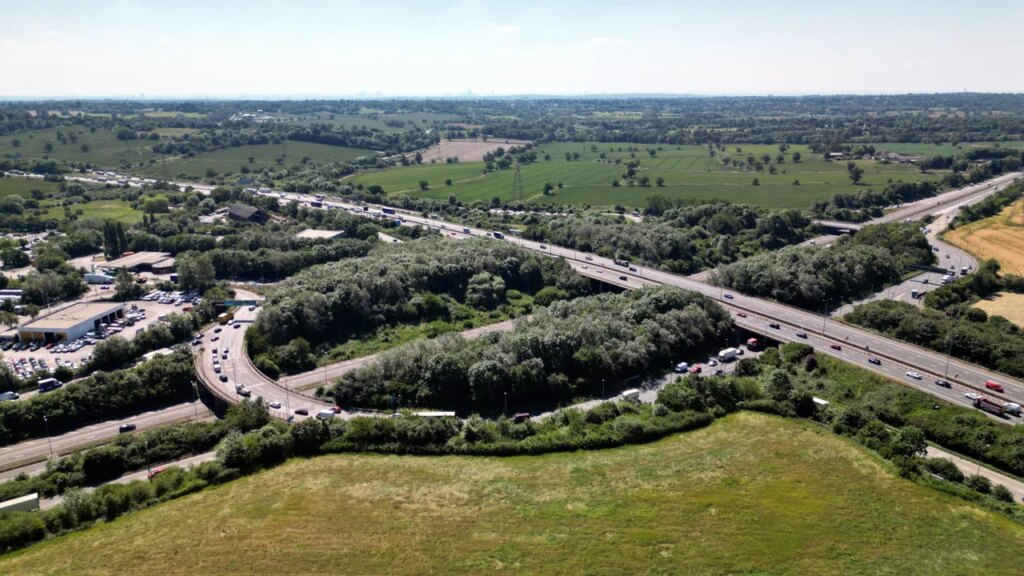
A short drive from London, the town of Potters Bar is separated from the village of South Mimms by 85 acres of rolling farmland segmented by a scribble of hedgerows. In one of the fields, a lone oak serves as a rest stop along a public footpath. Lately, the tree has become a site of protest, too. A poster tied to its trunk reads: “NO TO DATA CENTRE.”
In September 2024, a property developer applied for permission to build an industrial-scale data center—one of the largest in Europe—on the farmland. When locals caught wind, they started a Facebook group in hopes of blocking the project. More than 1,000 people signed up.
The local government has so far dismissed the group’s complaints. In January 2025, it granted planning permission. The following October, multinational datacenter operator Equinix acquired the land; it intends to break ground this year.
On a dismal Thursday afternoon in January, I huddled around a gate leading onto the farmland with Ros Naylor—one of the Facebook group’s admins—and six other local residents. They told me that they object to the data center on various grounds, but particularly to the loss of green space, which they see as an invaluable escape route from town to countryside and buffer against the highway and fuel stop visible on the horizon. “The beauty of walking in this area is coming through this space,” says Naylor. “It’s incredibly important for mental health and wellbeing.”
As the UK government races to meet the voracious demand for data centers that can be used to train AI models and run AI applications, similarly large facilities stand to be built across the country. For the people who live in closest proximity, though, the prospect that AI might buoy the economy or infuse new capabilities into their smartphone is thin consolation for what they consider a disruption to a countryside way of life.
Bonfire of Red Tape
Since the mid-20th century, London has been hemmed in on all sides by a nearly contiguous patchwork of land known as the green belt, made up of farms, forest, meadows, and parks. Under UK law, construction is only permitted on green belt land in “very special circumstances.” The aim is to protect areas of countryside from urban encroachment and stop neighboring towns from melding into an amorphous blob.
After the present government came to power in 2024, however, the UK introduced a new land classification—grey belt—to describe underperforming parcels of green belt on which construction should be more readily permitted. At around the same time, the government announced it would treat data centers as “critical national infrastructure.” Together, those changes have cleared the way for a raft of new data centers to be built across the UK.
As they attempt to develop models capable of surpassing human intelligence, the world’s largest AI labs are planning to spend trillions of dollars in aggregate on infrastructure. Across the globe, wherever new data centers are being built, developers are encountering organized resistance from impacted communities.
When the local planning authority approved the Potters Bar data center, its officers concluded that the farmland met the definition of grey belt. They also said their decision was colored by the government’s support for the data center industry. The benefits from an infrastructure development and economic standpoint, they concluded, outweighed the loss of green space.
“People have this slightly romantic idea that all green belt land comprises pristine, rolling green fields. The reality is that this site, along with many others, is anything but that,” says Jeremy Newmark, leader of Hertsmere Borough Council, the constituency that encompasses Potters Bar. “It’s a patch of very low-performing green belt land.”
The protest group disputes the reclassification of the farmland, partly on the basis that the local council recently vetoed a planning application for a housing development on a neighboring field expressly to preserve green belt and agricultural land. They ask how one field can be dispensable and the adjacent plot invaluable. “Turn around, cross the road, come to this field—and it’s grey belt,” says Eamonn Lynch, one of the residents.
The protesters also say they feel steamrolled by the planning process. During the initial public consultation, the council notified people living in 775 nearby properties about the data center plan. Simon Rhodes—another resident I met in January—went door-to-door to spread the word further. He claims to have collected hundreds of objections, which he submitted to the planning authority. By the end of the consultation, objections filed by locals outweighed signatures of support by almost two-to-one. The council granted planning permission anyway.
To try to overturn the decision, the protest group has lodged multiple letters of objection, appealed to a third-party ombudsman and the UK’s Office of Environmental Protection, and filed a complaint against Newmark personally, whom it accused of acting as a mouthpiece for the property developer.
So far, nothing has worked. The council ruled there was nothing improper about the planning process, and a standards committee cleared Newmark of any wrongdoing. “I completely reject the idea that the consultation process was flawed or that this was in any way rushed through,” says Newmark. The housing development being blocked nearby is irrelevant, he says, because every planning application is considered in isolation.
“Get With the Program”
Faced with the complaints of the protest group, the local government has promoted the anticipated benefits of the new data center to the local economy and labor market.
Equinix estimates it will spend more than $5 billion on the development, which it expects to create 2,500 construction jobs and 200 permanent roles. Once operational, the data center is set to generate roughly $27 million in annual property tax, the council estimates, half of which will be retained by the local government and directed towards frontline services.
“For anybody to suggest that an investment at that level, in a place like this, will not have a major impact on our local economy is seriously misguided,” says Newmark. “There is ample evidence that data centers attract other high-tech businesses to cluster nearby. The effect is potentially exponential.”
While Equinix has 14 data centers in the UK, this would be its first on a rural site there. The company was attracted to the Potters Bar plot for its proximity to major population hubs and existing Equinix facilities—which helps to reduce latency—and for the strength of the local power infrastructure, says Andrew Higgins, global head of masterplanning and sustainability at Equinix.
The company will lease space in the facility to various clients, many of which will be running AI workloads, says Higgins. “If we want to continue to have the UK being a world player, absolutely data centers have to be built,” he says.
Equinix says half of the site will remain as green space; to increase biodiversity, the company will introduce ponds, wetlands, meadows, and new trees. “Sincerely, I can empathize with people who live in a rural community and are used to that landscape,” says Higgins. “I hope that we can demonstrate there is a path to responsible development.”
Higgins says he has never encountered a situation where planning permission for an Equinix site has been subsequently withdrawn.
“Ultimately, I believe it’s a very small number of admittedly very vocal people who take a dogmatic view that we exist in a binary where you can have either green belt or growth,” says Newmark. “My advice to them would be to get with the program.”
For Equinix to begin construction, it must hurdle a final stage in the planning process, obtaining permission for the particulars of its plan for the site. For the planning permission to remain valid, it must begin construction within three years of final approval being granted.
To that end, part of the protest group’s strategy is to mount a sort of filibuster, by objecting at every possible opportunity. “I think the pressure group, depending how well-organized it is, can make a big difference,” says Michael Batty, emeritus professor of planning at University College London. “The whole idea of public objection is writ large in the planning system in Britain.”
A Dog in the Fight
That afternoon in January, after the other residents had left, I walked a lap of the farmland with Janet Longley, a semi-retired teacher who has lived in the area since the 1980s. As we trailed after her boxer dog, Lola, ankle-deep mud sucked at our boots. We stopped under the oak tree.
Longley, whose husband works in IT, is clear-eyed about the potential for data centers to contribute to expanding the national economy and the value of the digital services they make possible. “I don’t like the idea of being a NIMBY, because we need these things,” she says. “I use the internet all the time.”
Nonetheless, Longley resents the green space where she has walked her dogs for so many years being dismissed by the council as dispensable. She can’t help but wish this thing would be built somewhere else.
“Beauty is in the eye of the beholder,” said Longley, gesturing across the field. “It is actually beautiful. Just maybe not so much today.”
The post The Small English Town Swept Up in the Global AI Arms Race appeared first on Wired.