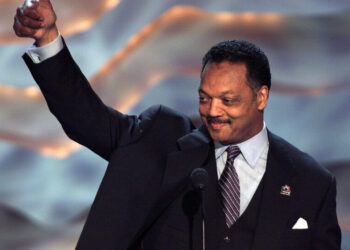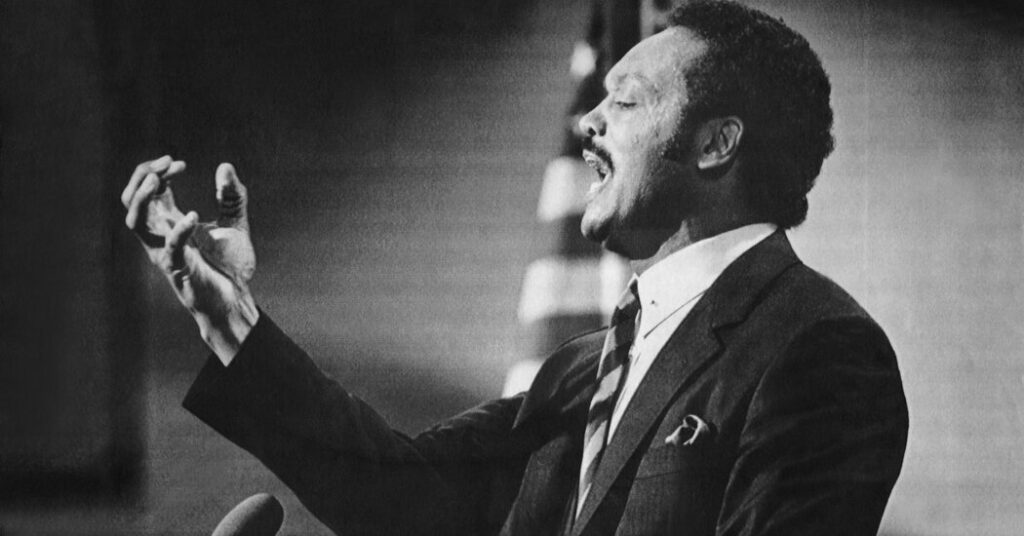
In 1984 in San Francisco, Jesse Jackson delivered a speech at the Democratic National Convention that helped unify the fractured party and redefine the modern Democratic base. “The Rainbow Coalition” speech, as it is known, is regarded as one of the most significant addresses in the history of American politics and helped shape a progressive vision for the party.
Mr. Jackson was coming off an unsuccessful presidential primary run when he delivered the speech, coming in third behind Senator Gary Hart of Colorado and former Vice President Walter Mondale, the eventual nominee. In his address, he urged the party to embrace a diverse, multiracial and multi-class alliance, encouraging the inclusion of marginalized groups, including the poor, workers and minorities.
The speech, which was evangelical in tone and contained numerous biblical allusions, described the country as a patchwork quilt.
“Our flag is red, white and blue, but our nation is a rainbow — red, yellow, brown, black and white — and we’re all precious in God’s sight,” he said. “America is not like a blanket — one piece of unbroken cloth, the same color, the same texture, the same size. America is more like a quilt — many patches, many pieces, many colors, many sizes, all woven and held together by a common thread.”
He argued in the address that the party should expand its coalition and embrace his constituency: “The desperate, the damned, the disinherited, the disrespected, and the despised.” He also pushed for patience and understanding.
“We must be unusually committed and caring as we expand our family to include new members,” he said. “All of us must be tolerant and understanding as the fears and anxieties of the rejected and of the party leadership express themselves in so many different ways.”
Mr. Jackson used the speech to attack President Ronald Reagan’s “trickle down” economic theories and argued for a renewed focus on the poor and the marginalized. He recited a list of what he saw as Mr. Reagan’s offenses against his coalition, including attacks on health care, education and food stamps, and used the speech to put forward what he saw as the mission of the Democratic party.
“This is not a perfect party,” he said early in the address. “We are not a perfect people. Yet, we are called to a perfect mission: Our mission, to feed the hungry, to clothe the naked, to house the homeless, to teach the illiterate, to provide jobs for the jobless, and to choose the human race over the nuclear race.”
Mr. Jackson had run a heated campaign against Mr. Mondale, who won the Democratic nomination, and he used the address as an olive branch to help unify the party after the bruising primary.
“If there were occasions when my grape turned into a raisin and my joy bell lost its resonance, please forgive me,” he said, adding: “I am not a perfect servant. I am a public servant doing my best against the odds. As I develop and serve, be patient.”
While the overarching theme of the speech was unity, Mr. Jackson ended the address by emphasizing the ideas of hope and change.
“I just want young America to do me one favor, just one favor: exercise the right to dream,” he said.
He added later: “Our time has come. We must leave the racial battleground and come to the economic common ground and moral higher ground. America, our time has come.”
In his conclusion, he drew from “The New Colossus” by Emma Lazarus, the sonnet at the base of the Statue of Liberty. He said, “Give me your tired, give me your poor, your huddled masses who learn to breathe free and come November, there will be a change because our time has come,” he said.
While Mr. Jackson’s two presidential campaigns in 1984 and 1988 did not earn him a nomination, he helped register millions of Black voters and built a multiracial coalition of voters, many of whom would remain politically active in the Democratic Party for decades.
Jonathan Wolfe is a Times reporter based in London, covering breaking news.
The post The Jesse Jackson Speech That Helped Redefine the Democratic Party’s Base appeared first on New York Times.