1 p]:text-cms-story-body-color-text clearfix”>
He whispered in the ears of the powerful, strode the battlefield like a god of war and ultimately embodied both of those extremes in performances of exquisite complexity. Robert Duvall’s death on Sunday at age 95 signifies not just an incalculable loss to movie fans, but also the turning of a generational page, away from the dazzling character actors who redefined screen performance in the ’60s and ’70s to a new, as yet undefined group who will carry the work further. While Duvall’s filmography is too rich for us to be comprehensive — even when he’s on the margins, he shines — here are our 10 favorites, presented in the order of their release.
2
‘To Kill a Mockingbird’ (1962)
p]:text-cms-story-body-color-text clearfix”>
How marvelous that Duvall made his screen debut as Boo Radley in the 1962 classic “To Kill a Mockingbird.” So what if the role had no dialogue? An unknown theater actor couldn’t ask for a better drum roll than a script that talks about his character nonstop but doesn’t show his face until the last five minutes. To young Scout (Mary Badham), Boo is the neighborhood bogeyman who stabbed his abusive father with scissors and spent years locked inside a bat-infested cell. When she gets her first real peek at him, he’s stabbing someone again in self-defense. Even so, what a jolt to finally see Duvall’s pale, blond Boo hiding behind a door as though (justly) scared of the spotlight. He barely allows the petrified Boo to twitch, yet somehow, we catch a glimpse of the qualities Duvall the actor will go on to reveal: dangerous and vulnerable, mythic and man-sized, electrifyingly watchable. — Amy Nicholson
3
‘The Godfather’ (1972) and ‘The Godfather Part II’ (1974)
p]:text-cms-story-body-color-text clearfix”>
There are many reasons why “The Godfather Part III” didn’t work. The script was rushed, the plotting tangled and confusing. The supporting characters were forgettable. Poor Sofia Coppola, a last-minute replacement for Winona Ryder, flat-out couldn’t act.
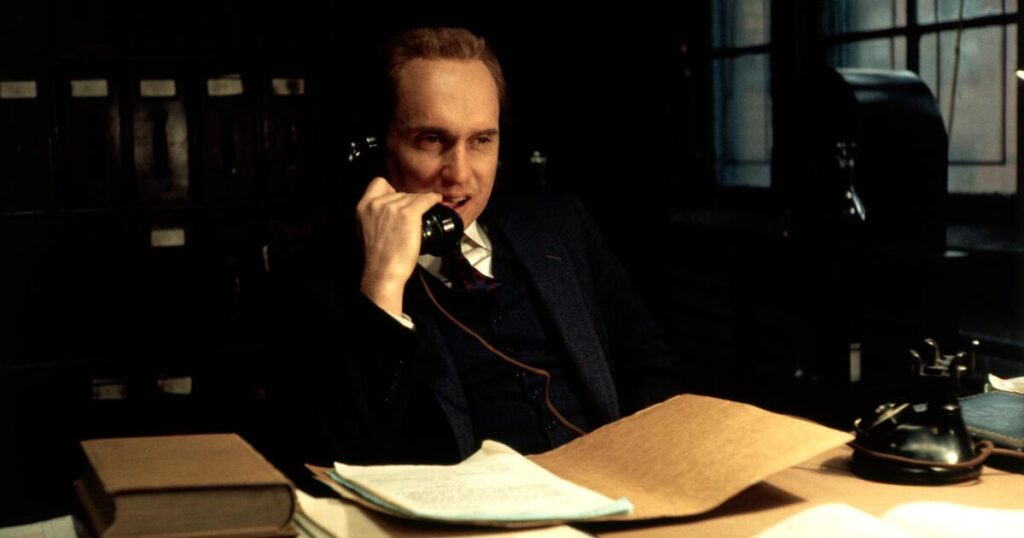
But the biggest problem: There was no Duvall. Casting George Hamilton instead of making Duvall an offer he couldn’t refuse to reprise his role as Tom Hagen, the loyal, level-headed consigliere of the Corleone family, doomed “Part III” before the cameras even rolled. Duvall’s coiled intensity was a key element in the first two “Godfather” movies. He was the outsider, the Irish-German adopted son of Vito Corleone. No, he didn’t have Sicilian blood, but that allowed him to be the calm tactician while Sonny was out bada-binging his way through a full-scale war with the five families.
Every Duvall scene in these movies is perfect. The best involve Tom working to persuade someone that it’s in their best interest to go along with the family’s wishes. Sometimes it plays out smoothly, like when he talks Roman history with informant Frank Pentangeli in “Part II,” letting him know that his family would be taken care of should he die. Sometimes it doesn’t and there’s a horse’s head under your nice clean sheets. That’s the nature of diplomacy. As Tom famously says, “This is business, not personal.” And with Duvall stating it, how could you argue? — Glenn Whipp
4
‘Network’ (1976)
p]:text-cms-story-body-color-text clearfix”>
Written by Paddy Chayefsky and directed by Sidney Lumet, this acidly funny satire of the TV news business is best remembered for Peter Finch’s “I’m mad as hell” on-air breakdowns and Faye Dunaway’s manic pursuit of ratings — performances that earned both of them Oscars. But Duvall works on a different frequency, making the corporate machinery of the network feel even more unsettling than the chaos on camera. As UBS executive Frank Hackett, he charges through meetings barking orders and treating morality as disposable: the cost of doing business. While others rant idealistically, Hackett keeps steering everything back to what will play with the affiliates and what the network can sell. Even the idea of killing an increasingly unhinged anchor becomes, in his hands, not an ethical crisis but a programming decision. Watching it now, the performance feels disturbingly prescient, offering a glimpse of the managerial mindset that would eventually reshape American media into a pure war for attention. — Josh Rottenberg
5
‘Apocalypse Now’ (1979)
p]:text-cms-story-body-color-text clearfix”>
You know this performance well, but consider how much Duvall gets done in such a small amount of screen time. Kilgore’s barrel-chested, stiff-backed swagger is the whole of American imperialism in a single posture. Strumming a guitar at an unlikely cookout deep in country, Duvall somehow manages to convey fearless confidence and a singular brand of well-armed bonhomie that has no equivalent in movies. (He’s more like a “Catch-22” creation.) Kilgore leads his cavalry into air battle to the strains of Wagner, taking out combatants in between swigs of coffee. Later, he commands the boys to surf and the movie’s surreal take on war snaps into place. Every one of his lines has become iconic, but Duvall’s final moment in the film might be his most darkly funny and haunting: “Some day this war’s going to end,” he cryptically says. Then he walks away, untroubled. — Joshua Rothkopf
6
‘The Great Santini’ (1979)
p]:text-cms-story-body-color-text clearfix”>
For some of us who grew up in the ’70s and early ’80s, “The Great Santini” was the first time Duvall’s ferocity hit you where you lived. Adapted from Pat Conroy’s autobiographical novel and set in 1962, the film casts the actor as Lt. Col. Wilbur “Bull” Meechum, a volatile Marine fighter pilot stationed with his family in Beaufort, S.C., who runs his household like a command post. At once grandiose and insecure, Meechum turns pickup basketball games into tests of will and teases his son Ben (Michael O’Keefe) to the edge of cruelty, wielding the self-bestowed nickname “the Great Santini” like a boast and a shield. Just two months after appearing as the swaggering Kilgore in “Apocalypse Now,” Duvall offered a more intimate variation on a military man — essentially Kilgore without an actual war, just a domestic battlefield. “The Great Santini” struggled to find an audience — the studio fretted that the title sounded like a circus movie — but the performance earned Duvall his third Oscar nomination and confirmed he could carry a film on his uneasy balance between charm and menace. — Josh Rottenberg
7
‘Tender Mercies’ (1983)
p]:text-cms-story-body-color-text clearfix”>
Duvall won his only Oscar for his role as a former country star slowly trying to rebuild his life after fading into obscurity due to his out-of-control drinking. Written by Horton Foote — an ongoing collaborator of Duvall’s going back to the actor’s film debut in “To Kill a Mockingbird” — “Tender Mercies” has a stripped-bare quality, a simplicity and directness that only places its complex emotions in stronger relief. Rather than the explosive fits of some of Duvall’s other performances, there is a sustained sense of a man trying to control the turmoil within himself. In one of the film’s most stirring moments, indicative of its quiet power, Duvall keeps his back to the camera as he sings a lullaby hymn only for himself. Drawing the audience in with just his pleading voice and vulnerable physicality, Duvall expresses a lifetime of regrets. — Mark Olsen
8
‘Falling Down’ (1993)
p]:text-cms-story-body-color-text clearfix”>
The cop on his last day before retirement is a trope that needs to be sent out to pasture. After Robert Duvall in “Falling Down,” who can top it? Michael Douglas has the sweatier, showier role as a hair-trigger depressive on a cathartic spree of L.A. destruction. We’re tempted to root him on — and for a while, we do — but Duvall’s wise and weary Sgt. Martin Prendergast simply won’t let us turn Douglas’ “D-Fens” into a hero. He steers the romantic violence back into reality, and despite the movie’s slippery empathy for how D-Fens has been betrayed by the system (and Prendergast’s own sour opinion of his bosses), he doesn’t hesitate to insist that the man who just frightened his ex-wife and daughter with a gun is, in fact, the bad guy. As he vents at the climax, “They lie to everybody — they lie to the fish!” — Amy Nicholson
9
‘The Apostle’ (1997)
p]:text-cms-story-body-color-text clearfix”>
Duvall threw himself body and soul into the galvanic cadences (“Holy Ghost power!”) of Pentecostal preaching in order to summon this exhilarating performance, certainly among his best. His Sonny, a Texas evangel with a devoted flock, is deeply flawed — to watch the way his wife flinches when he approaches her tells its own sad backstory. But the movie has much more in store for its title character than a mere redemption arc. Duvall shades Sonny’s run from the law into a nuanced portrayal of wounded pride and unanswerable questions. One of the many beauties of this indie is the way faith seems to be a renewable resource, even among strangers; it’s a story about the transporting power of religion that anyone can appreciate. Consider, too, that Duvall also wrote the original script and directed it, and you’ll realize that his full talent went deeper than most realized. — Joshua Rothkopf
10
‘The Judge’ (2014)
p]:text-cms-story-body-color-text clearfix”>
Robert Duvall earned seven Oscar nominations over the course of his celebrated career, the last for the 2014 legal drama “The Judge,” a movie no one would have in the upper echelon of his filmography. But it is the one that put me in a theater with him and co-star Robert Downey Jr. for a Q&A following a screening — with Duvall being so gruffly funny that I nearly fell out of a director’s chair several times. If you’ve seen “The Judge,” you know there’s a lot going on in this movie. There’s a story about an estranged father (Duvall) and son (Downey). There’s a criminal mystery involving the dad. There’s a courtroom drama. There’s a love story. There’s a nod to the sublime, sugary pleasures found in a piece of Bit-O-Honey. It’s unwieldy and imperfect but also at times quite moving thanks to the superlative work of its stars. Downey, a producer, said he saw the movie about 20 times and cried at the end of every viewing. Duvall had seen it twice. Did you cry, I asked him. “I didn’t cry but I got moved,” he answered. “Same thing.” “I cried enough for both of us,” Downey added. Duvall smiled. “I cried when I got paid.” Spoken like a consummate working actor. — Glenn Whipp
11
‘Widows’ (2018)
p]:text-cms-story-body-color-text clearfix”>
Continuing to act into his 80s and 90s, Duvall could convey full lives and experiences even in small supporting roles. In Steve McQueen’s dynamic crime thriller, Duvall plays a Chicago politician who has long been a part of the local power structure attempting to hand things off to his son. He is plainly not a good man, with a casual racism and contempt for his own constituents, but in just a few scenes Duvall somehow gives the character a stalwart appeal, someone who sees himself as manning the barricades against impending societal change. In a moment with Colin Farrell as his preening son, Duvall is shocked and disappointed by how things are being handled. Unfurling a beautifully outrageous string of obscenities, Duvall threatens a beating, noting “And I can still do it, believe me.” And not a single person watching would doubt the truth of that. — Mark Olsen
The post Robert Duvall’s legacy in 10 essential films appeared first on Los Angeles Times.