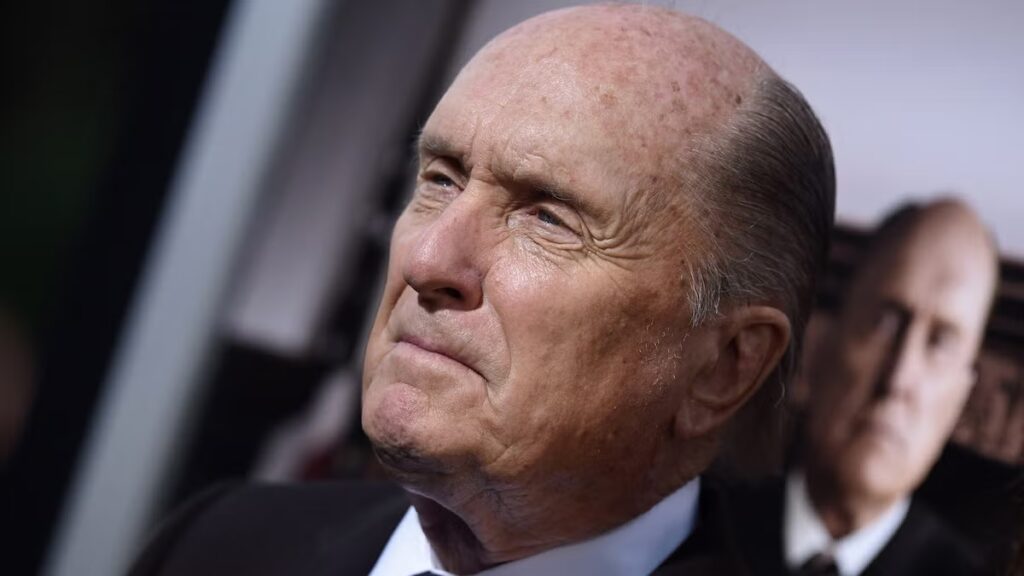
It’s common to praise an actor by calling him a real scene-stealer, and you could say that about Robert Duvall, who died on Sunday at the age of 95.
Duvall, after all, was a commanding presence in films from “To Kill a Mockingbird” to “The Pale Blue Eye,” picking up seven Oscar nominations and one win along the way. He also delivered one of the formidably and endlessly quotable lines in cinema history in “Apocalypse Now” when his character, Lieutenant Colonel Bill Kilgore, squats shirtless on the beach and says, “I love the smell of napalm in the morning.”
But really, to call him a scene-stealer misses the point. Robert Duvall didn’t steal scenes so much as he grounded them. He played his share of showy roles, Kilgore being one of them and Frank Hackett in “Network” and “Bull” Meechum in “The Great Santini” being others, but his approach was never showy. When he first got the role in “Apocalypse Now,” he lobbied director Francis Ford Coppola not to give the guy more juicy lines like the one for which he’s known, but to tone down the character and make him less over-the-top.
It’s entirely appropriate that Duvall got his start in the movie business in “To Kill a Mockingbird” playing Arthur “Boo” Radley, a reclusive neighbor who is thought to be a ghost but turns out to be a quiet hero. Duvall didn’t play monsters, he played human beings, and he played them with relentless and eloquent understatement. Marlon Brando’s Don Corleone in “The Godfather” is powerful because he can be the calm in the eye of the storm, but Duvall’s Tom Hagen is the consigliere who creates and guards that quiet, who moves the world one whisper at a time.
In the last decades of his life, Duvall would mostly show up in small roles, but he calmly brought the weight of his decades to those characters. Having Duvall in your movie, even for just a scene or two, was a sign that you meant business, and a bar that every other actor in the movie would try to reach. He raised the bar for Billy Bob Thornton in “Sling Blade,” for Tom Cruise in “Jack Reacher” and most notably for Jeff Bridges, who won the Best Actor Oscar for playing a washed-up country singer in the 2009 drama “Crazy Heart” – alongside, in a small but key role, Duvall, who had won the Best Actor Oscar for playing a washed-up country singer in the understated drama “Tender Mercies” 26 years earlier.
In conversation, he could be as taciturn as many of his characters. He didn’t volunteer a lot in interviews, but neither was he difficult; he would answer what he was asked without any hype or overstatement, and he’d call you sir while he was doing it. The baseline seemed to be that he showed respect and wanted it in return, a worldview that didn’t always fly in Hollywood. “If you’re Brad Pitt, you can get anything you want made,” he once told me of trying to get a pet project off the ground. “But for other people, it’s hard.”
Back in December, the gifted Austin-based singer Joe Ely passed away – and in the aftermath of that death, which hit me hard, I found myself listening to Ely’s great recording of the Billy Joe Shaver song “Live Forever,” which speaks to a life that’s sustained through art even after the person is gone. There’s a haunting version of that same song on the soundtrack to “Crazy Heart,” this one sung a cappella by Duvall.
“Nobody here will ever find me But I will always be around Just like the songs I leave behind me I’m gonna live forever now”
He tosses off the song casually and quickly in less than a minute; there’s not a trace of melodrama or overstatement. It’s not a performance by somebody who’s interested in stealing the scene; it’s a testament from someone who was all about being right and true and honest. And somebody who, in a lot of ways, is gonna live forever now.
The post Robert Duvall Didn’t Steal Scenes. He Grounded Them. appeared first on TheWrap.