A kooky amateur inventor named Wallace and his loyal pet pooch, Gromit, employ an untested invention to dispel a rabbit infestation at the estate of the grand Lady Campanula Tottington. A flock of rebellious chickens plots to escape a prisonlike egg farm. A band of swashbuckling pirates accidentally kidnaps Charles Darwin.
The whole cast and crew are here at the Young V&A museum in London for the exhibition “Inside Aardman: Wallace and Gromit and Friends” — in idiosyncratic humor and resplendent visuals, in two and three dimensions, in still and moving images.
Whatever your knowledge of the characters and the movies they feature in, the show offers a fascinating and immersive look behind the scenes of Aardman, the Bristol, England-based animation studio that created them. Founded 50 years ago by Peter Lord and David Sproxton, Aardman is known for its pioneering and singular use of stop-motion film techniques and special effects combined with madcap and hilarious narratives.
The exhibition is targeted at audiences aged 8 to 14, but there’s something for everyone, particularly in the sense that children’s films can transcend age and taste, and unify with visual innovation and playful storytelling.
This is certainly true for their makers. Across a series of process-themed spaces — atmosphere, storyboarding, worldbuilding, sets and models, sound, lighting, animation, visual effects, voice-over — videos of the team behind the Aardman world reveal their painstaking and devoted practice.
The show begins at the beginning, with one-minute shorts of Morph, a small terra cotta-colored Plasticine man who lives in a wooden box and speaks gobbledygook. (Think of a high-pitched version of the Swedish Chef from “The Muppets.”)
Morph will be familiar to an older generation of BBC watchers who tuned in to the 1970s children’s show “Take Hart,” and he undertakes various self-directed activities — soccer, card tricks, April Fools gags, painting, hide-and-seek — that often go awry.
His Plasticine form is supple enough to transform into whatever shape the madcap narrative requires — an inventive plasticity that’s both funny and visually mesmerizing.
He can mimic objects, extrude parts of himself to produce other forms, squeeze or expand to fit through spaces: You can’t look away, but moreover, this early work shows how inspired, and intelligent, children’s entertainment can be — an important constant in the Aardman universe.
Because of the infinitesimal movements required to generate nuanced movement and expression using puppets and clay models, it takes animators a week to make roughly six seconds of film.
Plotlines go through intense storyboarding and joke revisions for years; characters are sketched and resketched, fine-tuning the shape of Gromit’s nose, for instance, or Lady Tottington’s wardrobe. A character might have upward of 22 clay mouthpieces for a single sentence that are swapped mid-vowel or consonant to produce the appearance of smooth speech and aid lip-syncing.
There are numerous do-it-yourself stations for visitors, and I’ll admit that my attempts at stop-motion with some toy cars and Lego were disastrous. Other stations allow you to take on the role of a lighting technician, pressing buttons and sliding switches to dim or illuminate the prison cell of Feathers McGraw, the infamous bandit penguin from “Wallace and Gromit: Vengeance Most Fowl” (2024), or try a hand at Foley artistry, clomping a pair of heavy shoes, banging coconuts together, scraping a saw along a rough surface to make a soundtrack of everyday life.
More traditional museum-style displays also show drawings and backdrops, props and ephemera, puppets and models of varying sizes.
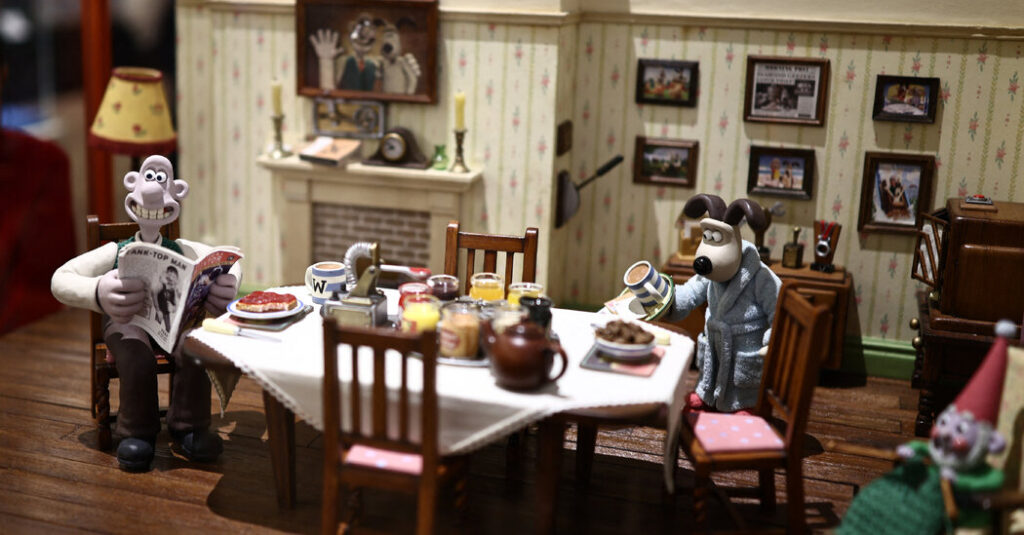
The pirate ship from “The Pirates! In an Adventure With Scientists!” (2012) is surprisingly enormous — Aardman’s largest ever model — and was built in pieces that could be taken apart and moved around. By contrast, Wallace and Gromit’s homey living room is modest but chock-full of detail you might miss in the moving images of the film: Peer closely and you will see, on the mantel, an unopened overdue bill next to a well-thumbed copy of “A Room of One’s Own” by Virginia Woolf — or in this case Virginia Woof.
Whether you spend time scrutinizing the minute details of the brilliantly varied models and puppets, inspecting the intricate scheduling board that shows the planning and filming of scenes over weeks of production, or kicking back to watch a selection of clips from Aardman films over the last half century, you’ll leave the exhibition with a sense of how much work — and how much fun — it is to imagine so many different worlds within our own.
The post Peeking Behind the Scenes of ‘Wallace and Gromit’ appeared first on New York Times.