What might be worse than the first day of a monthlong scrambling of train, bus and ferry service for hundreds of thousands of commuters just trying to get into Manhattan?
Overly chipper transit employees.
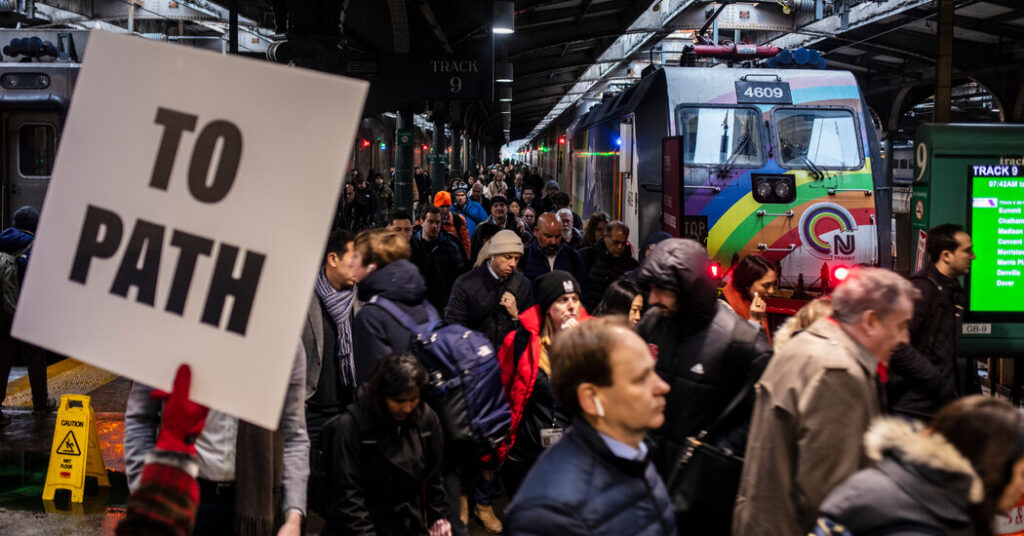
“Welcome to the party!” an NJ Transit worker shouted into a bullhorn at Hoboken station in New Jersey as she corralled train riders inching toward a crowded platform.
“Please move on down! We’ll make room! We’re just doing a little two-step shuffle!”
On Tuesday, New Jersey commuters, who weren’t feeling particularly festive, got their first taste of weekday service disruptions caused by work on the Portal Bridge, a century-old span and critical choke point along the Northeast Corridor, the busiest passenger rail route in the United States.
The so-called cutover project, in which complicated infrastructure from the 116-year-old bridge will be moved to a new and taller one, is expected to have a major effect on the rush hour commutes of NJ Transit, PATH and Amtrak passengers until March 15, if not longer.
Amtrak, the national railroad, owns the Portal Bridge and its replacement, the Portal North Bridge. But the crossing over the Hackensack River is most frequently used by NJ Transit, which is cutting its weekday service over the span roughly in half, to 178 trains from 332. Amtrak also reduced weekday service on its Acela, Northeast Regional and Keystone lines, and a number of related services warned customers of cascading delays.
The bridge, an important segment of the Northeast Corridor, ferries as many as 200,000 people a day.
Riders of NJ Transit’s Midtown Direct lines, which typically go to Pennsylvania Station in New York, were being diverted on weekdays to Hoboken station, where they could make a free transfer to Manhattan with the No. 126 bus, NY Waterway ferry or the PATH train. The services have warned of overcrowding and unexpected delays, and have asked riders to work from home, when possible.
Transit officials said the project, a major step toward replacing a bridge that has been the cause of countless delays, was both necessary and overdue.
For decades, the 961-foot Portal Bridge, which is designed to open for maritime traffic below, has frequently gotten stuck, forcing workers to slam tracks back into place with sledgehammers. It has been the site of at least two fires, and even when traffic is moving smoothly, its outdated design requires trains to slow down.
Transit advocates have long awaited the arrival of a new bridge, which could be in service as early as this year. Tom Wright, the president of the influential Regional Plan Association, called the work “short-term pain for long-term gain,” with no alternative that would be less disruptive to riders.
“This is the right way to do this kind of work,” he said.
Still, transit officials concede, things will get worse before they get better.
Kris Kolluri, the chief executive of NJ Transit, greeted harried riders on the Maplewood, N.J., platform early Tuesday.
Michelle Salerno, who spotted the executive on her way into work, was unimpressed.
“It’s going to take a lot more than a handshake to make up for a month of inconvenience,” she said.
Christina Cammaroto, 35, who usually rides NJ Transit from New Providence, N.J., to Hoboken, said she felt lost in the shuffle. The line to the ferry she normally took to Lower Manhattan was longer than usual and the boat was delayed, because the operator was dealing with the overflow.
“This is the most unreliable transit system that I’ve ever taken in my life,” she said. “Nothing is ever actually what it is, or what they claim it will be.”
Others were more understanding. Peter Ballas, 70, a four-decade veteran of NJ Transit who works above Penn Station in Midtown Manhattan, had prepared for the worst. He opted to take the 113X bus rather than his typical train to avoid hiccups.
“It’s got to get done,” he said of the bridge construction.
More surprises for riders could be on the way.
On Sunday, the first day most service changes went into effect, NJ Transit officials apologized after 27 trains were canceled, citing work schedule issues with their unionized engineers.
A spokesman for the Brotherhood of Locomotive Engineers and Trainmen, which represents NJ Transit engineers, disputed that the weekend delays had been caused by their workers.
James P. Louis, the union’s national vice president, said in a statement that “work assignments for engineers were issued at the last possible moment and riddled with errors.”
On Tuesday morning, the union said, at least five trains were canceled because of ongoing scheduling issues and that more disruptions were likely.
John Chartier, a spokesman for NJ Transit, said the process had been “a collaborative one with the unions,” but that the window for assigning the work had been shorter than usual.
Emily Jabbour, the mayor of Hoboken, said in a statement on Tuesday that the morning commute had gone “relatively smoothly.” The real test, she said, begins Wednesday, when more commuters return to work.
Dodai Stewart, Andy Newman, Davaughnia Wilson, Mark Bonamo and Sean Piccoli contributed reporting.
Stefanos Chen is a Times reporter covering New York City’s transit system.
The post NJ Transit Commuters Grumble as Bridge Work Disrupts Train Rides appeared first on New York Times.