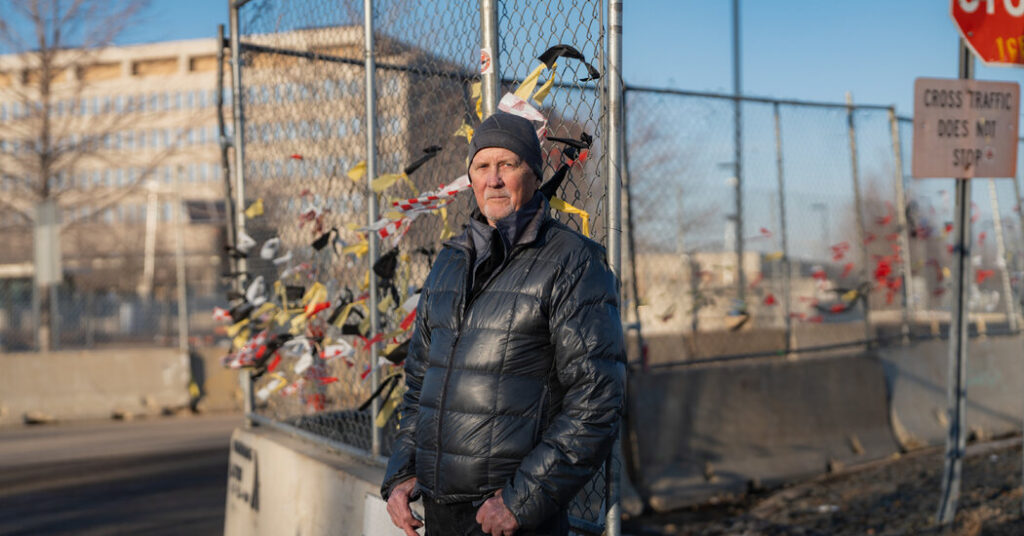
Tom Kendall, 78, can usually spot a fellow veteran outside the Whipple building near Minneapolis, where he has stood in his gray parka keeping tabs on federal immigration agents’ vehicles for six weeks.
Some wear military insignia on their hats or coats, identifying themselves as veterans of wars in Korea, Vietnam, Iraq or Afghanistan. Others are people he has slowly gotten to know over conversations in the bitter cold, as they have demonstrated together in opposition to the immigration crackdown. Late last week, there were dozens more veterans than usual outside Whipple, the home base for federal operations in the region, drawn by a boisterous protest organized by a veterans’ group.
In the Twin Cities, veterans of the U.S. military have been among those on the front lines of protest during the Trump administration’s immigration enforcement operation that has convulsed the Minneapolis area for months and was expected to wind down in the coming days.
Veterans, who make up about six percent of the U.S. adult population, are often visible members of protests around the country. But they bring a unique perspective to the conflict between some members of the American public and immigration agents that has played out in Los Angeles, Chicago and, most recently, in the Twin Cities.
While many veterans favor a crackdown on illegal immigration and some have even gone on to work as federal immigration agents, veterans who have been protesting in Minnesota said they view the operation through the lens of their own military experience. Some said they were troubled to recognize weapons used by agents that were similar to those they carried overseas. Many of them said their sense of patriotism drove them to protest.
“I can’t speak for all the veterans,” said Mr. Kendall, who served in the U.S. Air Force. “But a lot of us feel that we protected America once, we’ll protect America again.”
It has been more than two months since the Trump administration began the crackdown that sent thousands of Immigration and Customs Enforcement agents into Minnesota. Trump officials said the effort was necessary to arrest undocumented immigrants, particularly those with violent criminal records, who have dodged the legal system in the Twin Cities, and have defended their tactics as lawful and claimed that the state was safer because of the operation.
But the operation drew widespread criticism from Minnesota residents, including those who have served in the military and have seen armed conflict up close. In interviews, veterans participating in anti-ICE efforts said they were especially dismayed to see ICE agents patrolling streets recklessly in their own country, wearing masks and treating civilians roughly.
“These guys are drawing weapons on observers who are in their cars and driving around like they’re in ‘Sicario,’” Chris Foreman, an Army veteran, said, referring to a 2015 Hollywood film that chronicled a clandestine team of federal agents who take on a Mexican drug cartel.
Mr. Foreman, a regular protester outside the Whipple building, said he observed inadequate training and violations of norms that were deeply meaningful in his military experience. “I believe in the institutions,” he said. “I want them to work right. And they’re eroding the institutions.”
Sara Teig, a veteran who was in the Army reserves for 23 years, said that she been haunted by witnessing military-style coordination by the federal agents in Minnesota, her home state. She said she recognized tactics she had seen during her time in Afghanistan and Kuwait, including the way that heavily armed agents would go about searching a house. Seeing the same practices at home felt like something of a betrayal, she said.
Many of the veterans who participated in protests in Minnesota said they have long favored Democrats and opposed President Trump’s policies. Some described themselves as political independents or had voted for Mr. Trump in previous elections.
As the immigration crackdown began in Minnesota in December, Andrew Mercado, a U.S. Army veteran and former Trump supporter who says his politics now veer center-left, joined independent journalists and others who tracked and recorded the activities of ICE agents. From a phone attached to the windshield of his pickup truck, Mr. Mercado livestreamed video on social media platforms as he tailed caravans of federal immigration officers or searched for them.
At times, he chatted with followers or argued with right-wing influencers, building a diverse audience.
“We’ve all been watching how they are acting, and it’s so unprofessional,” he said.
In response to an inquiry about the veterans’ critiques, Tricia McLaughlin, assistant secretary for public affairs at the Department of Homeland Security, defended the actions of ICE agents, saying that “these types of smears” against them had contributed to a large uptick in assaults against them. “To most Americans our brave ICE law enforcement are heroes,” she said in an email.
Some veterans have come to the Twin Cities from afar, eager to join demonstrations, particularly after federal agents fatally shot Renee Good and Alex Pretti in January. One veterans group sponsored an ice sculpture on the steps of the State Capitol in St. Paul that read “Prosecute ICE,” though it was knocked down.
“We’re banding together to stand up for the oath that we took, to stand for the Constitution, to make this country what it says it is,” said Jesse Amo, a veteran of the Minnesota National Guard.
Many of the veterans, including Mr. Amo, are part of groups such as Veterans for Peace, a group which frequently organizes antiwar rallies around the county. But others have protested for the first time, arriving in Minnesota without much of a plan.
Max Adamson, 39, said he drove to the Twin Cities from Idaho after seeing how protesters were being treated outside of the Whipple building, which has become a staging ground for immigration agents and for protesters.
“I was just watching the news and paying attention to what was going on and seeing multiple constitutional, civil rights violations being performed by the ICE agents,” he said. “It was like a little war going outside that building every day.”
Ian Austin said he came to Minnesota from Pennsylvania in part to document interactions between civilians and immigration agents. He was arrested a day after he arrived on Jan. 16. Video captured by CNN shows Mr. Austin backing away from agents before he was tackled and shoved to the ground. He was released without charges hours later.
Mr. Austin was arrested again days later in connection with a protest at a Minnesota church. A demonstration interrupted a service where an ICE official serves as a pastor, and Mr. Austin was one of nine people charged with conspiracy to deprive the congregants of the church of their rights and to interfere with religious freedom in a house of worship. Mr. Austin has entered a not guilty plea.
As Trump officials last week announced plans to scale down operations in the Twin Cities, some veterans said that they intend to keep watching the actions of agents, even if the immigration operations move to another city.
“We’re not stopping because they say that they’re stopping,” Mr. Austin said. “I know at least among veterans, there will be a whole lot of people that, if they’re racking up somewhere else, will be transitioning to go and help in those places.”
Julie Bosman is the Chicago bureau chief for The Times, writing and reporting stories from around the Midwest.
The post Military Veterans Protesting ICE See Crackdown Through Different Lens appeared first on New York Times.