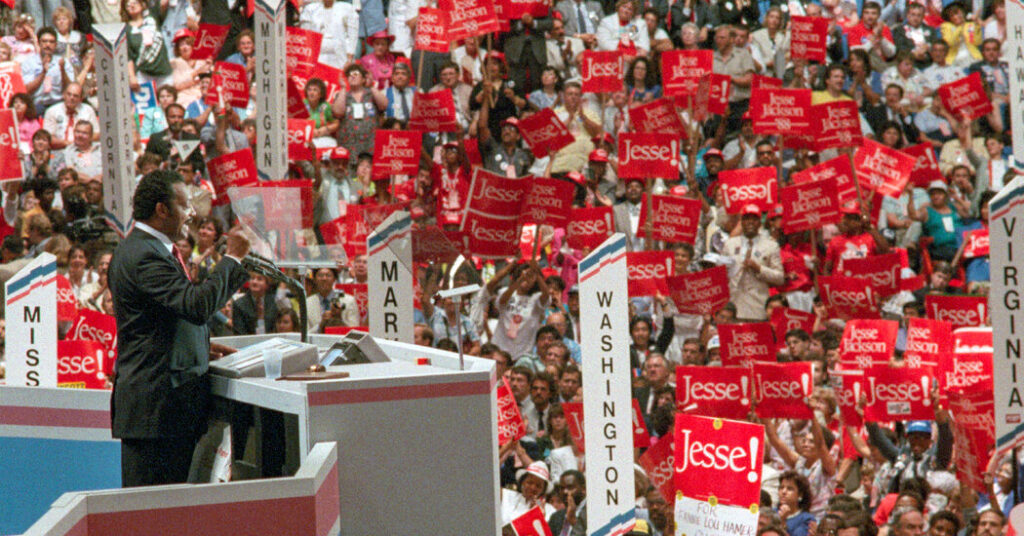
The Rev. Jesse Jackson rose to prominence in the shadow of Martin Luther King Jr.’s ghastly assassination. Mr. Jackson was 26 at the time — the same age Dr. King had been when he emerged as a leader of the Montgomery bus boycott.
Mr. Jackson captured the nation’s attention for more than half a century with his tireless activism, his pioneering presidential campaigns and his dazzling oratory. His influence can be measured by the recognition that neither his most renowned mentee, the Rev. Al Sharpton, nor former President Barack Obama, the ever-popular Democratic politician, would enjoy their perches without Mr. Jackson’s groundbreaking achievements.
Quite simply, Jesse Jackson led one of the most consequential American lives. He was a genuine populist who stood in stark contrast to the ersatz populists of today.
Like all Black southerners of his generation, as a young man, Mr. Jackson was denied equal access to public libraries, public transportation, public accommodations, department stores, restaurants, water fountains and voting booths. In the early 1960s, he became a movement leader, already driven to clip the vicious wings of Jim Crow. In 1965, around the time of the “Bloody Sunday” march, he went to Alabama to join the voting rights campaign led by, among others, Dr. King.
He would soon become the head of the Chicago chapter of Operation Breadbasket, the arm of the Southern Christian Leadership Conference dedicated to Black economic uplift, a goal he preached about and worked toward for the rest of his life.
Dr. King delivered his immortal 1968 “Mountaintop” speech in Memphis, Tenn., on the night before he was killed. As he spoke about the striking sanitation workers whom he was there to support, he quoted Mr. Jackson, offering this summation: “As Jesse Jackson has said, ‘Up to now, only the garbage men have been feeling pain; now we must kind of redistribute the pain.’”
As the leader of his own organization, Operation PUSH, founded in 1971, Mr. Jackson’s influence grew. He headlined the National Black Political Convention, the 1972 gathering of Black activists and leaders in Gary, Ind., that aimed to expand the ranks of Black office holders and develop a Black political agenda. “What time is it?” Mr. Jackson demanded, addressing the gathering in his thick southern brogue. “Nation time!” the crowd roared.
Mr. Jackson confronted the hurdles faced by Black Americans: He led boycotts of Coca-Cola, Anheuser-Busch, Burger King, Nike and CBS television affiliates to push them to hire more Black workers, establish contracts with more Black-owned businesses and generate greater investment in Black communities. The success of his efforts helped put more Black faces in important places and more money in Black pockets.
Though he began his career emphasizing the cause of Black civil rights, he became a civil rights leader for Americans from many different walks of life.
He had a string of successes as an American diplomat: In 1984, an American delegation led by Mr. Jackson negotiated the release of Robert Goodman, a Navy officer whose plane had been shot down in Lebanon. That same year, Mr. Jackson negotiated the release of American and Cuban prisoners from Cuba. He did it again in 1990, bringing home dozens of hostages from Iraq and Kuwait.
Mr. Jackson transformed the national political landscape with his presidential campaigns. In 1984, he won more than three million votes, encouraging the Democratic Party to embrace a coalition of voters and a slate of issues that cut across lines of race, gender, class and sexual orientation.
In 1988, on Super Tuesday, he came in first or second in 16 Democratic primaries and caucuses. That year, he garnered nearly seven million votes. Mr. Jackson’s performance was the first time a Black candidate had emerged as viable on a national level. His strong showing was a catalyst for rules changes in the Democrats’ primary process. It was a seismic shift, without which Mr. Obama very likely would never have become president.
Addressing the 1988 Democratic National Convention, Mr. Jackson urged Americans to find “common ground,” a refrain that presaged Mr. Obama’s famous 2004 D.N.C. speech, in which he said Americans from all walks of life are “connected as one people.”
In that 1988 speech, Mr. Jackson dispatched Reaganomics as “the belief that the rich had too little money and the poor had too much.” He said:
We find common ground at the plant gate that closes on workers without notice. We find common ground at the farm auction, where a good farmer loses his or her land to bad loans or diminishing markets. Common ground at the schoolyard where teachers cannot get adequate pay, and students cannot get a scholarship, and can’t make a loan. Common ground at the hospital admitting room, where somebody tonight is dying because they cannot afford to go upstairs to a bed that’s empty waiting for someone with insurance to get sick. We are a better nation than that.
You could give that speech today. Indeed, I believe Americans long for a leader who would give that speech today.
Mr. Jackson’s oratorical artistry possessed varied velocities, spellbinding cadences, compelling tones, fiery salvos and hushed and whispered articulations. His arsenal included rhyming admonitions — “down with dope, up with hope.” It featured antiphonal expression — “I am!” he would proclaim; “Somebody!” his audience would respond.
His rhetoric revealed a brilliant mind at work, a public moralist and a public intellectual who took on the most controversial matters of the day, fearlessly debating figures such as the conservative standard-bearer William F. Buckley Jr. and the former Ku Klux Klan leader David Duke.
The loss is more than political. It is quite personal for me. I knew Mr. Jackson for more than 30 years. I worked with him on an autobiography that we never completed. I traveled with him around the country as he fought for poor folks of every race. In 1990, I flew with him to London to meet with Nelson Mandela after the South African leader was released from prison.
I shared many telephone conversations with him wherein he barely said hello before he began waxing profoundly on the issues of the day. He was laser focused on edifying and repairing this nation.
His voice may now be silenced and his body returned to dust as his spirit has ascended to his God and the ancestors, but his legacy as one of our greatest patriots is undiminished.
For half of his life, he heard a version of “Run, Jesse, run.” Now it is “Rest, Jesse, rest.”
Michael Eric Dyson is the author of “Tears We Cannot Stop: A Sermon to White America.”
The Times is committed to publishing a diversity of letters to the editor. We’d like to hear what you think about this or any of our articles. Here are some tips. And here’s our email: [email protected].
Follow the New York Times Opinion section on Facebook, Instagram, TikTok, Bluesky, WhatsApp and Threads.
The post Lessons for Democrats From Jesse Jackson’s Rainbow Populism appeared first on New York Times.