China has been good at a lot of things: manufacturing cheaply, catching up on A.I., dominating renewable energy, building hard power. What it’s been less good at is soft power. But that seems to be changing. Have you heard about Chinamaxxing? Read on.
Today, my colleague Vivian Wang in Beijing writes about how China is suddenly winning hearts and minds. (Spoiler alert: It might not actually have that much to do with China itself.)
Cool China
By Vivian Wang
Last week, my colleague Yan Zhuang wrote about a funny trend: young people on TikTok who are “becoming Chinese” by embracing stereotypically Chinese behaviors — drinking hot water, wearing slippers, eating congee.
“Becoming Chinese” (or “Chinamaxxing,” if that’s your preferred term) may just be a TikTok fad. But it fits into something I’ve noticed recently: To a growing number of people around the world, China seems to be getting cooler.
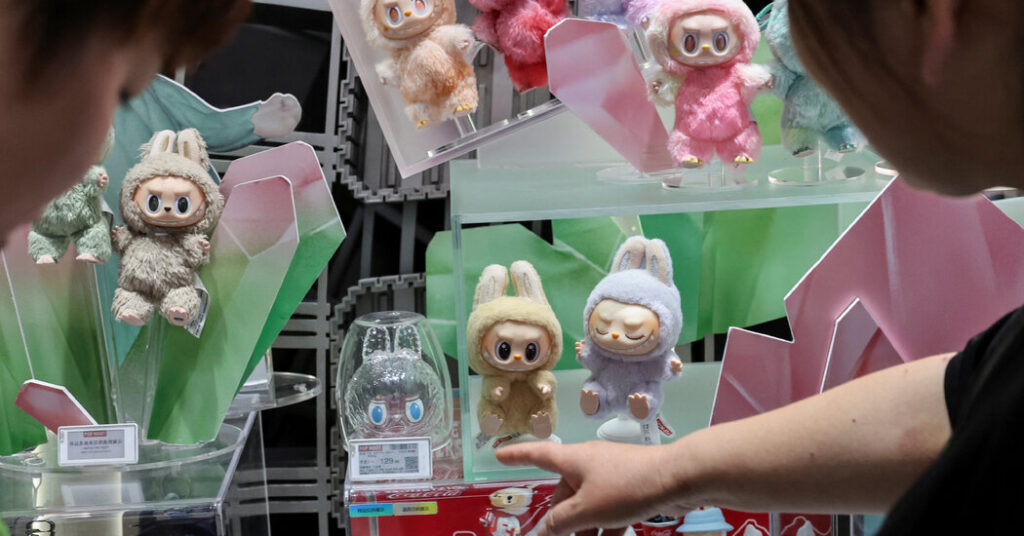
Major American influencers, like the YouTuber IShowSpeed and the streamer Hasan Piker, have traveled to China, where they raved about its high-speed trains and LED light shows. The N.B.A. star Victor Wembanyama spent 10 days meditating at a Shaolin temple. A new Adidas jacket inspired by the historical Tang suit was a viral fashion hit. And of course, there was the Labubu.
Over the course of its decades-long ascent, China has been good (and is getting better) at many things: developing technology, dominating supply chains, building up military power. What it has not been great at is winning hearts and minds, especially in the West — until, seemingly, now. So what changed? It might not actually have that much to do with China itself.
Savvier outreach and glittering infrastructure
China’s struggles with soft power have usually boiled down to its authoritarian government, which has hurt the country’s image abroad in multiple ways. (Just last week, a Hong Kong court sentenced the pro-democracy media mogul Jimmy Lai to 20 years in prison.)
Government censorship has also limited many outsiders from seeing the full range of Chinese creativity. Instead, the government has tried too hard to manufacture a state-sanctioned version of Chinese cool, with heavy-handed movies. (Remember the film “The Great Wall,” starring Matt Damon? Most people don’t.)
The authoritarianism hasn’t changed, but the government has gotten savvier in its outreach efforts — for example, making it easier for foreign tourists to visit China. Most casual tourists won’t encounter the more suffocating political controls here, and they get to interact with ordinary Chinese people, in all their diversity. Visitors often say they’re surprised by how normal everyday life seems.
But the biggest reason for China’s sudden appeal may have little to do with China itself. Polls show that opinions of China in the West are still, on the whole, mostly negative. It’s just that America, to many people around the world, is looking bad, too. And according to scholars, if people are looking for an alternative to the United States, China may be the most obvious place to turn.
Even aside from the most drastic actions by the Trump administration — its threats to take Greenland, its defense of killings by federal agents in Minneapolis — there’s a sense that the U.S. has failed to provide basic things, like functioning infrastructure. China’s gleaming trains look appealing in comparison.
The political and cultural fracturing of America has “significantly weakened the appeal of the U.S.,” Ying Zhu, a film studies scholar who has studied Chinese soft power, told me. “The appeal of China at the moment is more of a reaction” to that than real enthusiasm for China itself, she said.
Can the vibe shift last?
Still, these shifting attitudes — regardless of what’s behind them — could have real implications for how other countries approach China. Many Western leaders have visited Beijing recently, promoting trade and cultural exchange, despite blowback from China hawks at home. If there was less domestic pressure, those types of visits could become easier and more frequent. And there would probably be less appetite for moves against China, as we saw in the opposition from many young Americans to the TikTok ban.
A recent survey by the Carnegie Endowment for International Peace found that most Americans, especially younger ones, were not very worried about what would happen if China surpassed the U.S. in global influence. That “casts doubt on whether the American public would be willing to bear significant costs to maintain a power position superior to China’s,” the authors wrote.
An important question is whether this vibe shift can last. Zhu was skeptical. “Cultural trends come and go,” she said. “Fashion and fads are sensitive to the shifting geopolitical dynamic.” She noted that, despite viral trends and Labubus, China had yet to produce, say, a global hit movie.
Parts of the Chinese government, too, seem worried that other countries’ soft power is still stronger. The Ministry of State Security last month published a warning, seemingly directed at Chinese influencers, about posts showing off glossy lives outside China.
“They one-sidedly showcase the glamorous aspects of foreign countries. Even worse, some have selectively ignored China’s development achievements,” the post said. “That provides an opportunity for the ‘soft aggression’ of Western ideology.”
MORE TOP NEWS
‘We stood on his shoulders’: Remembering Jesse Jackson
Tributes from religious leaders, friends and political figures flowed in for the Rev. Jesse Jackson, who died yesterday at 84.
He was America’s most influential Black figure in the years between the civil rights crusades of the Rev. Dr. Martin Luther King Jr. and the election of Barack Obama. While Jackson’s two presidential campaigns in 1984 and 1988 did not earn him a nomination, he helped register millions of Black voters, built a multiracial coalition of voters and created a pathway for scores of Black Democrats to run for office. “We stood on his shoulders,” Obama said in a joint statement with Michelle Obama. Here’s more on his life.
Jackson was also esteemed across Africa, particularly for his vigorous activism against apartheid in South Africa. Read about seven pivotal moments in Jackson’s life and see his life in pictures.
Iran sees ‘good progress’ in talks with the U.S.
Iran’s foreign minister, Abbas Araghchi, said yesterday that an agreement on a “set of guiding principles” for a potential deal with the U.S. had been reached during indirect talks in Switzerland.
Araghchi said that Iran and the U.S. had agreed to exchange drafts on a potential agreement, but he cautioned that a deal was not imminent. A U.S. official said that the two sides had made progress and that the Iranians would provide more detailed proposals in the next two weeks.
The second round of U.S.-Iran talks, which lasted about three hours, were held as the Middle East remained on edge over the possibility of an American attack.
In Iran, dissidents are using memorials for those killed during the crackdown on protests as a way to voice their anger at the government.
OTHER NEWS
-
Ukraine and Russia began a new round of U.S.-brokered peace talks in Switzerland, but expectations for a breakthrough were low.
-
Peru’s Congress voted to impeach President José Jerí after he failed to disclose meetings with Chinese businessmen who were under government scrutiny.
-
Warner Bros. Discovery will restart talks with Paramount Skydance, giving the company another chance at besting Netflix for a deal that could reshape Hollywood.
-
U.S. forces blew up three more boats, killing 11 men in strikes in both the Eastern Pacific Ocean and the Caribbean Sea.
-
Spain will investigate X, Meta and TikTok for allegedly spreading child abuse material generated by artificial intelligence.
-
A new set of oral history interviews shows how Obama and his advisers missed the country’s shifting mood and failed to predict Donald Trump’s rise.
WHAT ELSE IS HAPPENING
-
Prosecutors in Austria filed charges against a man they said was a member of a terrorist group that was planning an attack on a Taylor Swift concert in Vienna in 2024.
-
More than a billion people across Asia and in diaspora communities welcomed the Year of the Horse. See the celebrations.
-
GQ named Adam Baidawi as its next global editorial director.
-
Top of The World: The most clicked link in your newsletter yesterday was about how the visa debate in the U.S. is fueling racism against South Asians.
WINTER OLYMPICS
Figure skating: Adeliia Petrosian, a neutral athlete from Russia, held first place at the start of the women’s short program. Follow our live updates.
Hockey: The Czech Republic advanced to the men’s quarterfinals against Canada, while the winner of Latvia vs. Sweden will face the U.S., the other top seed in the lineup.
Paralympics: Six Russians and four Belarusians will be allowed to compete under their own flags instead of as neutral athletes at the Paralympic Games next month.
Drones: The robotic cameras chasing behind lugers, skiers and speedskaters can be as much fun to watch as the athletes.
PARTY OF THE DAY
The Boi Tolo
— Few parties represent the fervor of Rio’s street carnival scene better than the Boi Tolo. It started by chance two decades ago, when a group of people arrived at a public square during carnival Sunday ready to party, but found no party, apparently misled by a newspaper announcement. They partied anyway.
MORNING READ
Surgery to lengthen arms and legs has been done for decades to correct deformities or length discrepancies. The operations can also be used for people who wish to add a few centimeters to their height.
In the U.S., four clinics have reported an uptick in interest in height surgery over the past decade. Aaron Trinh, an engineering student, underwent the painful procedure to become taller. Here’s his story.
AROUND THE WORLD
Easing loneliness with robots … in the U.S.
After her husband died, Jan Worrell, 85, sometimes went several days without seeing another person or leaving her house in remote Washington State.
Enter the A.I. robot ElliQ. Designed by an Israeli start-up to be a companion — “a robot with soul,” the company’s founder has said — the small machine has been given to older Americans across the U.S. since 2023 by nonprofits and state health departments as an experiment to combat loneliness.
Here’s what happened when Worrell brought it into her home.
RECOMMENDATIONS
Watch: Shot in Iraq, “The President’s Cake” is about a young girl’s preparations for a celebration of Saddam Hussein’s birthday. Our critic called it “striking.”
Read: Mohammed Hanif’s “Rebel English Academy” follows three characters in the politically fraught Pakistan of the late 1970s.
Consider: Do energy drinks offer benefits beyond caffeine?
Travel: Here are five destinations for design tourism, from Milan to Ohio.
RECIPE
Ramadan, the holiest month in the Islamic calendar, begins this week. For many, suhoor and iftar meals, which bookend long days of fasting, are incomplete without these sweet, stuffed semolina pancakes known as qatayef. The cream filling in this recipe is scented with orange blossom and rose water.
WHERE IS THIS?
Where is this view of offshore windmills?
TIME TO PLAY
Here are today’s Spelling Bee, Mini Crossword, Wordle and Sudoku. Find all our games here.
You’re done for today. See you tomorrow! — Katrin
We welcome your feedback. Send us your suggestions at [email protected].
Katrin Bennhold is the host of The World, the flagship global newsletter of The New York Times.
The post Labubu Diplomacy appeared first on New York Times.