Eugene Robinson is a former Post Opinions columnist.
To appreciate the Rev. Jesse L. Jackson’s place in history — to understand his role in expanding the Constitution’s promise of freedom and opportunity to those of us once excluded — let photographs be the starting point. Consider three indelible images of Jackson, who died Tuesday at age 84, captured over a span of 40 years.
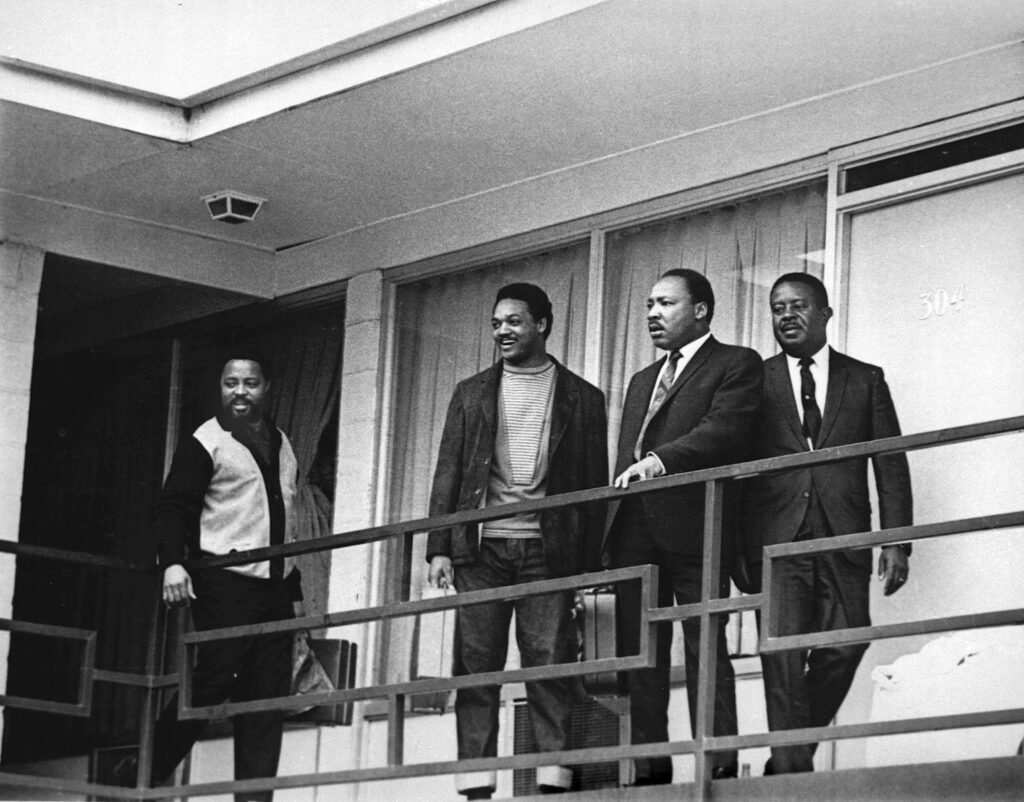
The first was taken on April 3, 1968. Jackson stands on a balcony at the Lorraine Motel in Memphis, next to the Rev. Martin Luther King Jr. Flanking them are two other giants of the civil rights movement, the Rev. Hosea Williams and the Rev. Ralph Abernathy. All four men have their eyes trained on something that has made Jackson, Williams and Abernathy smile. King’s face is more serious, a look that suggests weariness.
Jackson was 26, and to get to that balcony he had already made a remarkable journey. Born to a single mother in Greenville, S.C., he had grown up poor and on the wrong side of the Jim Crow color line. The family’s bathroom was an outhouse. Wallpaper was thought of not as decoration but as insulation to help keep out winter’s drafts.
But Jackson excelled in Greenville’s segregated schools, both as a student and as an athlete. When he graduated from his all-Black high school in 1959, he was good enough at baseball to be offered a minor league contract — but smart and ambitious enough to instead accept a football scholarship from the University of Illinois. After a year there, he transferred to North Carolina A&T, the historically Black college in Greensboro, N.C. whose students had drawn international attention in February 1960 by sitting down at the Whites-only lunch counter of a Woolworth’s department store and refusing to move.
That July, while Jackson was home in Greenville for the summer, he and seven other Black students staged a sit-in of their own at the city’s main public library, which admitted only Whites. They were arrested for disorderly conduct, and the city responded by closing both the main library and the smaller, “colored” branch.
Jackson was eloquent and charismatic, and he showed precocious skill as an organizer. By the time of the 1965 marches from Selma to Montgomery, he had come to King’s attention. The following year, King put Jackson in charge of Operation Breadbasket, the economic arm of the Southern Christian Leadership Conference, with headquarters in Atlanta.
That was how Jackson came to be on that Memphis balcony at King’s side. Hours later, King would deliver his prophetic “mountaintop” speech. The next day, on that same balcony, King would be assassinated while Jackson stood in the parking lot below.
The second iconic photograph was taken two decades later, in Atlanta, on July 19, 1988. Jackson stands at the lectern at the Democratic National Convention and delivers a powerful speech, commanding attention and respect that he has richly earned.
He had run for the 1984 Democratic presidential nomination and surprised the political world by winning five primaries. When he ran again in 1988, his performance was no less than shocking: He won 11 primaries and caucuses — in Alabama, Georgia, Louisiana, Mississippi, Virginia, Delaware, Michigan, South Carolina, Vermont, Puerto Rico and the District of Columbia — and finished second to the eventual nominee, former Massachusetts governor Michael Dukakis.
In the process he had more firmly cemented the bond between African American voters and the Democratic Party, an alliance that continues virtually undiminished today. He had brought a new generation of Black political activists and operatives into the party. And he had outlined a broad, inclusive view of civil rights that encompassed the struggles of women, Latinos, Native Americans, the disabled and the LGBTQ+ community.
“Dr. Martin Luther King Jr. lies only a few miles from us tonight,” Jackson said. “Tonight he must feel good as he looks down upon us. We sit here together, a rainbow, a coalition — the sons and daughters of slave masters and the sons and daughters of slaves, sitting together around a common table, to decide the direction of our party and our country. His heart would be full tonight.”
The third unforgettable image of Jackson was captured two decades after that, in Chicago’s Grant Park, the night of Nov. 4, 2008. Barack Obama has just become the first Black man elected president of the United States, and emerged to celebrate the historic victory. Cameras catch sight of Jackson amid the huge crowd, tears streaming down his face.
In the bare-knuckle world of Chicago politics, Jackson and Obama did not start off as allies. Jackson opposed Obama in his first run for the House, as did most of the city’s political establishment, and Obama lost badly. The fact is, though, that Obama never could have reached the pinnacle of American power if Jackson had not paved the way.
Since his earliest days as an aide to King, Jackson had been criticized as a performer, an attention-seeker. But tears have not been part of his repertoire. Everyone around him that night in Grant Park was beaming. Jackson’s emotion looked deep, raw and wholly genuine.
Asked the following day why he had been crying, Jackson told NPR: “Well, on the one hand, I saw President Barack Obama standing there looking so majestic. And I knew that people in the villages of Kenya and Haiti, and mansions and palaces in Europe and China, were all watching this young African American male assume the leadership to take our nation out of a pit to a higher place. And then, I thought about who was not there.”
Jackson mentioned, among others, Medgar Evers, the Mississippi NAACP leader who was murdered by a racist assassin in 1963.
“So, the martyrs and the murdered whose blood made last night possible. I could not help but think this was their night. And if I had one wish, if Medgar, or if Dr. King, could have just been there for a second in time, it would have made my heart rejoice. And so it was kind of the duo-fold — of his ascendance in leadership, and the price that was paid to get him there.”
The post Jesse Jackson in three photos appeared first on Washington Post.