Donna Brazile is a Democratic political strategist and analyst.
In 1983, when I went to work in the Rev. Jesse Jackson’s first presidential campaign, many saw it as a hopeless quest. How could a Black man possibly be elected president of the United States?
Today we know the answer, thanks to Barack Obama’s historic success in 2008, but thanks also to Jackson, who paved the way because he knew the answer before anyone else.
Jackson, who died Tuesday at age 84, profoundly changed American politics. The forces he united still shape the Democratic Party — and our broader politics.
Jackson’s life story is a triumph over adversity. He was born in 1941 in Greenville, S.C., to an unwed mother still in high school. Segregation was in full force. Black people had to live with the indignity of “colored” restrooms and drinking fountains, sit in the back of buses, and attend all-Black schools. But rather than accept second-class status or become bitter, Jackson resolved to work to make things better, and he never stopped.
He attended the University of Illinois as a football player but transferred to North Carolina A&T before becoming student body president. He moved to Chicago, joined the Southern Christian Leadership Conference and worked closely with civil rights leaders such as the Rev. Martin Luther King Jr. and the Rev. Ralph Abernathy before starting Operation Push in 1971.
I was 23 when he launched his first run for the White House, and this was Ronald Reagan’s America, so it’s easy to understand why so many cynically dismissed his campaign as hopeless.
But Jackson was no cynic. Working on his campaign — traveling with him, raising funds, organizing speeches and voter registration drives and endless other events — was a graduate-level education in the struggle to open the doors of the American Dream to all.
That first campaign was long on moral vision and short of money. So we worked constantly, Jackson leading by example. Targeted with frequent death threats, he was reviled by some who believed the Oval Office should remain the exclusive preserve of White men.
On the trail, Jackson was a mesmerizing speaker, full of energy. Hearing Jackson was like being in church, and he used his clerical background to summon biblical analogies reminiscent of King, his mentor. Jackson could riff like few before him or since — oh, those effortless, virtuoso rhymes — with never the need to poll-test his message. He knew what he stood for.
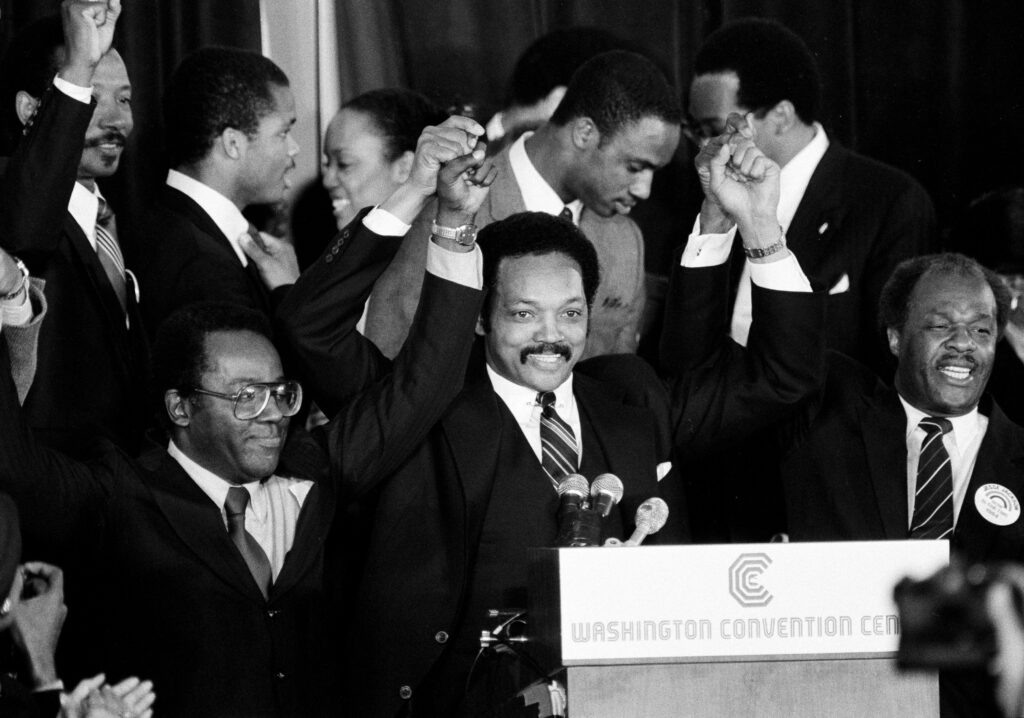
No, Jackson did not win in 1984 — or in 1988, when he returned with a better-organized campaign — but it would be wrong to think he lost. He registered millions of Black voters, particularly in the Deep South, setting the stage for a Democratic takeover of the Senate built on wins in Southern states in 1986, surprising many in his own party. His 1988 campaign — he won 13 primaries and caucuses and amassed more than 1,000 delegates — registered millions more, while catapulting a new generation of Black activists (including me) into positions of power inside the party.
The Black share of Democratic primary votersjumped from 14 percent in 1980 to 24 percent in 2016, a dramatic shift in power. Consider: In the 1983-1984 session of Congress, there were no Black senators and only 22 Black members of the House. Today there are five Black senators and 61 Black House members. Jackson’s son, Jonathan, a congressman from Illinois, is one of them.
Still, pioneering though he was, Jackson could not be typecast as “the Black candidate,” and he would not be limited to what some perceive as “Black issues.” He advanced a broadly progressive agenda on both domestic and foreign affairs and embraced the then-relatively new idea that diversity was a strength, not a weakness. He liked to talk about the nation as a quilt patched together by intent and accident.
“America is not like a blanket — one piece of unbroken cloth, the same color, the same texture, the same size,” he said in his speech at the 1984 Democratic National Convention. “America is more like a quilt: many patches, many pieces, many colors, many sizes, all woven and held together by a common thread. The White, the Hispanic, the Black, the Arab, the Jew, the woman, the Native American, the small farmer, the businessperson, the environmentalist, the peace activist, the young, the old, the lesbian, the gay and the disabled make up the American quilt.”
Pause to think about that list. This was a time when discrimination against gay men and lesbians was so pervasive that the president of the United States still had not bothered to say the name of the new and terrifying epidemic ravaging gay men in America. It is this inclusive vision that drives the Democratic Party today, nearly 40 years later.
Now, like his mentors before him, Jackson has passed the torch. But you can still hear that stirring voice, can’t you? Hear him as he closes his rousing speech to the 1988 Democratic convention: “Keep hope alive. Keep hope alive. Keep hope alive. On tomorrow night and beyond, keep hope alive.”
Jesse Jackson made us see what could be, which helped so much of it come to be, and we are all the better for it.
The post Jesse Jackson envisioned a more inclusive politics — and made it happen appeared first on Washington Post.