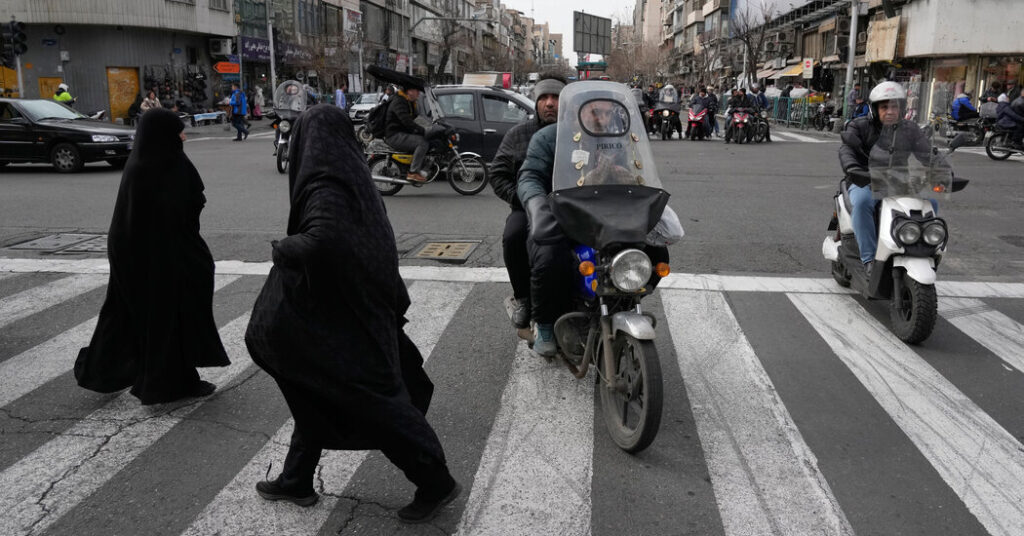
With patriotic anthems and chants against the country’s clerical rulers, Iranians on Tuesday began commemorating the end of a traditional 40-day mourning period for loved ones killed at the peak of the government’s bloody crackdown on nationwide protests.
Authorities have moved quickly to tamp down protests or other demonstrations of anti-government sentiment to mark the occasion, with videos verified by The New York Times showing security patrols in at least two cities.
Tuesday is the first of what is expected to be several days of memorial ceremonies across the country to honor the 40th day since thousands of protesters were killed from Jan. 8 to Jan. 10. The commemorations will test both of the success of the crackdown and the ability of government opponents to find new ways to defy the state.
The ceremonies have played a pivotal role in the country’s modern history: They were a staging ground for the protests that eventually overthrew Iran’s shah in 1979.
This week may not be such as dramatic a turning point, but dissidents are already using the occasion as a way to voice their anger at the government. Some are transforming what was once a somber, religious funeral rite into boisterous, celebratory affairs, in a stark rejection of the country’s austere rulers.
“They’ve reinvented this with a revolutionary rage,” said Arash Azizi, a historian of Iran based in New York. “It is an attempt by Iranians to take back their country and rediscover their nationalism.”
For weeks before the memorials began, security forces sought to intimidate some families against holding public memorials, according to rights groups and relatives of several slain protesters interviewed by The New York Times.
On Tuesday, videos verified by The Times showed security forces patrolling some towns, including Lesfijan in the north, where trucks filmed on the streets were loaded with troops wearing helmets and camouflage gear. In southwestern Abdanan, a video verified by the Times showed large crowds screaming as they fled smoke and detonations near a cemetery.
Fortieth-day commemorations for the dead have been at the heart of Iran’s mourning culture for generations— one of the final rituals of farewell before returning to the rhythms of daily life. The ceremonies are common among the region’s Shiite Muslims. They have pre-Islamic roots in Iran too, and are practiced by Iranians of all faiths.
As a profound cultural symbol in Iran, authorities this week appeared keen to control the memorials.
The government itself announced plans for official mourning ceremonies in the capital, Tehran, and the northern city of Mashhad.
“We are grieving for the blood that was shed,” the supreme leader, Ayatollah Ali Khamenei, said in a speech on Tuesday. He called security forces killed in the unrest “the highest-ranking martyrs.” Bystanders and protesters who were “misled,” he said, were also martyrs. Others killed, he said, “were the very corrupters, the seditionists, and coup plotters themselves,” he said.
“Their reckoning is with God. We have nothing to do with them.,” he added.
The government argues it was fighting unrest fomented by “terrorists” backed by Israel and the United States, leading to more than 3,000 deaths.
Rights groups say that toll vastly underestimates the toll, particularly from Jan. 8 to 10, which many now consider the bloodiest days in Iran’s modern history. Over three weeks of protests, the U.S.-based rights group HRANA says more than 7,000 protesters were killed, with most killed in that three- day period.
One of the victims was Robina Aminian, a 23-year-old fashion student, whose family said she was shot in the head while protesting in Tehran. Officials banned her family from public 40th-day memorials, according to her aunt, Hali Nouri, who lives in Europe.
For more than a month, Ms. Nouri said, plainclothes police were stationed at either end of the alleyway where the Aminian family resides.
Reaching Ms. Aminian’s grave will be particularly arduous for her family.
Security forces have regularly forced families to bury dissidents in remote areas to prevent their graves from becoming a gathering point, and Ms. Aminian’s family was forced to lay her to rest in a remote, snowy village of western Iran.
“My sister says, ‘Even if they shoot bullets, I will go for her 40th day,’” Ms. Nouri told The Times.
There are increasing signs of dissent in the face of the ongoing crackdown.
At several universities, students have repeatedly attempted to hold sit-ins, according to student social media channels.
In some cities, videos showed Iranians took to their rooftops in the cover of darkness to chant for the toppling of the supreme leader.
On Monday night, a small protest broke out in the town of Abdanan. In one video verified by The Times, people can be seen chanting “death to Khamenei” as passing cars honk.
Another video verified by The Times, which appeared to be from Tuesday morning, shows security forces deploying in the town with armored vehicles.
New displays of defiance do not necessarily mean that momentum toward a new wave of nationwide protests is building, said Farzan Sabet, an analyst on Iran and Middle East politics at the Geneva Graduate Institute in Switzerland.
“What I think everyone is waiting for is whether the other shoe will drop — that is, whether a U.S. strike will happen or not.”
The severity of Iran’s crackdown is also partly a reaction to threats beyond its borders. President Trump has massed warships in Persian Gulf waters, a show of force amid a brief round of tenuous U.S.-Iran talks in Geneva on Tuesday over reining in Iranian nuclear and military capabilities.
The risk of another regional war looms.
“Almost everyone is waiting for Trump’s promises to be carried out and for foreign help to arrive,” said Masoud, an accountant in Mashhad who did not want to be identified by his full name for fear of repercussions. “The people have done everything they could.”
Some Iranians said they are trying to hold 40th-day commemorations, despite restrictions.
The family of the slain 17-year-old protester Mohammad Mahdi Ganj Danesh, signed pledges not to chant political slogans at their memorial, according to a family friend.
Still, authorities refused to grant them permission to conduct their memorial at their mosque in the northern town of Zanjan. They, like several other families interviewed, rented an event hall instead.
Video of the memorial obtained by The Times shows large crowds crammed together to celebrate his life and protest against the government. “The fallen flower has become a gift to the homeland,” they chanted and clapped.
Instead of tearful rituals of mourning, many families of those killed at protests have transformed their commemorations with dancing, singing and clapping over people’s graves. This is seen as a way of defying traditionally somber religious customs that many Iranians now associate with the Islamic Republic’s austere rule.
Video of the 40th-day ceremony for Raha Bahlooli-Pour, a student at the University of Tehran, shows mourners playing folk tunes instead of the customary recitations of Quranic verse. In the video, verified by The Times, women perform the traditional kel, a high-pitched ululation most Iranians traditionally reserve for weddings.
Reimagining mourning rituals has been a part of Iran’s culture at least since the revolution, said Mr. Azizi, the historian, when Islamic revolutionaries transformed 40th-day ceremonies from somber affairs to “rabble-rousing occasions.”
After an uprising in 2022 calling for greater personal freedoms denied under the Islamic Republic’s restrictive rule, protesters’ funerals began changing religious traditions.
Today’s protesters have are turning mourning into celebration.
“Their sadness is defiant,” Mr. Azizi said. “They are saying that the battle is not over, that they have not given up and that they will stand up to the regime again.”
Sanam Mahoozi contributed reporting.
Sanjana Varghese is a reporter on The Times’s Visual Investigations team, specializing in the use of advanced digital techniques to analyze visual evidence.
The post Iranians Defy Government Crackdown at Memorials for Slain Protesters appeared first on New York Times.