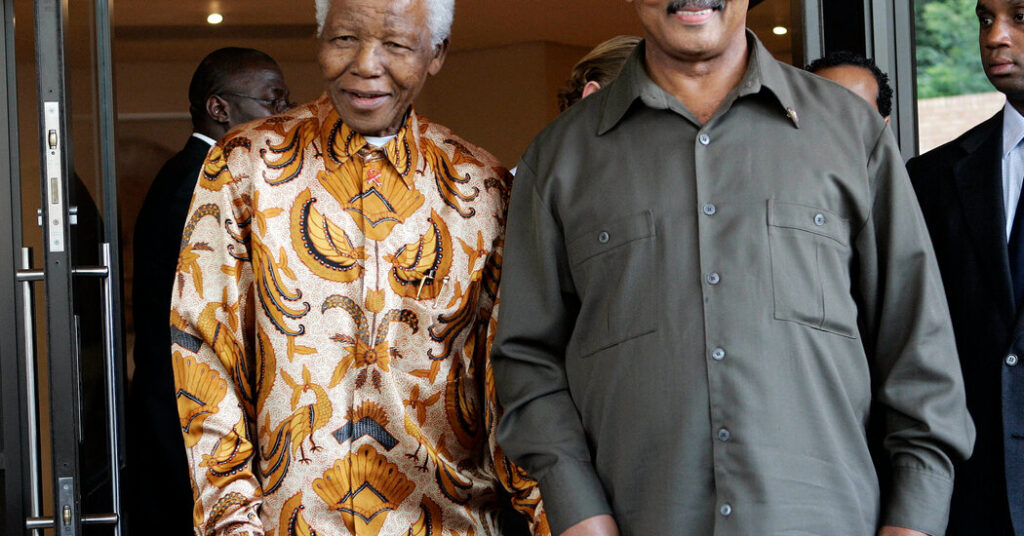
Jesse Jackson lobbied Pope John Paul II and the Soviet leader Mikhail S. Gorbachev to rebuke South Africa’s apartheid government. He called on Harvard University to divest from the country. And he was there when Nelson Mandela was released from Robben Island in 1990 after serving 27 years as a political prisoner.
Just as Mr. Jackson, who died on Tuesday, became synonymous with the Civil Rights Movement in the United States, he was esteemed across Africa, particularly for his vigorous activism against the apartheid regime in South Africa.
Mr. Jackson first visited South Africa in 1979, two years after the killing of the anti-apartheid activist Steve Biko. He drew massive crowds at rallies in Soweto, a deeply impoverished township where the white-minority government forced Black people to live.
In the decades that followed, he made several trips back to other countries in Africa as a peace broker and a representative of Black America who showed that the U.S. government’s acceptance of apartheid did not align with the views of many of its citizens.
“We are deeply indebted to the energy, principled clarity and personal risk with which he supported our struggle and campaigned for freedom and equality in other parts of the world,” President Cyril Ramaphosa of South Africa said in a statement on Tuesday.
Mr. Jackson’s devotion to the anti-apartheid struggle stemmed from the parallels he saw with the fight for civil rights in the United States.
“As a young civil rights activist, I knew how raw and ugly and violent the apartheid regime was,” he wrote in an opinion column in the Guardian in 2013. “They were being jailed, we were being jailed. We were being killed, and they were being massacred.”
In 1986, Mr. Jackson took a whirlwind, eight-country tour of Africa, where he was greeted by huge crowds, red carpets, state dinners and lengthy meetings with heads of state.
In Zambia, he delivered a speech that moved Kenneth Kaunda, the country’s president at the time, to tears. He sought to make Americans aware of the ripple effects that apartheid was having in the region and vowed to push President Ronald Reagan to support the nations surrounding South Africa.
Mr. Jackson would return to Africa in the late 1990s as an envoy for President Bill Clinton, working to intervene in conflicts in the Democratic Republic of Congo, Sierra Leone, Zambia and Nigeria.
On Tuesday, President Bola Tinubu of Nigeria recognized his work in a statement: “Reverend Jackson was a great friend of Nigeria and Africa,.”
John Eligon is the Johannesburg bureau chief for The Times, covering a wide range of events and trends that influence and shape the lives of ordinary people across southern Africa.
The post In Africa, Jesse Jackson Was Esteemed for His Fight Against Apartheid appeared first on New York Times.